

The Dream Takes Flight
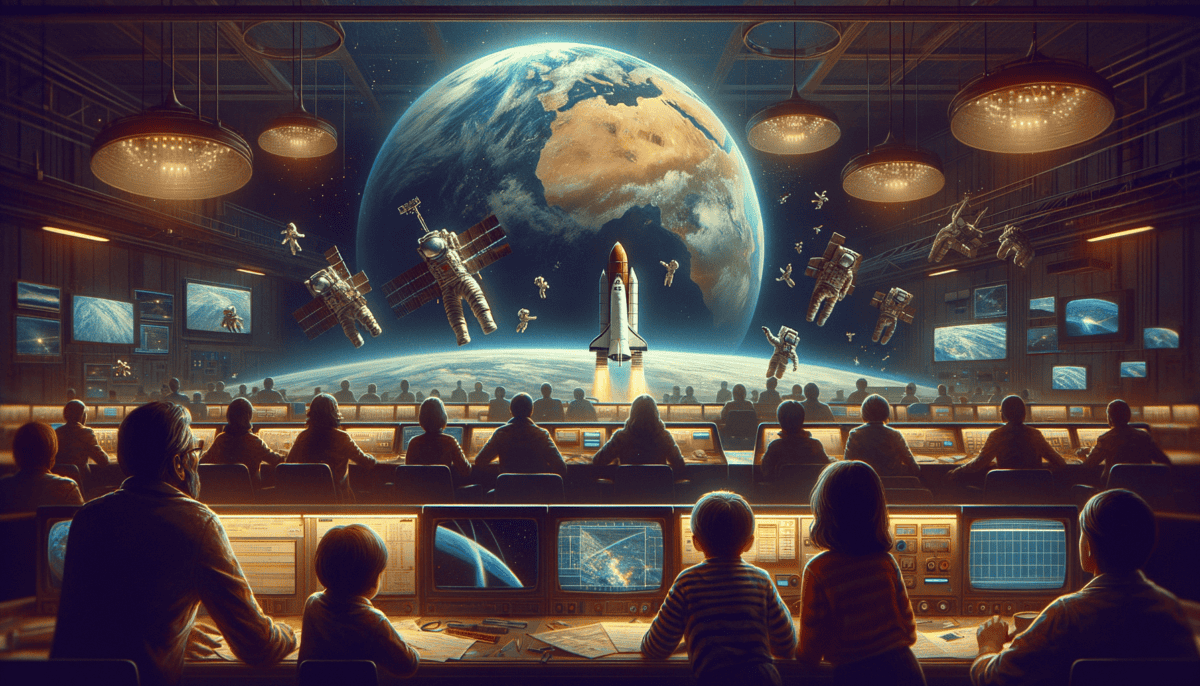
Tommy was bouncing with excitement as he walked into the NASA control room with his dad. It was 1973, and his father was one of the engineers working on something amazing – America's very first space station called Skylab!
"What's a space station, Dad?" Tommy asked, his eyes wide as he looked at all the blinking lights and screens.
"It's like a house in space, son," his father explained with a smile. "Astronauts will live there and do important science experiments."
The room buzzed with energy as dozens of engineers and scientists worked at their stations. Large screens showed pictures of a huge metal cylinder – Skylab itself. It was as big as a three-story house!
Tommy watched as his father joined a group of worried-looking engineers. They were trying to solve big problems. Building a home in space wasn't easy! They needed to figure out:
• How to keep the astronauts safe from space radiation
• Ways to store enough food and water
• How to exercise in zero gravity
• What kinds of science experiments to do
"Why do we need a space station?" Tommy asked.
His father knelt down beside him. "Remember when Neil Armstrong walked on the moon? That was amazing, but the astronauts could only stay for a few days. With Skylab, they can stay in space for months! They'll learn so much about living in space and study the Sun and Earth in ways we never could before."
Getting Ready for Launch
Everyone at NASA worked super hard to get Skylab ready. They built special solar panels to power everything. They packed freeze-dried food that wouldn't spoil. They even made a special toilet that would work without gravity!
"The hardest part," Tommy's dad explained, "is making sure nothing goes wrong. Space is very dangerous. We have to think of everything that could happen and have a plan to fix it."
Tommy noticed a model of Skylab on his father's desk. It looked like a giant soup can with wings. The wings were actually solar panels that would collect energy from the Sun.
"When will it launch?" Tommy asked excitedly.
"Soon," his father replied. "Very soon. And when it does, it will change how we explore space forever."
As they walked home that evening, Tommy looked up at the stars. Somewhere up there, Skylab would soon be floating around Earth. It would be the biggest thing humans had ever put in space – a real home among the stars.
His father squeezed his hand. "Remember this moment, Tommy. We're about to do something that's never been done before. Sometimes the biggest dreams start with just an idea – like building a house in space."
That night, Tommy dreamed of floating through Skylab's corridors, looking down at Earth through its windows, and being part of something bigger than himself. The real adventure was just about to begin.
Launch Day Drama
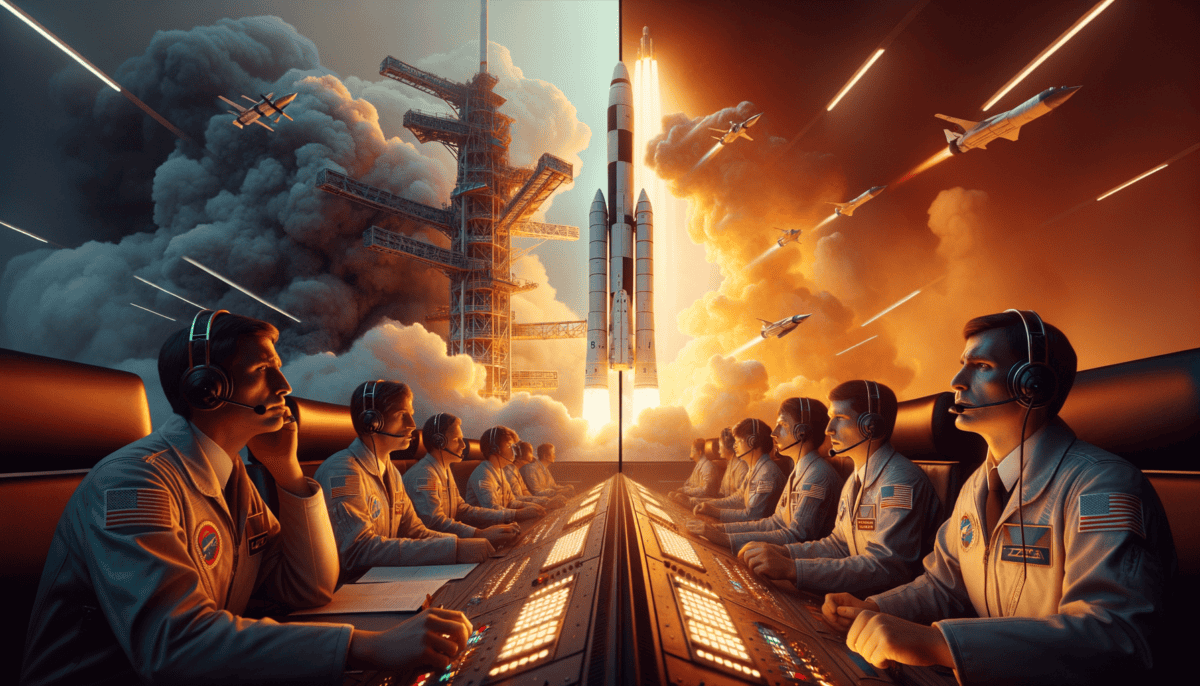
The big day had finally arrived! Tommy and his dad got to the control room extra early on May 14, 1973. Everyone was nervous and excited about launching Skylab.
“It’s like sending up a whole house on a giant firework!” Tommy whispered to his dad.
The huge Saturn V rocket roared to life. Fire and smoke poured out as it lifted off. At first, everything looked perfect! But then…
“Something’s wrong!” someone shouted. The room got very quiet.
Tommy watched as his father’s face turned worried. One of Skylab’s solar panels had broken off during launch! And that wasn’t all – a special shield that protected Skylab from the hot Sun had also torn away.
The Emergency Begins
“What happens now, Dad?” Tommy asked nervously.
“Without that shield, Skylab will get too hot inside,” his father explained. “And without both solar panels, it won’t have enough power. We need to fix this fast!”
The control room turned into a busy beehive of activity. Engineers rushed around with papers and drawings. Everyone was trying to think of ways to save Skylab.
“It’s like trying to fix a broken umbrella during a rainstorm,” Tommy’s dad said, “except the umbrella is in space where we can’t reach it!”
The temperature inside Skylab was getting dangerously hot – over 130 degrees! That’s hotter than the hottest day you can imagine. All the food and medicine on board might spoil.
Race Against Time
Tommy watched as his dad and other engineers worked day and night. They needed to invent something new – a special sun shield they could send up with the astronauts.
“We’re making a giant space umbrella!” one engineer told Tommy excitedly. “It will cover Skylab and keep it cool.”
They tested different materials and designs. Some looked like big tin foil blankets. Others were like giant window shades. Everyone worked together, sharing ideas.
Meanwhile, other engineers were figuring out how Skylab could work with just one solar panel instead of two. It was like trying to run a house with only half its lights working.
Hope Takes Flight
“Will Skylab be okay?” Tommy asked his dad after another long day.
“We’re going to try our very best,” his father smiled. “Sometimes the biggest problems lead to the most amazing solutions. The astronauts are brave and smart – if anyone can fix this, they can!”
Tommy looked at the big screen showing Skylab spinning slowly in space. Even with its broken parts, it was still the most amazing thing he’d ever seen. Now it was up to the astronaut repair team to save America’s first space station.
The whole world was watching and waiting. Would NASA’s emergency plan work? Could astronauts really fix a damaged space station while floating in space? The next mission would be more important than anyone had planned…
Heroes to the Rescue
The astronaut crew couldn’t wait to blast off and help fix Skylab! Pete Conrad, Joe Kerwin, and Paul Weitz had trained for months. Now they had a new mission – they were going to be space repair workers! ️
“It’s like being a doctor for a giant space house,” Tommy told his friend Sarah at school. His dad had explained everything about the repair mission.
The Repair Team Takes Off
On May 25, 1973, the rescue crew zoomed up into space. They carried special tools and the new sun shield they would use to cool down Skylab.
“Houston, we see Skylab!” Pete Conrad radioed back to Earth. “It looks like a wounded bird up here.”
The damaged space station was spinning slowly. One solar wing was completely gone, and the other was stuck. Without power from the solar wings, Skylab couldn’t do its important work.
The Big Fix
First, they had to put up the new sun shield. It was like opening a big umbrella in space! The astronauts carefully pushed it through a small window.
“Look!” Tommy pointed at the TV screen in the control room. “They did it!”
The temperature inside Skylab started going down right away. But they weren’t done yet. The stuck solar wing needed fixing too.
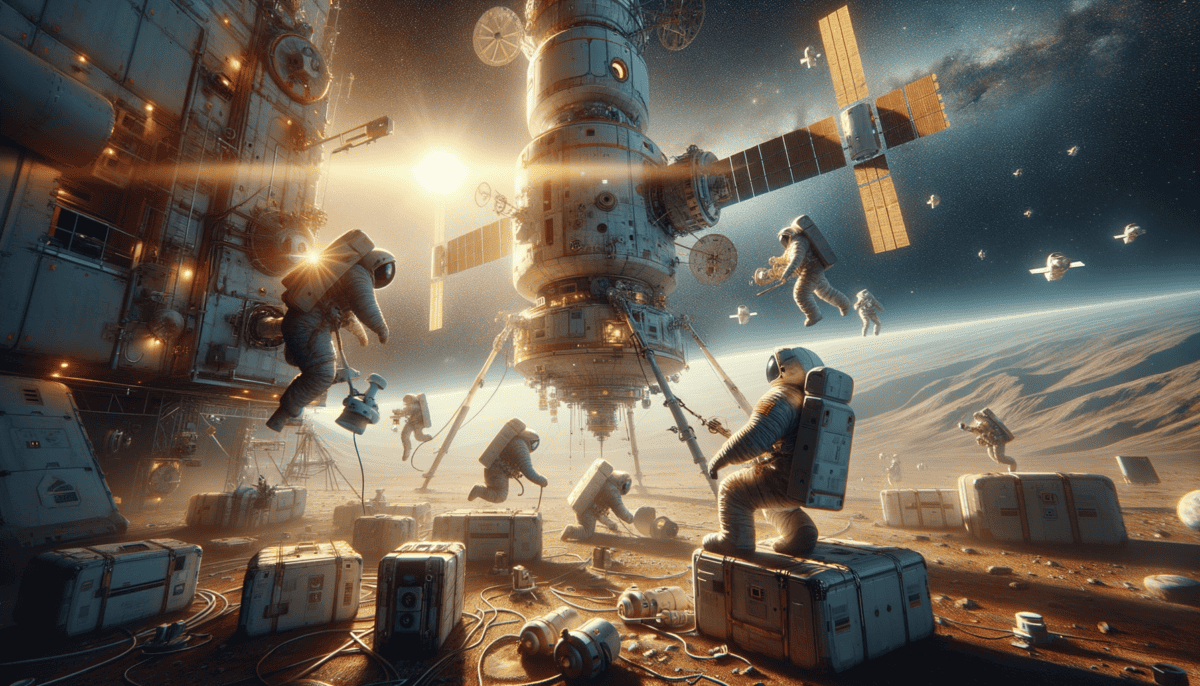
Joe and Pete floated outside Skylab using jet backpacks. They had to be very careful – one wrong move could send them floating away!
Working Together
“Pull harder!” Pete called to Joe as they tugged on the jammed solar wing. They pushed and pulled for hours.
Everyone in the control room held their breath. Tommy squeezed his dad’s hand.
Suddenly, there was a loud cheer! The solar wing had snapped free. Now it could catch the sun’s energy and give Skylab power.
A New Beginning
Back on Earth, Tommy’s dad gave him a high five. “Those astronauts are real heroes,” he said proudly.
“They fixed things I didn’t think could be fixed!” Tommy replied.
Thanks to the brave repair crew, Skylab was ready for its real mission. The space station had cooling shade and power. Now astronauts could live and work there, doing important science experiments.
The next crew was already getting ready for their turn to fly up to Skylab. They would stay there longer than any American astronauts had ever stayed in space. What would they discover? What would it be like to live in space for months?
Tommy couldn’t wait to find out. He knew the most exciting part of Skylab’s story was just beginning…
Living Among the Stars
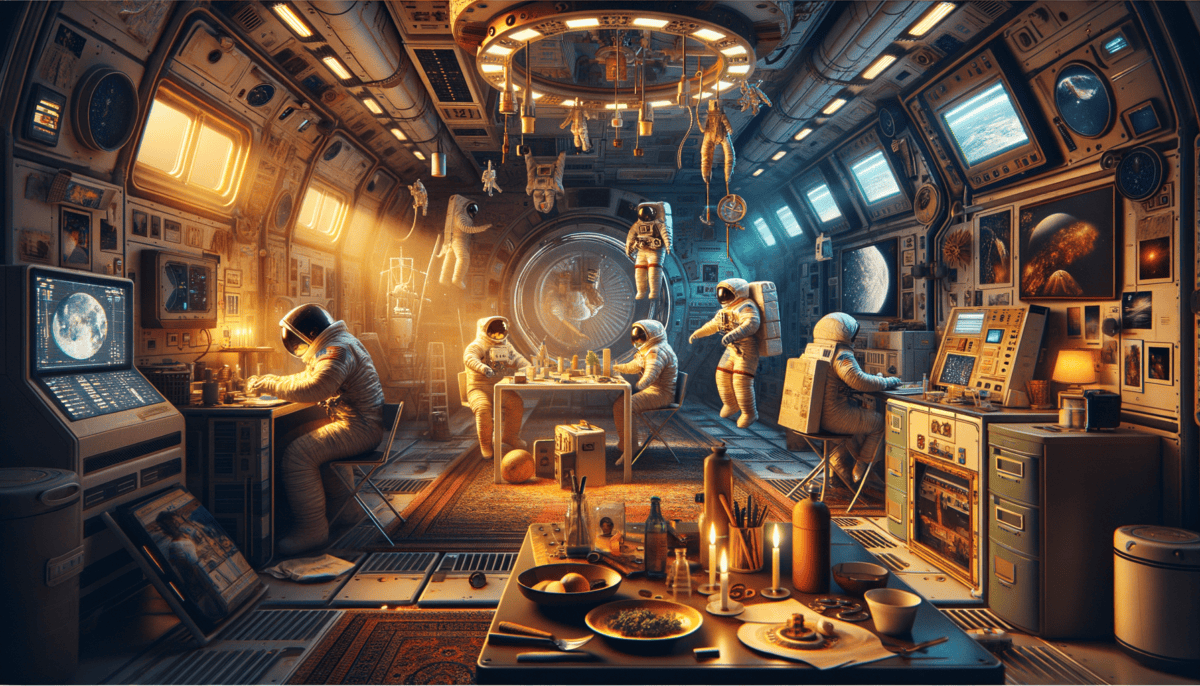
The astronauts floated into their new home in space. Skylab was huge – as big as a three-bedroom house! For the first time, astronauts had lots of room to work and live.
A Day in Space Life
“Good morning, Skylab crew!” called Mission Control. “Time to start another day above Earth!”
The astronauts didn’t need alarm clocks – they saw 16 sunrises every day! They floated out of their sleeping bags, which were tied to the walls.
Space Food Adventures
Breakfast was different in space. The astronauts squeezed orange juice from plastic bags and ate cereal with a spoon. They had to be careful – crumbs could float everywhere!
“The food’s not like Mom’s cooking,” astronaut Owen Garriott said with a laugh, “but we’re getting used to it!”
Working in Zero Gravity
Every day was packed with science experiments. The astronauts:
- Studied the Sun through special telescopes
- Tested how plants grow without gravity
- Did exercises to keep their bodies strong
- Took pictures of Earth’s weather
Fun and Games
It wasn’t all work! The astronauts had fun too. They did somersaults in the air and had water bubble fights. They even played catch with floating food packets!
Missing Home
“I miss my family,” said astronaut Alan Bean, looking at pictures of his kids. The astronauts talked to their families on special radios when Skylab passed over their homes.
Tommy watched Skylab pass overhead one night. It looked like a bright star moving across the sky. He waved, wondering if the astronauts could see him.
Breaking Records
The Skylab crews stayed in space longer than anyone before them. The third crew lived in space for 84 days! That’s almost three months of floating around Earth.
“My dad says they’re learning things we never knew before,” Tommy told his class during show-and-tell. “They’re discovering how our bodies change in space!”
Daily Challenges
Living in space wasn’t always easy. Simple things like washing your face or brushing your teeth became tricky tasks. Water formed floating bubbles instead of flowing down!
“Watch out!” called astronaut Jerry Carr as a glob of water floated by. “Sometimes I feel like I’m living in a bubble palace!”
The View of Home
The astronauts’ favorite part was looking at Earth through Skylab’s windows. They could see whole continents, swirling storms, and beautiful sunsets.
“Earth looks like a blue marble in space,” one astronaut wrote in his diary. “It makes you realize how special our planet is.”
As the crews worked and lived above Earth, they were doing more than just experiments. They were showing that humans could live and work in space for long periods. Their discoveries would help future astronauts go even further into space…
Amazing Space Science
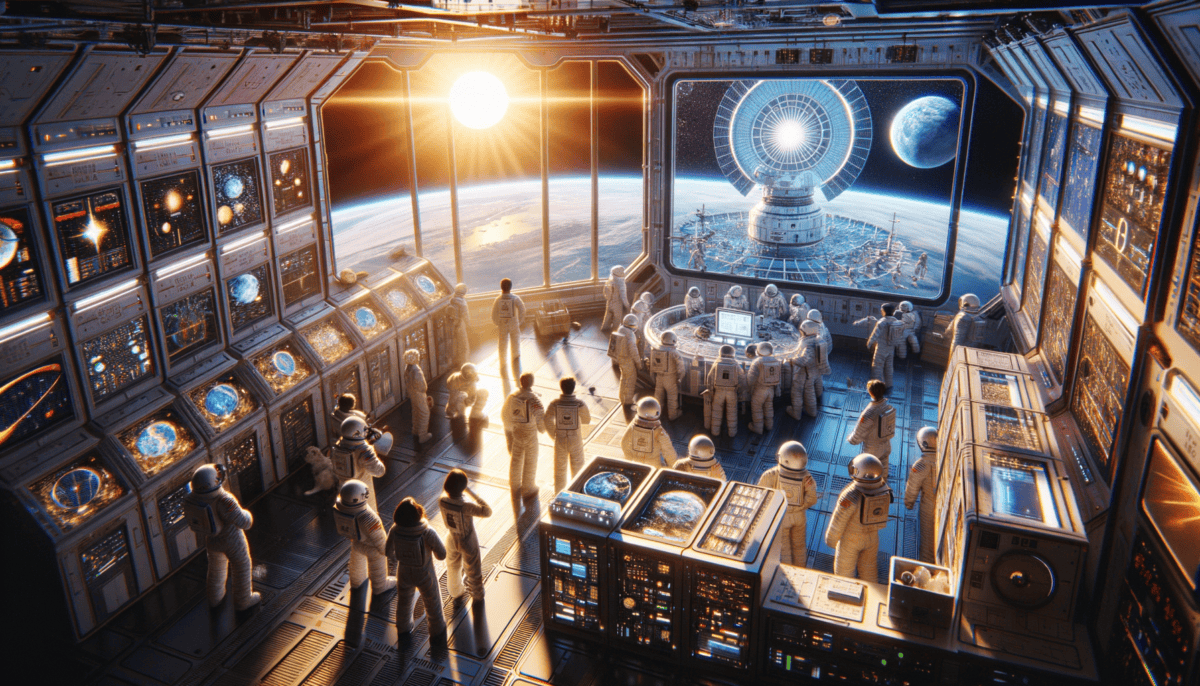
The Skylab astronauts made so many cool discoveries! Every day brought new and exciting findings that made scientists on Earth very happy.
Learning About Our Bodies
“Look how tall I’ve gotten!” astronaut Ed Gibson exclaimed. Without Earth’s gravity pulling them down, the astronauts grew about two inches taller in space!
“That’s why we exercise every day,” said Dr. Joe Kerwin. “We need to keep our bodies strong for when we return to Earth.”
Watching the Sun
Skylab had a special telescope just for looking at the Sun. The astronauts saw amazing things:
- Bright solar flares shooting into space
- Dark sunspots moving across the Sun’s surface
- Beautiful loops of glowing gas
- Strange patterns we’d never seen before
“The Sun looks like a giant dancing fireball!” Tommy told his friends at school after seeing pictures from Skylab.
Growing Space Plants
The astronauts planted tiny seeds in special containers. “Will plants know which way to grow without gravity?” they wondered.
To everyone’s surprise, the plants grew! They twisted and turned in funny ways, but they still reached for the light, just like on Earth.
Weather Watching
From high above, the astronauts could see huge storms forming. They took pictures to help weather scientists make better forecasts. ️
Spider Experiments
Two spiders named Anita and Arabella went to space! Scientists wanted to see if they could build webs without gravity. At first, their webs were messy, but soon they learned to spin perfect ones! ️
Metal Making
“In space, we can mix metals that don’t mix on Earth,” explained astronaut Bill Pogue. They made new types of metal that could help build better things on Earth.
Learning About Stars
Without Earth’s air in the way, Skylab’s telescopes could see stars more clearly than ever before. The astronauts discovered many new things about distant stars and galaxies. ⭐
Helping Future Astronauts
Every discovery helped plan for future space trips. The astronauts tested new space suits, tools, and ways to live in space.
“Because of Skylab, we know how to stay healthy in space for months,” said Mission Control. “This will help us go to Mars someday!”
Sharing Knowledge
Scientists all over the world were excited about Skylab’s discoveries. The experiments helped us understand our Sun, our Earth, and ourselves better than ever before.
Back in his classroom, Tommy drew pictures of all the amazing things the astronauts were learning. “When I grow up,” he said, “I want to be a space scientist too!”
As Skylab continued its journey around Earth, its discoveries were changing how we think about space, science, and what humans can do when they work together…
A Final Goodbye
It was 1979, and Skylab’s amazing journey was coming to an end. After living in space for over five years, the giant space station was getting tired.
Time to Come Home
“Skylab is falling!” announced the TV news. The space station was slowly dropping closer to Earth. NASA scientists worked hard to figure out where it would land.
Little Tommy watched the news every day. “Will pieces of Skylab fall in our backyard?” he asked his mom.
“Don’t worry,” she smiled. “NASA is watching it very carefully.”
The World Watches
People everywhere got excited about Skylab’s return. Some made funny t-shirts and had “Skylab watching parties.” Everyone wanted to see where it would land!
“It’s like a giant game of ‘Where Will It Land?'” said a news reporter on TV.
NASA tried to control Skylab’s fall. They used special rockets to aim it toward empty parts of the ocean.
The Big Splash
On July 11, 1979, Skylab finally came home. Most of it fell into the Indian Ocean, but some pieces landed in Australia. No one got hurt!
A little girl in Australia found a piece of Skylab in her backyard. “It looks like a sparkly rock from space!” she said. ✨
Skylab’s Special Gifts
Even though Skylab was gone, it left us with amazing gifts:
- New ways to live in space
- Cool discoveries about the Sun
- Better understanding of our bodies
- Dreams of future space stations
A New Beginning
Skylab taught us so much about living in space. NASA used these lessons to build new space stations. Today, astronauts live on the International Space Station, continuing Skylab’s important work!
Dreams for Tomorrow
Tommy grew up loving space, just like many other kids who watched Skylab. Some became astronauts, scientists, and engineers.
“Skylab was just the beginning,” said a NASA scientist. “Now we’re planning trips to the Moon and Mars!”
Never Forgotten
Today, pieces of Skylab are in museums. People can see them and remember America’s first home in space.
Every night, Tommy’s children look up at the stars. “Tell us about Skylab again, Dad!” they say. And Tommy tells them about the brave astronauts who lived among the stars and showed us what humans can achieve when they dream big.
As new spacecraft explore deeper into space, they carry with them the spirit of discovery that made Skylab so special. Our journey to the stars continues, inspired by that first amazing space home that taught us so much.