

Ancient Secrets in the Dust
On a sunny morning in 1900, Arthur Evans stood in the dirt of Knossos, Greece. His eyes lit up with wonder. He had found something amazing – little clay tablets covered in strange marks!
"What could these be?" he whispered, carefully brushing dust from a tablet. The marks looked like tiny pictures mixed with lines. No one had ever seen writing quite like this before.
Arthur picked up another tablet. And another. There were hundreds of them! Some were broken, but many were still whole. The strange marks covered every inch.
"These must tell important stories," he said to his helper. "But what do they say?"
A Big Mystery Begins
Arthur gave the mystery writing a name: Linear B. But trying to read it was like trying to read alien writing!
The marks weren't like any alphabet Arthur knew. Some looked like little pictures:
- A man walking
- A horse head
- A wheel
- Strange shapes no one recognized
“This is the biggest puzzle I’ve ever seen!” Arthur told his friends. “Someone needs to figure out what these ancient people were trying to tell us.”
The Hunt for Answers
Many smart people tried to read the tablets. They studied the marks for hours and hours. But no one could crack the code!
"Maybe it's a secret message," some said.
"Maybe it's a shopping list," others guessed.
"Maybe we'll never know what it means," worried Arthur.
A Story Waiting to Be Told
Arthur carefully packed the tablets away in museums. He knew they were special. These little pieces of clay held stories from long, long ago. Stories about people who lived, worked, and played in ancient Greece.
But what were those stories?
Every night, Arthur looked at pictures of the tablets before bed. The mysterious marks danced in his dreams. Someone, somewhere, would have to be very clever to solve this puzzle.
"These tablets are trying to tell us something important," Arthur said. "We just need the right person to listen."
Little did Arthur know, that special person was already growing up. A young boy who loved puzzles and codes would one day crack the mystery of Linear B. But that's a story for another day…
The clay tablets sat in their museum cases, waiting patiently. Their secrets were safe for now. But soon, very soon, someone would learn to read their ancient words again.
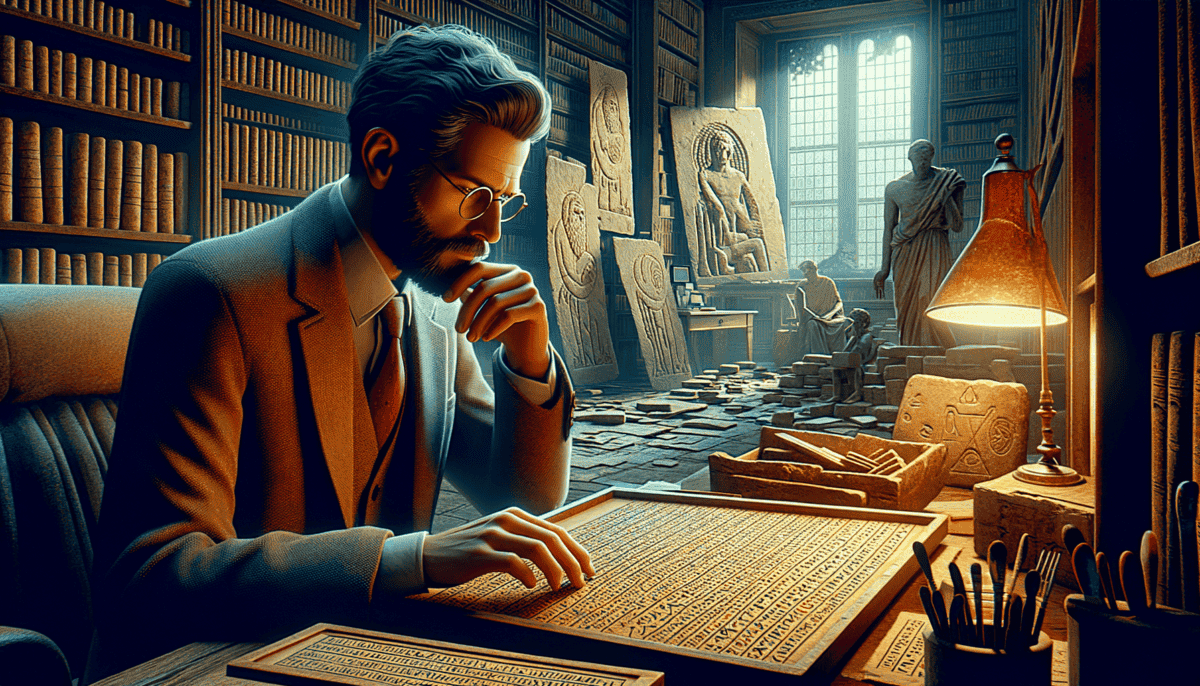
A Boy Who Loved Puzzles
While Arthur Evans was studying his mysterious tablets, a special little boy named Michael Ventris was growing up in England. He wasn’t like other kids – he LOVED puzzles and languages!
The Museum Visit That Changed Everything
One day, Michael’s mom took him to a special museum show. There, he saw something that made his eyes grow wide – Arthur Evans was showing his Linear B tablets!
“What are those funny marks?” young Michael asked.
“Nobody knows,” said Arthur Evans with a kind smile. “It’s a code no one can crack.”
“I’m going to solve it one day!” Michael promised. The grown-ups just laughed, but Michael was very serious.
Growing Up Different
While other kids played with toys, Michael played with alphabets and codes. He filled notebooks with strange symbols. His teachers were surprised when he learned to write in Egyptian hieroglyphs!
The Big Challenge
When Michael grew up, he started studying Linear B in his free time. He made charts and lists. He looked for patterns in the funny marks.
- He noticed some marks appeared more often than others
- Some marks always came at the start of words
- Other marks were usually found at the end
- Certain marks always appeared together
A Different Way of Thinking
Most people tried to read Linear B like it was a picture story. But Michael had a different idea.
“What if each mark is a sound?” he wondered. “Like letters in our alphabet?”
Michael worked late into the night. He wrote letters to other people who studied ancient writing. Some thought his ideas were silly. But Michael didn’t give up!
The First Clues
Slowly, very slowly, Michael started to see patterns. He noticed that some marks might stand for simple words like “boy” or “girl.” Other marks could mean numbers.
“It’s like a giant puzzle,” he told his wife. “And I’m finding the edge pieces first!”
Every night, Michael spread his papers on the kitchen table. The mysterious marks from Linear B covered everything. His wife brought him cups of tea while he worked.
Something exciting was about to happen. Michael was getting closer to cracking the ancient code. But even he didn’t know just how close he was!
Cracking the Code
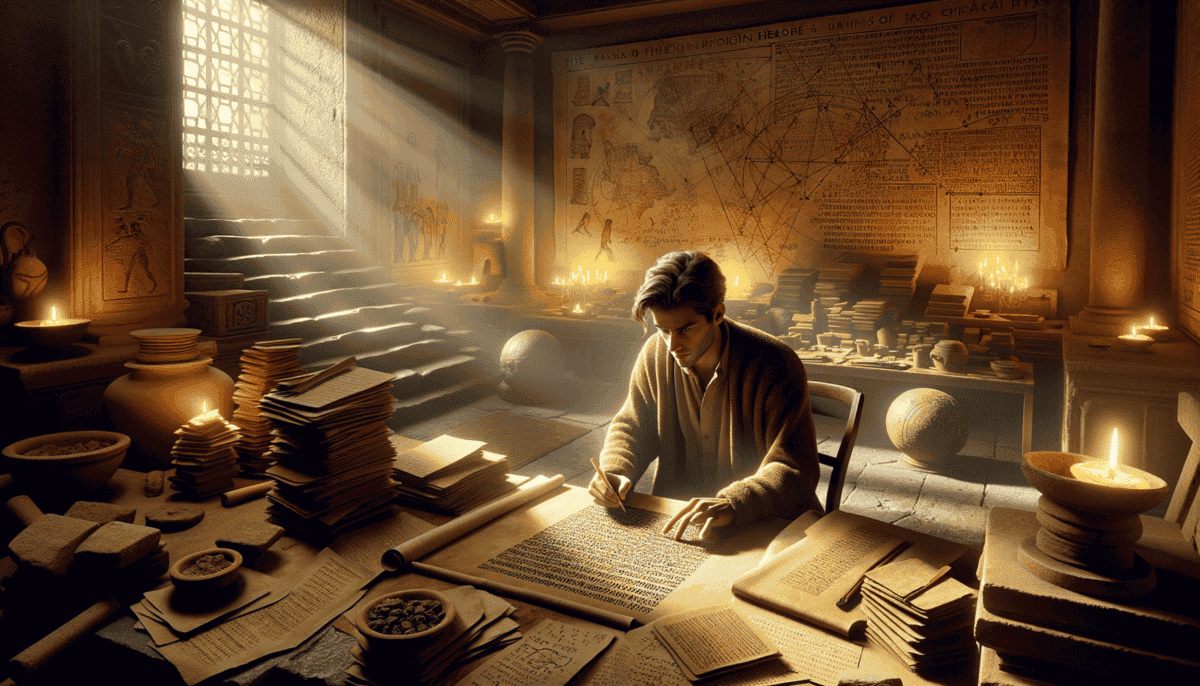
Michael Ventris sat at his desk late one night, surrounded by papers covered in strange marks. His eyes were tired, but he couldn’t stop working. He felt like he was getting closer to something big!
Working with Friends
“Maybe we can solve this together,” Michael wrote to his new friend Alice Kober, another person who studied Linear B. They shared their ideas through letters.
Alice had a clever way of organizing information. She made tiny cards for each symbol and sorted them into patterns. Michael thought this was brilliant!
The First Big Clue
One day, Michael noticed something exciting. Some tablets had little pictures of things like horses or wheat next to the Linear B marks.
“Look!” he told his wife. “If this picture shows wheat, maybe these marks spell out the word for wheat!”
“You’re like a detective finding footprints,” she smiled. “Each clue leads to the next!”
Small Victories
Michael started making lists of words he thought he understood:
- Words for things like food and animals
- Names of places
- Numbers and counting words
- Words about people and their jobs
A Surprising Discovery
As Michael studied the marks more closely, something strange happened. The words he was reading didn’t sound like any language he expected. They sounded a bit like… Greek!
“Could it be?” he wondered. “Could these ancient marks be an early form of Greek writing?”
Not Giving Up
Some people didn’t believe Michael when he shared his idea. They thought Linear B had to be something else.
“Keep trying,” Alice wrote to him. “You might be onto something important!”
Getting Closer
Every new tablet Michael studied made him more sure. The marks were spelling out Greek words! Words about farming, and trading, and everyday life from thousands of years ago.
Michael worked harder than ever. He was close to proving his idea was right. But the biggest surprise was still to come!
His hands shook as he reached for another tablet. Could this be the one that would help him solve the mystery once and for all?
The Big Discovery
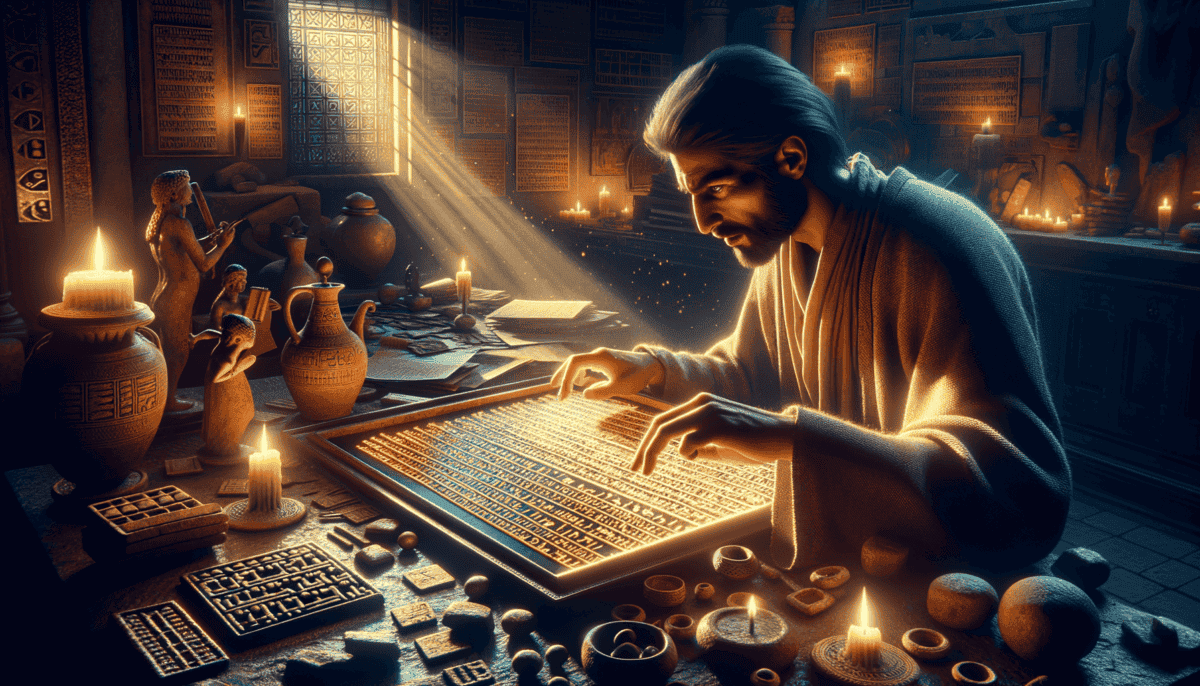
Michael Ventris’s heart was racing. He had just finished reading a tablet that would change everything! “This is it!” he shouted, jumping up from his desk.
The Special Tablet
The tablet that made Michael so excited had pictures of tripods – big three-legged pots. Next to the pictures were Linear B symbols. When Michael read the symbols using his Greek idea, they spelled out the word for “tripod”!
Sharing the News
“You won’t believe what I found!” Michael told his friend John Chadwick on the phone. John was a expert in old languages.
“Show me everything,” John said. “This could be the biggest discovery about ancient Greece in years!”
Working Together
Michael and John spent many days checking the discovery. They read more tablets using Michael’s method:
- Words about pottery and tools
- Lists of workers and their jobs
- Records of food and treasures
- Names of Greek gods
Telling the World
On July 1, 1952, Michael went on BBC radio. He told everyone about his discovery. The mysterious Linear B writing was actually Greek!
Happy Reactions
Scientists and researchers were amazed. Letters and telegrams came from all over the world.
“You’ve done it!” wrote one professor. “You’ve solved one of the greatest mysteries in history!”
A New Understanding
Now that people could read Linear B, they learned so much about ancient Greece. The tablets told stories about:
• How people lived
• What they bought and sold
• The things they made
• Their daily lives
More Discoveries
Michael kept working with John to read more tablets. Each one told them something new about life thousands of years ago.
A Special Honor
Universities wanted to give Michael special awards. Everyone knew he had done something amazing. But Michael was already thinking about what else the tablets might tell us.
“There’s still so much to learn,” he said, picking up another tablet. The mystery of Linear B was solved, but new adventures were just beginning!
Secrets from Long Ago
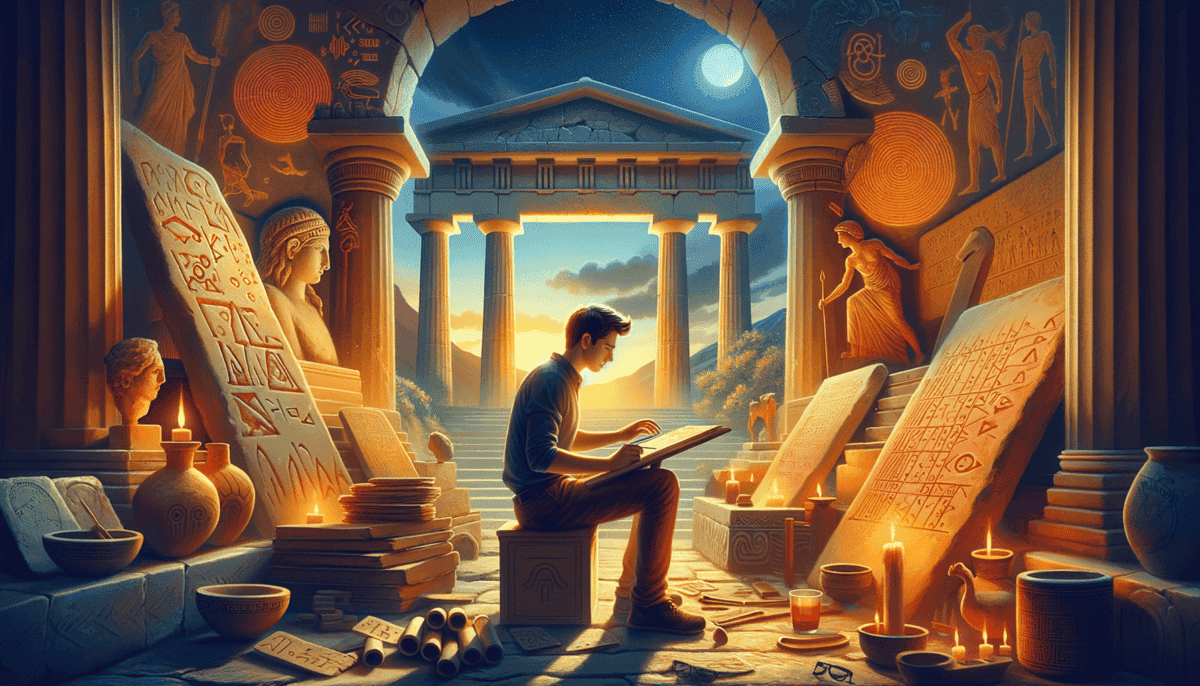
The tablets were like treasure maps into the past! ️ Now that Michael Ventris could read Linear B, amazing stories about ancient Greece came to life.
Daily Life Stories
“Look at this!” Michael said to John one morning. “This tablet talks about sheep farmers and their wool!”
Palace Life
The tablets painted a picture of busy palaces. Kings and queens lived there with many workers:
- Bakers making bread
- Weavers making clothes
- Soldiers protecting the palace
- Scribes writing on clay tablets
Special Foods
“They loved honey!” John exclaimed, reading another tablet. “And olives, just like people in Greece today!”
“It’s amazing how some things haven’t changed in thousands of years,” Michael smiled.
Hard Times
Reading the tablets wasn’t always easy. Michael often stayed up late trying to figure out tricky words. His eyes would get tired from looking at the tiny marks.
Big Questions
Other scientists started asking Michael lots of questions:
• How did ancient Greeks live?
• What did they eat?
• What games did children play?
• What did they believe in?
New Friends
Michael met many new friends who wanted to help read the tablets. They worked together like detectives solving a big puzzle.
Special Stories
Some tablets told stories about special parties at the palace. People brought gifts for the gods and had big feasts.
Sharing Knowledge
Michael traveled to different countries to tell people about what he learned. He wrote books and gave talks to help others understand ancient Greece better.
More to Learn
“Every tablet is like a window into the past,” Michael told his students. He knew there were still many more secrets to discover.
The tablets had stories about kings and farmers, parties and prayers, ships and soldiers. Each one helped paint a picture of life long ago. But there were still more tablets waiting to be read…
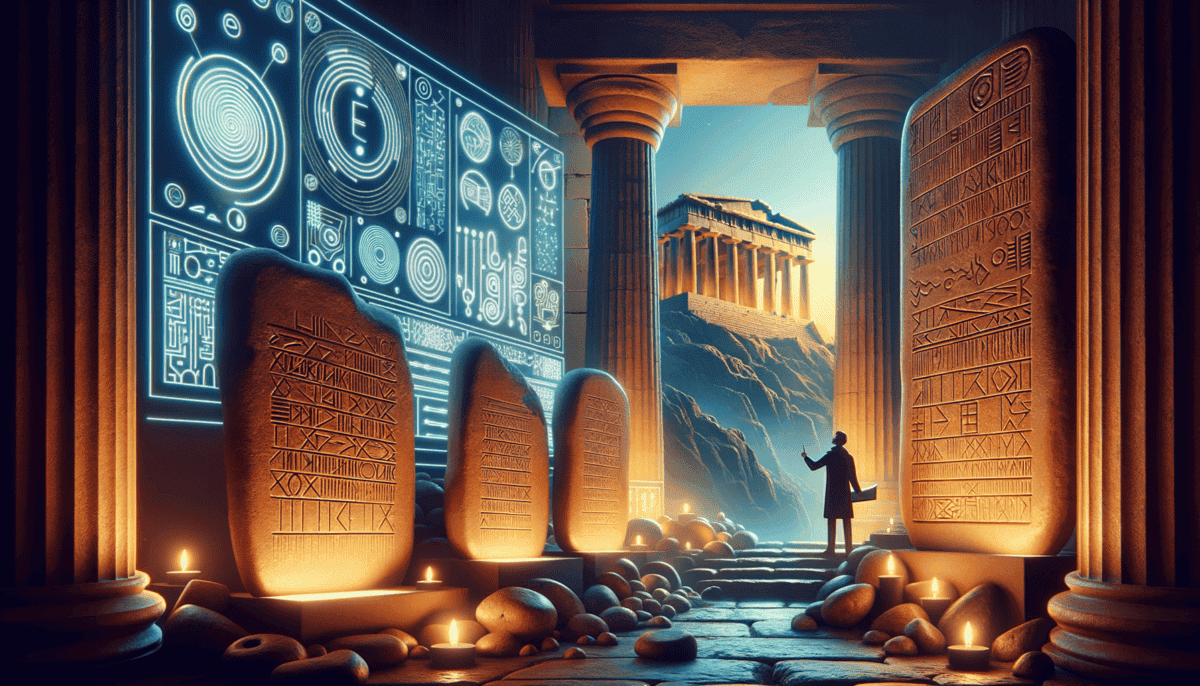
A Window to the Ancient World
The sun was setting over London as Michael Ventris sat at his desk, smiling at a stack of letters. People from all around the world were writing to thank him for solving the mystery of Linear B.
Sharing with the World
“Dear Professor,” one letter began, “thanks to you, we can now hear the voices of ancient Greeks!” Michael felt happy knowing his work helped so many people.
Teaching Others
Michael started teaching young people about Linear B. “Anyone can be a detective of the past,” he would say with a smile.
“The most important thing is to never give up when something seems hard,” he told his students.
New Adventures
More tablets were being found in Greece! Each one was like a new puzzle waiting to be solved.
Young students started learning how to read Linear B too. They were excited to become history detectives just like Michael!
A Big Change
Thanks to Michael’s work, we learned so many cool things about ancient Greece:
- What people ate for breakfast
- How they built their houses
- What games children played
- How they celebrated special days
Looking Forward
Even today, new tablets are being found! Scientists use special computers to help read broken pieces and solve more mysteries.
A Special Message
Michael wrote in his diary: “The ancient Greeks weren’t so different from us. They had families, jobs, and dreams – just like we do!” ✨
The Greatest Gift
Michael gave us an amazing gift – the ability to read messages from people who lived thousands of years ago. It’s like having a time machine made of clay tablets! ⏰
The Story Continues
Today, scientists are still finding new tablets and learning more about ancient Greece. Who knows what exciting secrets they’ll discover next? Maybe you’ll be the next person to solve an ancient mystery!
And so, the story of Linear B reminds us that with curiosity, hard work, and a little bit of detective skills, we can unlock the secrets of the past and learn amazing things about the people who came before us.