

The Curious Child
Little Albert Einstein sat by his window, watching raindrops dance down the glass. His right eye wandered slightly, making the world look different than it did to other children. But Albert didn't mind – he saw magic in everything! 🌟
"Mama, why do the raindrops race?" five-year-old Albert asked, pressing his nose against the cool window of their Munich home.
His mother Pauline smiled warmly. "What do you see, my curious one?"
"Some drops go fast, some go slow. They make patterns!" Albert's eyes sparkled with wonder as he traced the water trails with his finger.
Albert's father Hermann walked into the room carrying a special gift – a compass! "Here, son. I thought you might like this."
Young Albert held the compass carefully in his small hands. His eyes grew wide as he watched the needle always point north, no matter how he turned it. "But how does it know which way to point?" he whispered.
"That's the mystery of magnetism," his father explained. "There are invisible forces in our world."
Albert couldn't stop thinking about the compass. Even when his right eye got tired and drifted, making things look fuzzy, his mind stayed sharp and curious. His sister Maja often found him lost in thought, staring at objects for hours.
A Different Way of Learning
School wasn't always easy for Albert. His lazy eye made reading tricky sometimes. But this challenge made him think differently about the world around him.
"Albert, please pay attention!" his teacher would say when she caught him daydreaming.
But Albert wasn't just daydreaming – he was thinking. He imagined riding on beams of light. He wondered why things fell down instead of up. His mind painted pictures that helped him understand the world better than any textbook could.
One day, while playing with blocks, Albert made an amazing discovery. "Maja! Look what happens when I stack them this way!" He showed his sister how the blocks could balance in ways that seemed impossible.
"You're weird, Albert," Maja giggled, but she loved watching her brother's experiments.
Albert's uncle Jakob visited often, bringing math puzzles that made other children's heads spin. But Albert loved them! His unique way of visualizing problems helped him solve puzzles that even grown-ups found difficult.
"Show me how you did that," Uncle Jakob would say, amazed at Albert's solutions.
"I see the numbers dancing in my head," Albert explained. "They make pictures that tell me the answer."
As the sun set over Munich, little Albert sat with his violin, playing music while thinking about the mysteries of the universe. His lazy eye might have made some things harder, but it also helped him see the world in a special way – a way that would one day change how everyone understood the universe! 🎻 ⭐
His mother kissed him goodnight. "Sweet dreams, my little scientist."
"Mama," Albert whispered, "do you think I'll ever understand all the secrets of the world?"
"With your imagination and curiosity, Albert, you'll discover things no one has ever dreamed of."
The moonlight cast shadows on Albert's wall as he drifted off to sleep, his mind full of questions about light, motion, and the invisible forces that moved his compass needle. Tomorrow would bring new mysteries to solve, and young Albert Einstein couldn't wait to explore them all.
School Days and Challenges
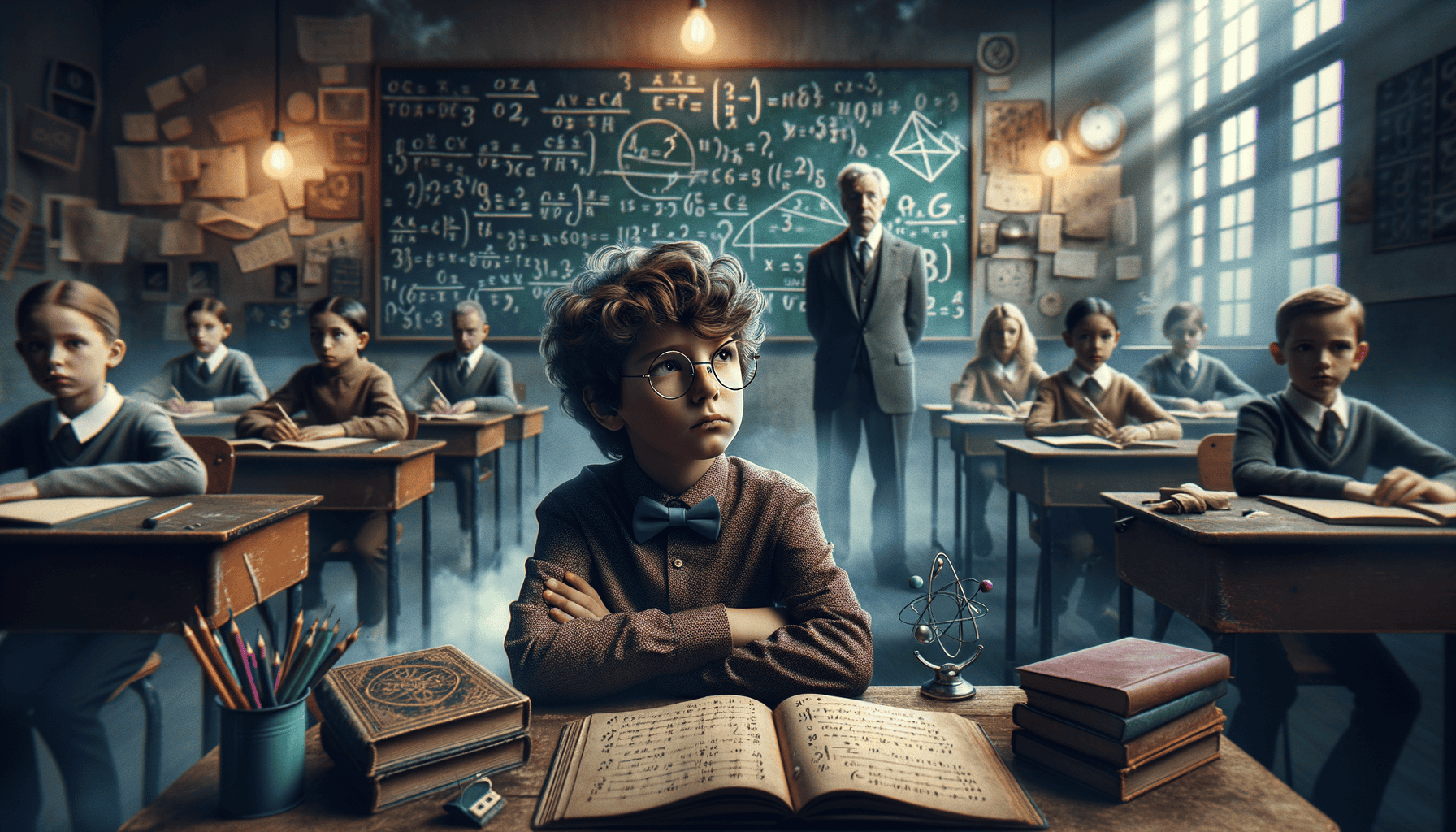
Ten-year-old Albert sat at his desk, squinting at the blackboard. His right eye wandered as usual, making the chalk marks dance and blur. But Albert had learned tricks to help him see better! 📚
“Einstein! Are you paying attention?” Herr Schmidt’s voice boomed across the classroom.
“Yes, sir,” Albert replied quietly. He was paying attention – just not in the way his teacher expected.
The other students giggled, but Albert didn’t mind. He was busy thinking about how light bounced off the blackboard and traveled to his eyes. Why did some things look blurry while others stayed clear?
Finding His Own Way
“Why can’t you just read like everyone else?” complained Herr Schmidt, tapping his ruler on Albert’s desk.
Albert’s friend Max whispered from the next desk, “Show him your math homework. That’ll quiet him down!”
You see, Albert had discovered something amazing. While reading was hard, numbers were his friends! When he looked at math problems, they seemed to come alive in his mind.
“2 + 2 might be boring,” Albert told Max during lunch break, “but what if we could add the speed of two running rabbits? Or calculate how fast light moves?”
The Mathematics Club
After school, Albert started a special club. He and his friends would meet in the school garden to solve puzzles and talk about science. 🌱
“Look at this!” Albert showed them a prism he’d borrowed from his uncle. “When sunlight goes through it, it makes rainbows!”
The other kids were amazed. Even those who usually teased him about his lazy eye wanted to join the club.
“Maybe you see things differently,” said his friend Helena, “but you help us see things we never noticed before!”
The Special Teacher
One day, a new teacher came to Albert’s school. Fräulein Weber noticed something special about the quiet boy with the wandering eye.
“Albert,” she said after class, “I saw your science drawings. They’re very creative!”
“But I can’t always copy what’s on the board like the others,” Albert admitted.
“That’s okay,” she smiled. “Sometimes the best discoveries come from seeing things differently.”
Fräulein Weber gave Albert special projects. Instead of just copying numbers, she let him design experiments. His favorite was measuring the speed of different moving objects in the schoolyard. ⚽
Growing Confidence
As months passed, Albert’s confidence grew. Yes, reading was still tricky. Yes, his right eye still wandered. But he was learning to use these challenges to his advantage.
“Einstein,” called Herr Schmidt one day, “come solve this problem on the board.”
Albert walked up confidently. The numbers might look fuzzy, but in his mind, they were crystal clear. He solved the complex math problem while explaining his unique way of thinking about it.
Even Herr Schmidt looked impressed. “Well done,” he said quietly.
That evening, Albert wrote in his notebook: “Every challenge is a chance to see the world in a new way.” 🌟
As he looked out his bedroom window at the stars, Albert smiled. School might be hard sometimes, but his mind was full of questions about the universe. And those questions were leading him toward amazing discoveries.
His mother found him still awake, scribbling equations. “What are you working on now?”
“I’m trying to figure out how fast starlight travels,” he said excitedly. “My eyes might see things differently, but maybe that’s exactly what I need to solve the biggest mysteries!”
Discovering a Different Way of Seeing
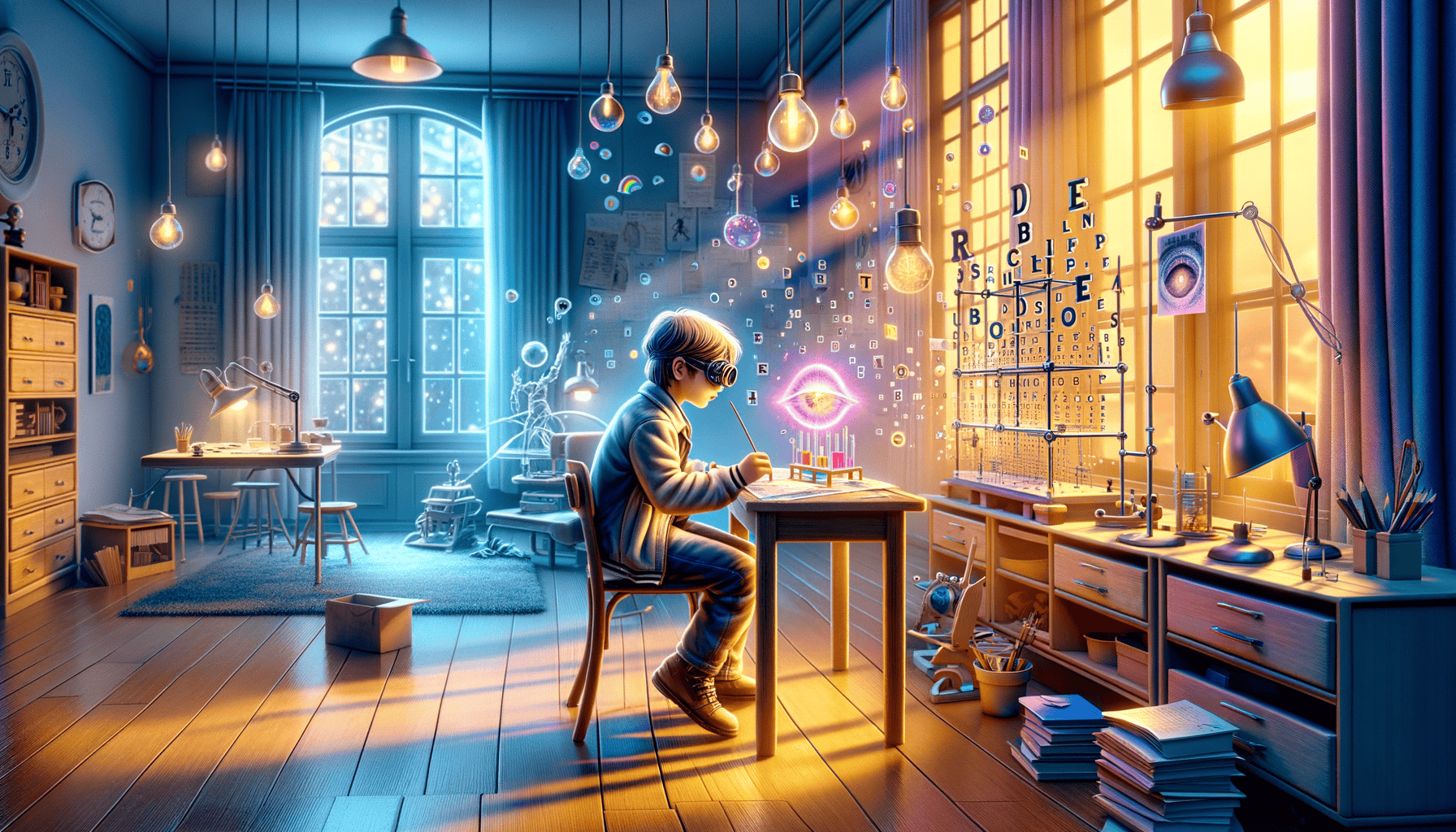
Twelve-year-old Albert sat in his favorite spot in the garden, holding a small mirror. Sunlight bounced off its surface, creating dancing patterns on the grass. 🌟
“That’s it!” he exclaimed, his eyes lighting up with excitement. “Light always travels the same way, even if I see it differently!”
The Magic of Light
“What are you doing out here?” asked his sister Maja, stepping into the garden.
“Watch this,” Albert said, tilting the mirror. “See how the light beam bends? My right eye might see it fuzzy, but my left eye sees it clear as day. It made me wonder – what if there’s more to light than what we can see?”
Maja sat beside him, fascinated by her brother’s experiments. “Show me more!”
The Special Notebook
Albert pulled out his special notebook. The pages were filled with drawings – not regular pictures, but shapes and lines showing how he imagined light moving through space. ✏️
“Most people draw what they see,” he explained to Maja. “I draw what I think about. Like this…” He sketched a beam of light bouncing between two mirrors.
The Backyard Laboratory
Albert turned his family’s garden into a science lab. He used:
• A magnifying glass
• His mother’s mirrors
• Glass prisms
• An old compass
“Mom!” he called out. “Can I borrow your hand mirror again?”
His mother smiled, already used to his experiments. “Just be careful with it this time!”
Making Friends with Numbers
While other kids played regular games, Albert invented his own. He would close his strong left eye and try to guess distances with just his weak right eye. Then he’d measure to check his guess.
“It’s like a puzzle,” he told his friend Max. “My eyes see things differently, so I have to think differently to understand them.”
“That’s actually pretty cool,” Max replied, joining in the game. “It’s like having a superpower!”
The Big Question
One evening, Albert lay on his back, watching stars twinkle in the dark sky. 🌠
“Papa,” he asked, “if my eyes see things differently from everyone else’s, how do we know what’s really real?”
His father thought for a moment. “Perhaps that’s exactly why you’ll discover something no one else has seen before.”
The First Theory
In his room, Albert wrote his first scientific theory: “Light is special. It doesn’t care how we see it – it follows its own rules.”
“What are you writing?” his mother asked, bringing him a snack.
“I think I’m starting to understand something big,” Albert said, his eyes shining. “Maybe my lazy eye isn’t just making things hard to see – maybe it’s helping me see things in a whole new way!”
That night, Albert dreamed of riding on a beam of light. In his dream, both his eyes worked perfectly, but he realized something important – it wasn’t about seeing clearly, it was about thinking differently.
The next morning, he added a new page to his notebook: “Questions are more important than answers. And sometimes, the best questions come from seeing the world in your own special way.” 📚

The Revolutionary Thinker
Young Albert sat at his desk in the patent office, staring out the window. His mind wasn’t on the pile of papers before him – it was racing through space and time. 🌟
A Different View
“Einstein! More patents to review!” his boss called out.
Albert nodded, but his thoughts were elsewhere. He picked up his pocket compass, watching the needle swing. With his stronger left eye closed, he noticed something interesting through his weaker right eye.
“The world looks different when I use just my weak eye,” he mumbled. “What if time and space work differently than we think too?”
The Train Ride
On his way home, Albert watched through the train window. The trees seemed to move backward, but he knew they were standing still. 🚂
“Hey mister,” said a little girl in the next seat, “why do the trees look like they’re running away?”
Albert smiled. “It depends on how you look at it. From here, they move. From out there, we move. Both are right!”
The Big Discovery
That night, Albert couldn’t sleep. He grabbed his notebook and wrote:
• Everything moves relative to other things
• Light always travels at the same speed
• Time can stretch and space can bend
• Energy and matter are the same thing
Explaining It All
“But how can I help others understand?” Albert wondered. He looked at his reflection in the mirror, his right eye turning slightly outward.
“I know!” he exclaimed. “I’ll use simple pictures!”
He drew stick figures and light beams, making complex ideas simple enough for anyone to understand. ✏️
Breaking the Rules
“Mr. Einstein,” said his friend Michele, “nobody has ever thought about physics this way before!”
“Maybe that’s because nobody has seen it quite like I do,” Albert replied with a grin.
The Famous Equation
Albert wrote his most famous idea: E = mc²
“What does it mean?” asked his wife Mileva.
“It means energy and matter are really the same thing,” he explained. “Like how my two eyes see differently but show the same world.”
Changing the World
People started paying attention to Albert’s ideas. Scientists came from far away to hear him speak. 🌍
“How did you think of all this?” they asked.
“I just looked at things differently,” he said. “Sometimes having trouble seeing clearly makes you think more deeply about what you’re looking at.”
The Power of Dreams
Albert kept having his favorite dream – riding on a light beam through space. Now he understood more about what it meant.
“Dreams help us see past what our eyes show us,” he told his students. “They let us imagine new possibilities.”
“Every new idea seems strange at first,” Albert wrote in his journal. “But if we’re brave enough to think differently, we can discover amazing things.” ⭐️
As he walked home that evening, Albert looked up at the stars. His right eye might not see them as clearly as his left, but his mind could now understand them better than anyone ever had before.
Standing Strong
Albert stood nervously in front of a room full of famous scientists. His hands were shaking a little as he held his papers. 😰
Facing the Doubters
“This is nonsense!” shouted one scientist from the back. “Time cannot bend!”
“And space cannot curve!” yelled another.
Albert took a deep breath. He remembered all the times people had doubted him before. 💪
Proving His Point
“Let me show you something,” Albert said calmly. He drew a simple picture on the blackboard.
“When light passes near the sun, it bends. During the next solar eclipse, we can prove this!”
The room got very quiet. 🌞
The Big Test
Scientists traveled around the world to watch the eclipse. They wanted to see if Albert was right.
“What if they don’t see what I predicted?” Albert wondered.
His friend Elsa squeezed his hand. “You’ve always seen things differently. That’s your strength.”
Growing Fame
Newspapers around the world wrote about Albert’s discovery. 📰
“German Scientist Changes How We See Universe!” read one headline.
“Einstein’s Theory Proves True!” said another.
New Challenges
More people wanted to meet Albert. Some still didn’t believe him.
“How can we trust someone who can’t even see straight?” they whispered.
Albert smiled. “My eyes may not work perfectly, but my mind sees clearly.”
Teaching Others
Albert began traveling to different universities. He taught students about his ideas.
“Remember,” he told them, “everyone sees the world differently. That’s how we make new discoveries!” 🌎
A Special Letter
One day, Albert got a letter from a young girl:
“Dear Mr. Einstein,
I have trouble seeing too. My teacher says I won’t do well in science. What should I do?”
Albert wrote back right away:
“Dear Friend,
Don’t let anyone tell you what you can’t do. Sometimes seeing things differently helps us understand them better.
Your friend,
Albert”
Growing Success
More and more people started to understand Albert’s ideas. Universities gave him special awards. 🏆
“How does it feel to be famous?” reporters asked.
“I’m just happy people are learning to look at the universe in new ways,” he said.
As Albert walked home that evening, he thought about his journey. His lazy eye had once made things hard. But it had also helped him see the universe in a special way. Now, he was helping others see it too. ⭐️

A New Way of Seeing
Albert sat in his favorite chair, looking out at the stars. His gray hair was messy as always, and his eyes twinkled with joy. 🌟
A Special Visit
“Professor Einstein!” called a young voice. A group of students had come to visit.
“Come in, come in!” Albert smiled warmly. He loved talking to young people about science.
Sharing His Story
“Professor, is it true you had trouble seeing when you were young?” asked a girl with glasses.
“Yes, Sarah. My lazy eye made some things hard. But it helped me think about light and space in new ways.” 👀
“Just like my colorblindness helps me notice patterns!” said Tommy excitedly.
The Big Message
Albert leaned forward in his chair. “You know what I learned? Everyone’s brain works differently. That’s not bad – it’s wonderful!”
“Our differences are like windows. Each one shows us something new about the world.”
Making Dreams Real
Sarah pulled out her science notebook. “I want to be a scientist too. But some people say girls can’t do science.”
Albert shook his head firmly. “Nonsense! Science needs all kinds of minds and all kinds of eyes.” 🔬
A Growing Legacy
Letters came from people all around the world. They told Albert how his story gave them courage. 📫
Scientists used his ideas to learn new things about space. Doctors learned more about how eyes and brains work together.
Looking Forward
“What’s next, Professor?” asked Tommy.
Albert’s eyes sparkled. “There’s still so much to discover! And you know what?”
“What?” the children leaned in close.
“The next big discovery might come from someone who sees things differently – just like you!” 🌈
The Greatest Discovery
Looking back at his life, Albert realized something important. His biggest discovery wasn’t about space or time.
It was learning that being different wasn’t a problem to fix. It was a gift to share.
“Every person has their own way of seeing the world. When we share our views, we all see more clearly.”
A Lasting Light
As the students left that evening, Albert watched them go. Each one carried a spark of curiosity and hope. 💫
His lazy eye might have made some things harder. But it had helped him show the world something amazing:
And somewhere out there, a child who felt different was looking up at the same stars. Maybe they would see something new too – something that would change the world again. ⭐️