

The Invasion Begins
Marcus peered through the misty morning air, his heart pounding. The sea looked different today. Strange ships dotted the horizon – more than he had ever seen before.
"Father, look!" Marcus pointed toward the water. His hands shook as he gripped his wooden staff tighter.
The ships grew larger as they approached the shore. Their red sails stood out against the grey sky. Hundreds of men in shiny armor stepped onto the beach. Their metal helmets gleamed even in the weak sunlight.
"Those are the Romans," Marcus's father whispered. "They have come from across the great sea."
Marcus had heard stories about the Romans. They came from a warm land far away. Now they were here, on his beach, where he played and fished with his friends.
The Roman soldiers moved in perfect lines. Their feet made the same sound as they walked. Thump. Thump. Thump. Marcus had never seen anything like it. His people, the Celts, didn't fight this way.
"Why are they here?" Marcus asked.
"They want our land," his father replied. "They want to make Britain part of their empire."
Marcus watched as more ships arrived. The beach filled with soldiers. Their armor clinked as they marched. Their red cloaks fluttered in the wind.
A loud horn blasted across the water. The sound made Marcus jump.
"We must warn the village," his father said. They ran through the forest, jumping over fallen trees and splashing through streams. Marcus's heart raced faster than his feet.
When they reached their village, everyone gathered around. The village chief stood on a big rock to speak.
"The Romans have come," he announced. "We must defend our homes!"
The villagers grabbed their weapons – spears, shields, and swords. Some painted their faces blue with woad dye. This was how Celtic warriors prepared for battle.
Marcus wanted to fight too, but his father shook his head. "You're too young, son. Stay with your mother."
From the safety of his roundhouse, Marcus watched as the warriors left. The Romans were getting closer. He could hear their marching drums.
That night, Marcus couldn't sleep. The sound of battle echoed through the trees. Flames lit up the dark sky. The world he knew was changing forever.
Through his window, he saw Roman soldiers walking through the village. Their armor reflected the firelight. Some spoke words Marcus didn't understand.
One young Roman soldier stopped near Marcus's house. He looked about Marcus's age. Their eyes met through the window. For a moment, neither boy moved.
Then the Roman boy smiled and waved. Marcus hesitated, then waved back. Maybe the Romans weren't exactly what he had imagined.
As the sun rose the next morning, Marcus knew nothing would ever be the same. The Romans were here to stay. His adventure was just beginning.
• They brought new weapons
• They wore special armor
• They came in big ships
• They marched in straight lines
• They spoke a different language
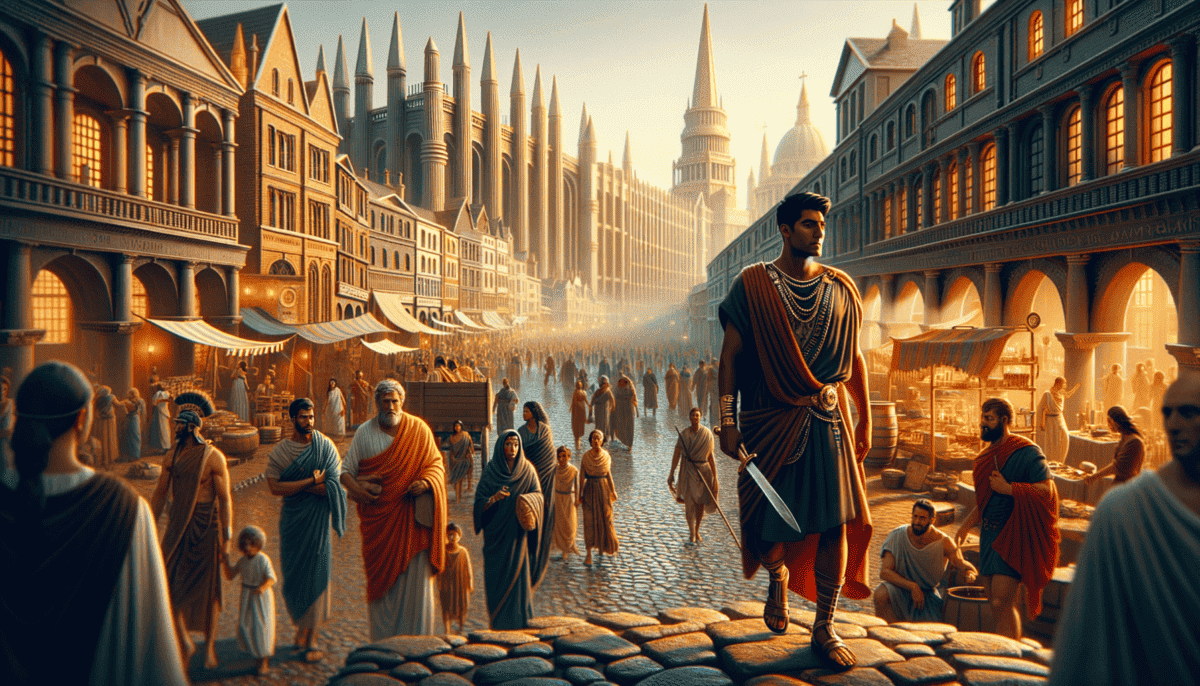
Londinium Rising
Two summers had passed since the Romans arrived. Marcus watched in amazement as they built their new city. They called it Londinium. ️
“Look how tall the buildings are!” Marcus exclaimed to his friend Lucia, a Roman girl he had met in the marketplace.
“This is nothing,” Lucia smiled. “In Rome, buildings touch the clouds!” Her father was one of the architects helping build the new city.
The Romans worked differently than Marcus’s people. They used strange tools and measured everything carefully. Their buildings were square, not round like Celtic homes.
Marcus watched the workers lay straight roads with smooth stones. “Why do they make the roads so flat?” he asked Lucia.
“So our soldiers can march faster,” she explained. “And traders can bring their carts full of goods.”
Every day brought something new. The Romans built a big wall around the city. They dug deep trenches for water pipes. Some Celts grumbled about the changes, but Marcus found it exciting.
“Look!” Lucia pointed to a group of workers. “They’re building the bathhouse today!”
Marcus had never seen a bathhouse before. The Romans loved to bathe in hot water and steam. They said it kept them clean and healthy.
• Strong stone walls
• Straight roads
• Big bathhouses
• Tall buildings
• Underground pipes
Not everyone was happy about the new city. Marcus’s uncle Brennus refused to go near it. “They’re changing our land,” he would say. “This isn’t our way.”
But Marcus’s father saw things differently. He learned to speak Latin and traded with the Romans. “Times change,” he told Marcus. “We must change too.”
One day, Lucia took Marcus to see the new marketplace. It was bigger than anything in his village. Traders sold purple cloth, shiny jewelry, and sweet fruits he had never tasted before.
“Try this,” Lucia handed him something round and red. “It’s called an apple. They grow them in Rome.”
Marcus bit into it. The juice was sweet and tangy. “It’s wonderful!” he exclaimed.
That evening, Marcus sat with his parents in their roundhouse. “The Romans know many useful things,” his mother said, cooking with new spices from the market. “But we must not forget our own ways.”
Marcus nodded. He was learning to live in both worlds. He could speak Latin with Lucia and still tell Celtic stories around the fire. He could eat Roman apples and Celtic bread.
Outside, the sun set behind the new stone buildings of Londinium. The city glowed with torchlight. Marcus heard Latin and Celtic words mixing in the evening air.
A group of children played nearby – some Roman, some Celtic. They didn’t care about their differences. They just laughed and ran together in the fading light.
“Maybe,” Marcus thought, “this is how our new world will be. Not just Roman, not just Celtic, but something new – something better.”
As night fell, Marcus watched the stars appear above Londinium’s walls. Tomorrow would bring more changes, more buildings, more adventures. And he was ready for all of them.
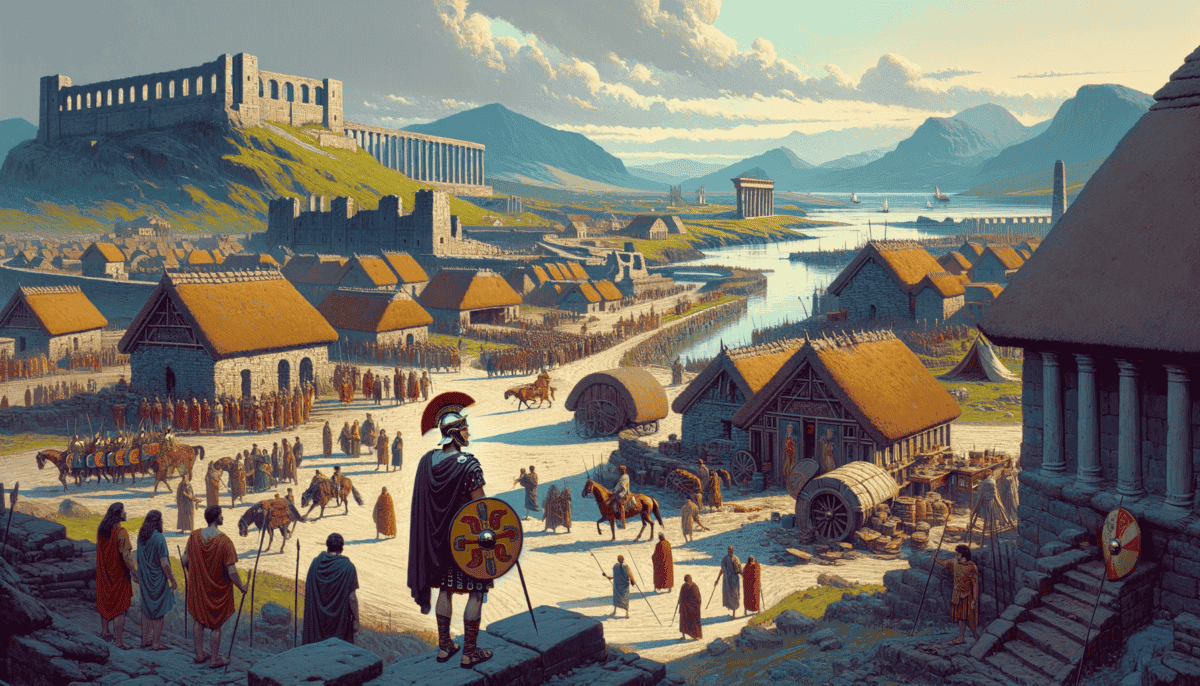
Storm of Rebellion
Dark clouds gathered over Londinium as Marcus hurried through the streets. Something was different today. The usual busy marketplace was quiet. ️
“Marcus!” Lucia called from her doorway. “Have you heard? Queen Boudicca is leading a rebellion against us!”
Marcus’s heart raced. Boudicca was the queen of the Iceni tribe. Her flaming red hair and fierce spirit were famous among all Celts.
“My father says she’s gathered thousands of warriors,” Lucia whispered. Her face was pale with worry.
Marcus felt torn. Part of him understood Boudicca’s anger. But he also thought about his Roman friends – Lucia and her family.
That night, Marcus overheard his parents talking:
“The Iceni are burning Roman towns,” his father said. “They’re coming this way.”
“Whose side will we choose?” his mother asked softly.
The next morning, smoke rose in the distance. Marcus ran to the city wall. He could see warriors approaching – thousands of them!
“Everyone to the river!” Roman soldiers shouted. “We must evacuate!”
Chaos erupted in the streets. People grabbed what they could carry. Marcus helped Lucia’s family pack their most important things.
• Fast chariots
• Sharp spears
• Brave fighters
• Fierce determination
• The support of many tribes
“Come with us,” Lucia begged Marcus. But he knew he had to find his own family first.
Running through the panicked crowds, Marcus saw both Romans and Celts helping each other. A Roman soldier carried a Celtic child. A Celtic woman helped an elderly Roman man.
“We’re all just people,” Marcus thought.
He found his parents at their house. “The Romans have been good to us,” his father said. “We won’t fight against them.”
They joined the crowd heading to the river. Behind them, Boudicca’s warriors entered the city. The sound of battle filled the air.
“Look!” someone shouted. Marcus turned to see Boudicca herself, standing tall in her chariot. Her red hair shone like fire in the sun.
“She looks so brave,” Marcus thought. “But also so sad.”
As they escaped on boats, Marcus watched Londinium burn. The beautiful buildings fell. The marketplace where he had tried his first apple was destroyed.
Lucia squeezed his hand. “We’ll rebuild,” she said. “Romans are good at building things.”
Marcus nodded. “And Celts are good at making things beautiful. Maybe we can do it together next time.”
Days later, news came that the Roman army had defeated Boudicca. But things would never be quite the same. Both sides had learned important lessons.
Marcus wrote in the dirt with a stick: “Sometimes being brave means choosing peace instead of fighting. Sometimes the strongest thing is to build bridges, not walls.”
Above him, the clouds began to clear. Spring would come again. New buildings would rise. And maybe, just maybe, Romans and Celts would find a better way to live together.

A Bridge Between Worlds
The summer sun shone bright as Marcus walked along the new Roman road. It was smooth and straight, nothing like the old dirt paths.
“Marcus!” called Flavius, the Roman engineer. “Come see what we’re building!”
Marcus jogged over to where workers were laying stones for an aqueduct. After Boudicca’s rebellion, the Romans were building Londinium bigger and better than before.
“We need your help,” Flavius said. “Can you explain to the Celtic workers how these stone blocks should fit together?”
Marcus smiled. Being able to speak both Celtic and Latin made him very useful. He had become a bridge between two peoples.
“See how the stones lock together?” Marcus explained in Celtic. “Like pieces of a puzzle. This makes the structure strong.”
Later that day, Marcus visited the marketplace. It was busy again, but different from before. Roman soldiers bought Celtic jewelry. Celtic farmers sold vegetables to Roman families.
Lucia waved from her family’s new shop. “Marcus! Try this!” She handed him a warm pastry. “It’s a Roman recipe, but we used local honey instead of grape syrup.”
“It’s delicious!” Marcus said. “The best of both worlds.”
Walking home, Marcus passed new buildings rising from the ashes:
• Roman bathhouses with hot water
• Schools teaching both languages
• Temples to Roman and Celtic gods
• Markets selling goods from across the empire
• Houses with heated floors
“Our city is changing,” Marcus’s father said that evening. “But maybe change isn’t always bad.”
Marcus helped his mother cook dinner. She used Roman spices in their traditional Celtic stew. The smell was amazing!
“Tomorrow,” his father announced, “I start work as a tax collector for the Romans.”
Marcus was surprised. “But you always said—”
“Times change,” his father smiled. “And we must change too. Besides, I can help make sure our people are treated fairly.”
That night, Marcus couldn’t sleep. He thought about how much had changed since the Romans came. Some changes were hard, but others made life better.
The next morning, Marcus had an idea. He gathered his friends – both Roman and Celtic – and suggested they build a garden together.
“We can grow Roman grape vines,” said Lucia.
“And Celtic healing herbs,” added Marcus’s cousin.
They worked together all day. Roman engineering helped them build good soil beds. Celtic knowledge showed them which plants grew best together.
“This is how it should be,” Marcus thought. “Everyone bringing their best ideas.”
As the sun set, Marcus watched a Roman soldier teaching Celtic children to play their board game called “ludus latrunculorum.” Nearby, a Celtic musician played while Roman children danced.
A messenger rode into town with news: The Romans were building more cities across Britain. They wanted Marcus to help as a translator.
“Will you go?” Lucia asked.
Marcus looked around at their new garden, at the rising aqueduct, at the happy faces of both Romans and Celts.
“Yes,” he said. “There are more bridges to build.”
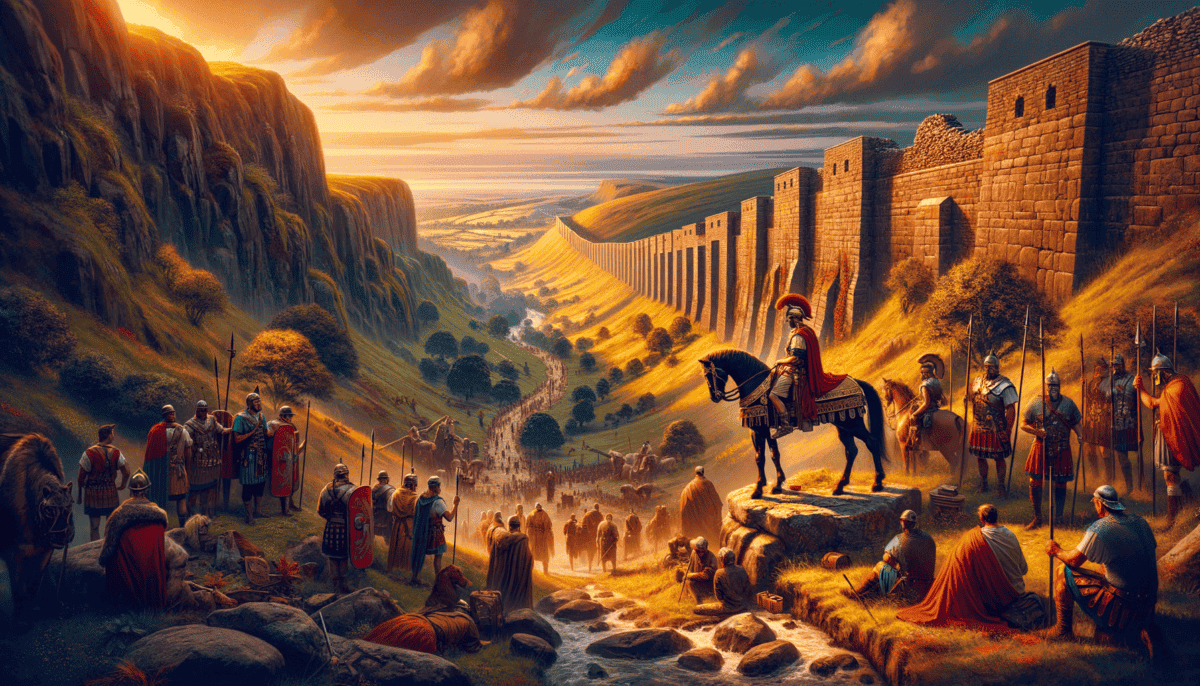
The Great Wall
Marcus stood at the edge of the world. At least, that’s what it felt like. Before him stretched the biggest wall he had ever seen. ️
“It will stretch from sea to sea,” announced Commander Atticus. “Emperor Hadrian wants to protect our northern border.”
The wall was amazing! Soldiers and workers moved like ants, lifting heavy stones. Some blocks were bigger than Marcus himself.
“Why here?” Marcus asked, looking at the rolling hills.
“The tribes up north are fierce,” Atticus explained. “We need to know who comes in and out of Roman Britain.”
Marcus helped translate for the Celtic workers. Many had traveled far to help build the wall. Some grumbled about working for Romans, but the pay was good.
“Think of it as building something that will last forever,” Marcus told them. “Your grandchildren will see this wall!”
Every mile of the wall had a gateway. Marcus worked at one called Segedunum. He helped check travelers:
• Checking traders’ goods
• Helping travelers find places to stay
• Making sure rules were followed
• Keeping peace between different groups
• Writing messages in both languages
One day, a group of northern traders arrived. They looked different from the Celts and Romans, with bright red hair and blue paint on their faces.
“We want to trade,” their leader said in a language Marcus didn’t know.
Lucia, who now worked with Marcus, brought a trader who spoke their language. Soon, they were all sharing stories and showing their goods.
“See?” Lucia smiled. “The wall doesn’t just keep people apart – it brings them together too!”
Life at the wall was busy. Small towns grew near each fort. Romans, Celts, and traders from far away lived side by side. ️
Marcus met people from all over the empire:
“I’m from Syria,” said a cook serving spicy food.
“Spain,” said a soldier showing his special sword moves.
“Germania,” said a merchant selling warm furs.
One evening, Marcus walked along the top of the wall. The sunset painted the sky orange and pink. To the south, he could see Roman farms and towns. To the north were wild forests and mountains.
“We’re not just guarding a border,” he thought. “We’re guarding two different worlds.”
A horn sounded! Someone was attacking a nearby farm. Marcus and the soldiers rushed to help.
It wasn’t a real attack – just some hungry wolves. But Marcus saw how quickly everyone worked together. Roman soldiers, Celtic farmers, and northern traders all helped chase the wolves away.
“You see?” Commander Atticus said later. “The wall helps us protect everyone.”
As winter came, Marcus helped organize games and festivals to keep spirits high. Romans shared their winter feast of Saturnalia. Celtic tribes taught their midwinter traditions.
“The wall is more than stones,” Marcus told new arrivals. “It’s a meeting place, a trading place, a place where different peoples learn from each other.”
News arrived that Emperor Hadrian himself might visit when the wall was finished. Everyone worked harder than ever.
“Will the wall really last forever?” a young Celtic worker asked Marcus.
Marcus looked at the mighty stone barrier stretching across the hills. “Parts of it will,” he said. “But more importantly, what we’re building together – understanding between peoples – that will last even longer.”
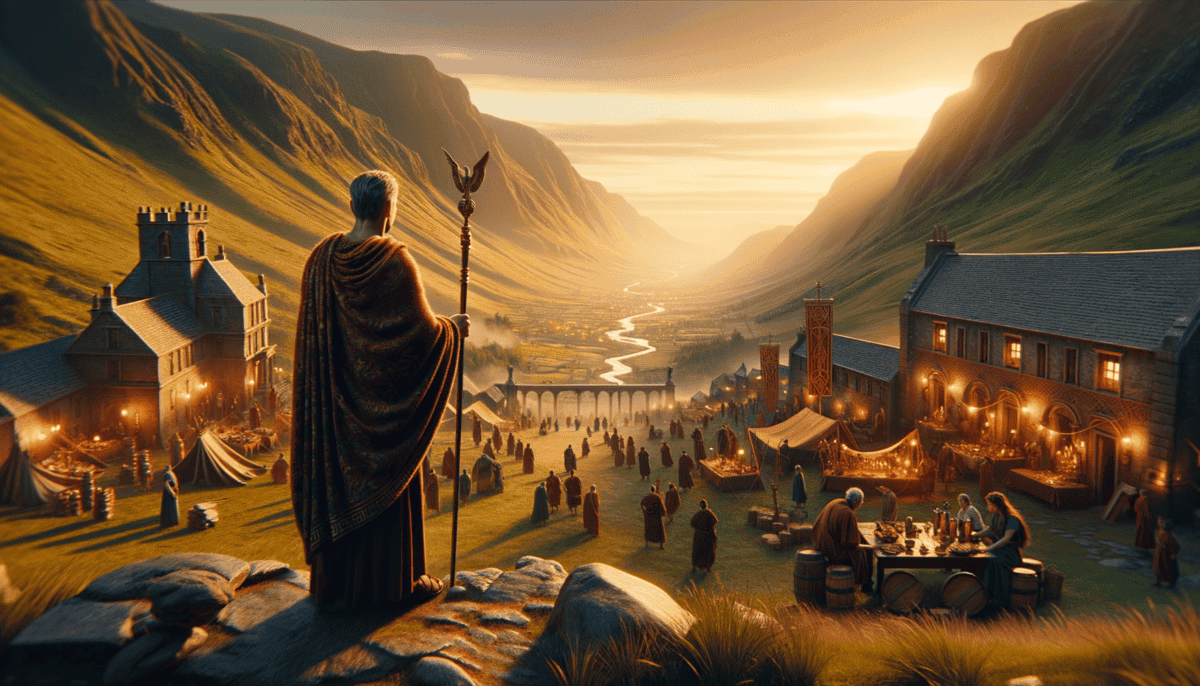
A New Britain
Years had passed since Marcus first saw Roman ships on the horizon. Now, standing on Hadrian’s Wall with his own son, he could hardly believe how much had changed.
“Father, tell me again about the old days,” young Lucius asked, his eyes bright with curiosity.
Marcus smiled, ruffling his son’s hair – dark like his Celtic mother’s but styled in Roman fashion. “Well, when I was your age, there were no great stone buildings, no straight roads…”
As they walked through the bustling town near the wall, Marcus pointed out the changes:
“See that bathhouse? Romans taught us to enjoy hot baths. And that temple? People pray to both Roman and Celtic gods there.”
A group of children ran past, playing with wooden swords. Some wore Roman tunics, others Celtic plaids. They switched easily between Latin and Celtic words in their game.
“This is what peace looks like,” Marcus thought. “Not everyone the same, but everyone together.”
In the marketplace, Lucia waved them over to her shop. She sold medicines that mixed Roman and Celtic healing ways.
“Remember when you first arrived at the wall?” she laughed. “You couldn’t tell north from south!”
Now Marcus was an important man in the town. People came to him to solve problems and give advice. He helped everyone understand each other.
• Roman city planning
• Celtic farming methods
• Both groups’ stories and songs
• New ways of making things
• Special British-Roman food
That evening, Marcus took Lucius to their favorite spot on the wall. The sunset painted the sky in beautiful colors.
“Father,” Lucius asked, “are we Roman or Celtic?”
Marcus thought carefully. “We are both, and that makes us stronger. Like this wall – it’s made of both Roman and Celtic stone, built by both Roman and Celtic hands.”
A trader arrived from far away, bringing news of the empire. Marcus listened as his son practiced translating, just as he had done years ago.
“The world is bigger than just Romans and Celts,” Marcus told Lucius. “There’s always more to learn from others.”
As night fell, they joined a festival in town. There was Roman wine and Celtic ale, music from both cultures, and dancing that mixed old steps with new ones.
Marcus watched his son play with friends – children of Romans, Celts, and traders. They didn’t care about where anyone came from. They were just children of Britain.
Later, looking at the stars, Marcus remembered the young warrior he had been, so afraid of change. Now he saw how change had made Britain stronger.
“What do you think Britain will be like when I’m grown?” Lucius asked.
Marcus hugged his son. “It will be whatever you and your friends make it. You are the future of this land.”
As they walked home, Marcus looked back at the wall gleaming in the moonlight. It wasn’t just a border anymore – it was a symbol of how different peoples could come together and build something new.
The next morning, Marcus watched his son leave for school, carrying tablets for Latin lessons and wearing a Celtic good-luck charm. He smiled, knowing Britain’s story was still being written, every day, by all its people together.
And so Britain changed, not just through conquest, but through countless small moments of people learning from each other, working together, and building a new world stone by stone, story by story, day by day.