

A City in Danger
Long ago, in a beautiful city called Athens, there lived a brave king named Codrus. The city had tall white buildings and pretty gardens. People loved living there. They were happy and free. ️
But one day, dark clouds gathered over Athens. Not rain clouds – these were the clouds of war. The mighty army of Sparta was coming to attack!
"My king," said a worried soldier, running into the palace. "The Spartans are getting closer! What should we do?"
Codrus sat on his golden throne, his face showing deep worry. He loved his city and his people. He needed to protect them.
"We must ask the Oracle for help," Codrus decided. The Oracle was a wise woman who could see the future. She lived far away in a place called Delphi.
Codrus sent his fastest messenger to Delphi. The messenger ran day and night until he reached the Oracle's temple. It was a beautiful building with tall columns.
"Please," the messenger said, bowing to the Oracle. "Athens needs your help. Will we win or lose against Sparta?"
The Oracle closed her eyes. When she spoke, her voice was soft but clear:
“Athens will only win if their king dies in battle. If the king lives, Athens will fall.”
When the messenger brought this news back to Athens, everyone was scared. They looked at their king with sad eyes. But Codrus didn't look sad. He looked determined.
"My people," he said, standing tall. "I have been your king for many years. Now I know what I must do to save you."
His son, young Prince Medon, grabbed his father's hand. "No, father! There must be another way!"
But Codrus knew there wasn't. He watched as more reports came in about the Spartan army. They were getting closer every day. Their weapons shined in the sun. Their soldiers marched in perfect lines.
That night, Codrus walked through the streets of his beloved city. He touched the smooth marble walls. He smiled at the children playing. He knew what he had to do to keep them safe.
In his room, Codrus took off his royal crown. He placed it carefully on a silk pillow. Next to it, he put a letter for his son. Then he looked out his window at the beautiful city of Athens, sparkling under the stars. ⭐
Tomorrow would bring great change to Athens. But for now, the city slept peacefully, not knowing that their king had already made the biggest decision of his life.
The moon cast silver light over the sleeping city, as Codrus began planning what would become the most famous sacrifice in Athens' history.
Plans in the Dark
The next morning, King Codrus woke up early. He had a special plan, but he couldn’t tell anyone about it.
“Your Majesty,” said his loyal guard. “The army is ready for your orders.”
But Codrus wasn’t thinking about armies. He was thinking about something else. He walked to a small room where old clothes were kept.
“Bring me farmer’s clothes,” he told his most trusted servant. “And don’t tell anyone.”
The servant looked worried. “But my king, why would you want to wear such simple clothes?”
Codrus smiled. “Sometimes the best way to be brave is to be clever.”
While the servant went to get the clothes, Codrus met with his son Medon one last time.
“Remember, my son. A good king thinks first about his people. Always.”
Medon didn’t understand why his father was saying these things. But he listened carefully and remembered every word.
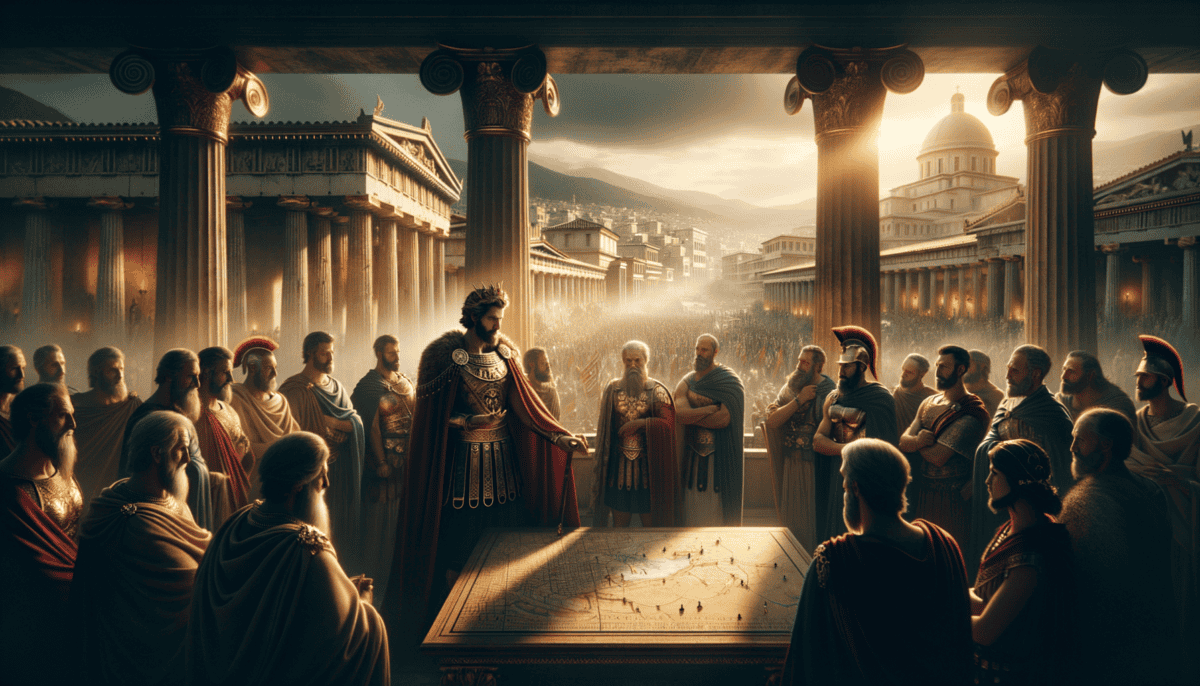
Later that day, Codrus called all his advisors together. They sat around a big table with a map of Athens spread out.
“The Spartans are here,” said one advisor, pointing to the map. “They have many soldiers.”
“And strong weapons,” said another. “How can we stop them?”
Codrus looked at the map. He knew the Spartans were strong. But he also knew about the Oracle’s words. Only his death could save Athens.
That night, Codrus worked on his disguise. He put on the old farmer’s clothes. He rubbed dirt on his face. He even changed the way he walked.
“Now no one will know I’m the king,” he said to himself.
He wrote a special message for the people of Athens:
“Dear People of Athens,
Be brave. Be kind. Take care of each other.
Your King, Codrus”
The next morning, before the sun came up, Codrus looked at his royal crown one last time. He touched it gently, then walked away. He picked up a simple wooden stick – his only weapon.
The guards at the city gate didn’t recognize their king as he walked past them. They thought he was just another farmer heading to the fields.
“Good morning, friend,” they said. “Be careful out there. The Spartans are close.”
Codrus nodded. “I will be,” he said. But in his heart, he knew he wouldn’t be coming back.
As he walked toward the Spartan camp, Codrus thought about Athens. He thought about its beautiful buildings, its happy children, and its free people. He knew his sacrifice would keep them safe.
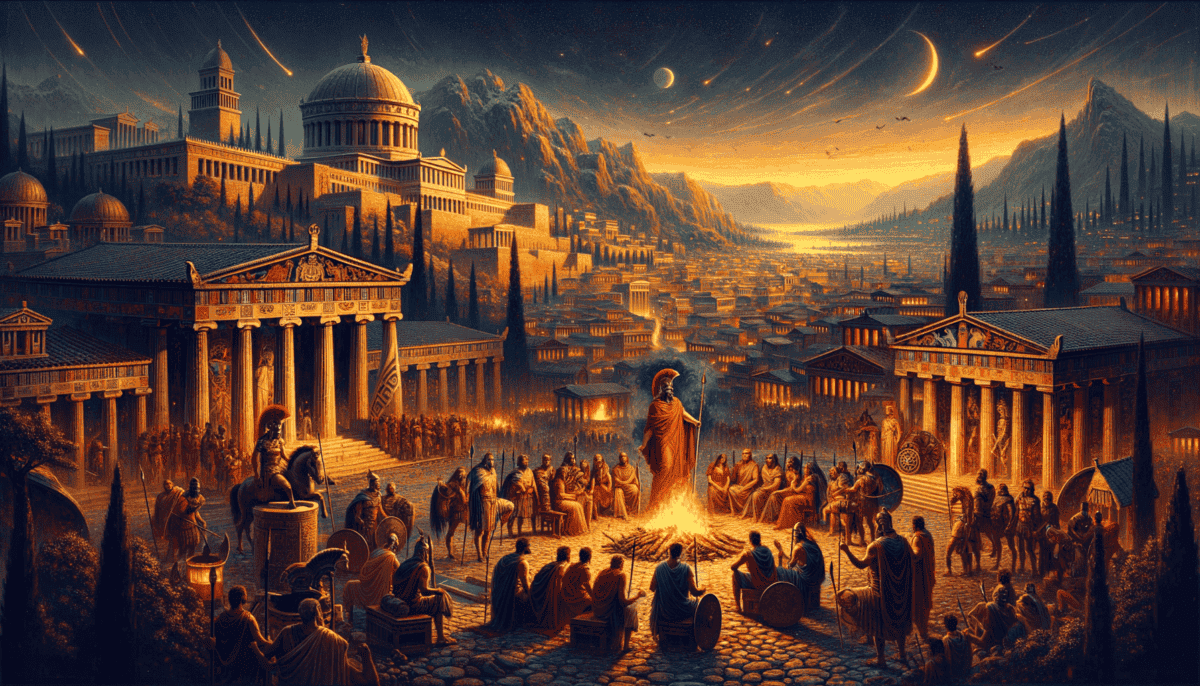
The sun was rising now, painting the sky pink and orange. In the distance, Codrus could see the smoke from the Spartan camp fires. It was time to be brave. It was time to save Athens.
The Brave Disguise
The morning sun found Codrus walking toward the Spartan camp. His feet hurt in the rough farmer’s sandals. But he kept going.
Two Spartan guards stood at their camp entrance. They looked mean and strong. But Codrus wasn’t scared.
“Who goes there?” one guard shouted.
“Just a poor farmer,” Codrus said in a different voice. “Looking to sell some wood.” He held up his wooden stick.
The guards looked at each other. They didn’t know they were talking to the King of Athens!
“Come closer,” said the second guard.
Codrus walked closer. His heart was beating fast, but his face stayed calm. He remembered what was at stake.
“For Athens,” he whispered to himself. “For my people.”
Inside the camp, Codrus saw many Spartan soldiers. They were getting ready for battle. Some were sharpening swords. Others were eating breakfast. ️
“Hey, farmer!” called a soldier. “What news from Athens?”
Codrus smiled. This was his chance to be brave and clever.
“Oh, everyone in Athens is scared,” he lied. “They say their king is hiding in the palace!”
The Spartan soldiers laughed. They didn’t know the truth. They didn’t know the king was right there with them!
As the day went on, Codrus walked through the camp. He listened to the Spartans’ plans. He watched them prepare their weapons.
Some soldiers were mean to him:
“Get out of the way, dirty farmer!”
“Go back to your fields!”
“What good is your little stick against our swords?”
But Codrus stayed calm. Each insult made him stronger. Each mean word reminded him why he was there.
At lunch time, Codrus sat near a group of soldiers. They were talking about the battle plan.
“Tomorrow,” said one soldier, “we attack Athens from the east gate.”
“And their king won’t even fight!” laughed another. “He’s too scared!”
Codrus gripped his wooden stick tighter. He knew what he had to do next. The Oracle’s words echoed in his mind:
As the sun started to set, Codrus walked to a quiet part of the camp. He could see Athens in the distance. Its white buildings glowed in the evening light.
He thought about his son Medon. He thought about all the people in Athens. He knew they were counting on him, even if they didn’t know it.
“Time to be more than just clever,” he said quietly. “Time to be brave.”
Codrus stood up straight. He fixed his farmer’s clothes. The next part of his plan would be the hardest. But he was ready. For Athens, he was ready for anything.
The Final Battle
The stars were fading when Codrus made his move. He knew what he had to do. The fate of Athens rested on his shoulders.
Still wearing his farmer’s clothes, Codrus walked to where the Spartan soldiers kept their wood. He picked up his stick and started working.
“What are you doing, farmer?” a guard asked.
“Just collecting wood,” Codrus replied. But he had a bigger plan.
He walked over to a group of sleeping soldiers. With his stick, he knocked over their weapons. The loud crash woke them up!
“Hey!” they shouted. “What do you think you’re doing?”
Codrus stood tall. “I’m helping Athens!” he said in a loud voice.
The soldiers jumped up, grabbing their swords. Their faces turned red with anger.
“You’re a spy!” they yelled. “Get him!”
Codrus didn’t run away. Instead, he swung his stick at more weapons, making the soldiers even angrier.
“Come and fight me!” he shouted. “I’m not afraid!”
More soldiers woke up. They grabbed their swords and ran toward him. The camp was now full of angry shouts.
Codrus thought about his city one last time:
“Beautiful Athens, with your tall temples”
“Brave people who trust their king”
“My son Medon, who will lead after me”
“This is for all of you”
The soldiers surrounded him. Their swords flashed in the early morning light. ⚔️
“Any last words, spy?” one soldier growled.
Codrus stood straight and proud. He threw off his farmer’s hat. “I am Codrus, King of Athens!” he declared.
The soldiers were shocked. They couldn’t believe the farmer was really the king!
But it was too late. In their anger, they had already attacked. Codrus fought bravely with his wooden stick, but he knew this was his final battle.
As the sun rose over the hills, Codrus fell. But on his face was a smile. He knew Athens would be safe now. The Oracle’s words had come true.
The Spartan soldiers stood silent. They had just killed a king. And not just any king – a king who gave his life to save his city.
In the distance, trumpets started to sound. The Athenian army was coming. The real battle was about to begin.
But Codrus had already won the most important fight of all. His sacrifice would change everything.
The Price of Victory
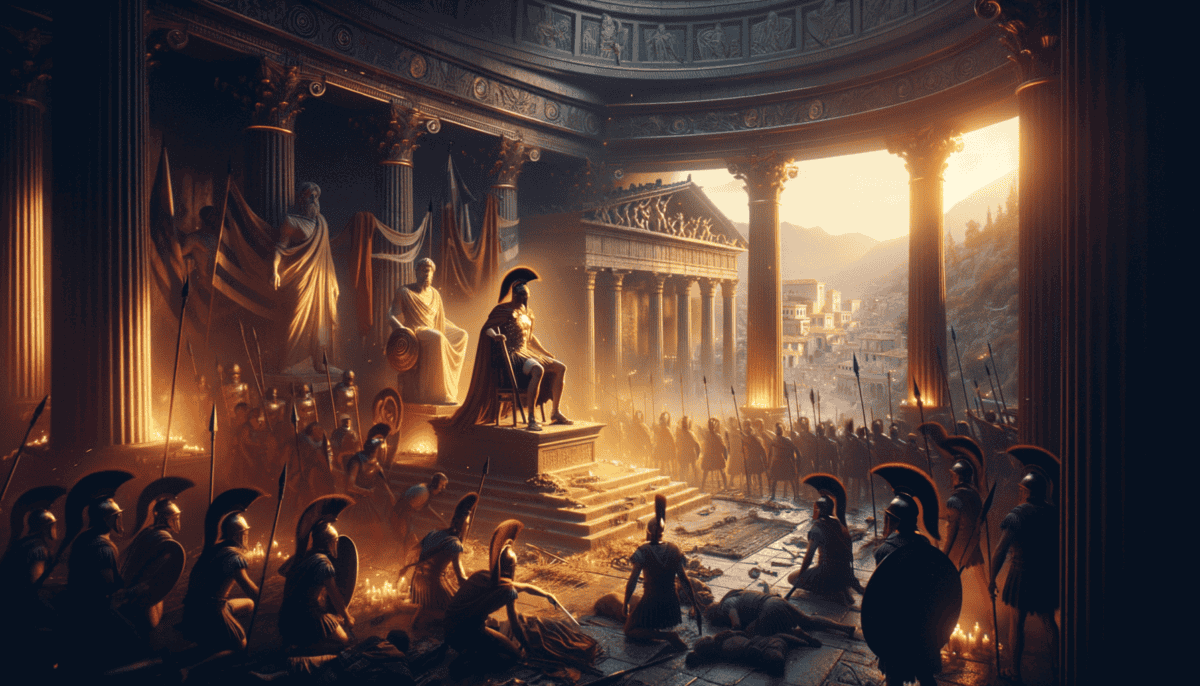
The morning sun painted the sky red. The Spartan soldiers stood frozen. At their feet lay King Codrus, still wearing his farmer’s clothes.
“What have we done?” whispered a young Spartan soldier. His hands shook as he dropped his sword.
The camp burst into action. Soldiers ran everywhere, shouting:
“We killed their king!”
“The prophecy! Remember the prophecy!”
“The gods are against us now!”
Back in Athens, the news spread fast. People gathered in the streets. Some cried, but others stood tall and proud.
“Our king gave his life for us,” said an old woman. “He loved Athens that much.”
Little children placed flowers at the city gates. They sang songs about their brave king:
“Codrus the Brave, who wore simple clothes”
“Codrus our King, who saved us all”
“We will remember, we will be strong”
“Athens stands tall, thanks to you”
The Spartan army started packing up their camp. Their leaders knew they couldn’t win now.
“The gods have spoken,” said the Spartan general. “We must leave Athens.”
The Athenian soldiers watched as their enemies marched away. No arrows flew. No swords clashed. The war was over before it really began. ✨
In the city, people began to talk about what would happen next:
“Who will be our new king?” asked a merchant.
“Codrus’s son Medon?” suggested another.
But an old wise man stepped forward. “Perhaps,” he said, “we need something different now.”
The people gathered closer to listen. The old man continued:
The crowd nodded. They understood that Codrus’s sacrifice meant more than just saving the city. It was the beginning of something new.
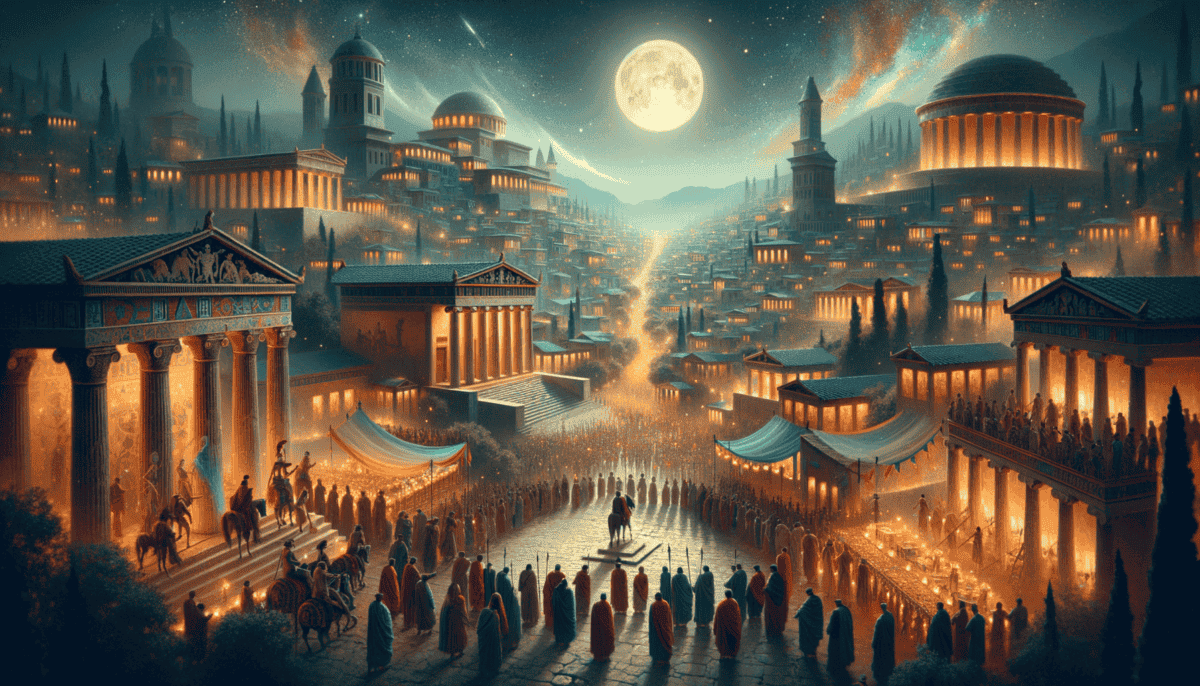
As the sun set, the Athenians carried Codrus’s body back to the city. They didn’t walk in sadness, but with pride. Their king had shown them what it meant to love Athens more than life itself.
In the temple, priests lit sacred fires. The flames danced high into the night sky.
“Remember this day,” they said. “Remember how one brave king changed everything.”
The story of Codrus would be told for many years to come. It would teach people about bravery, sacrifice, and loving something more than yourself.
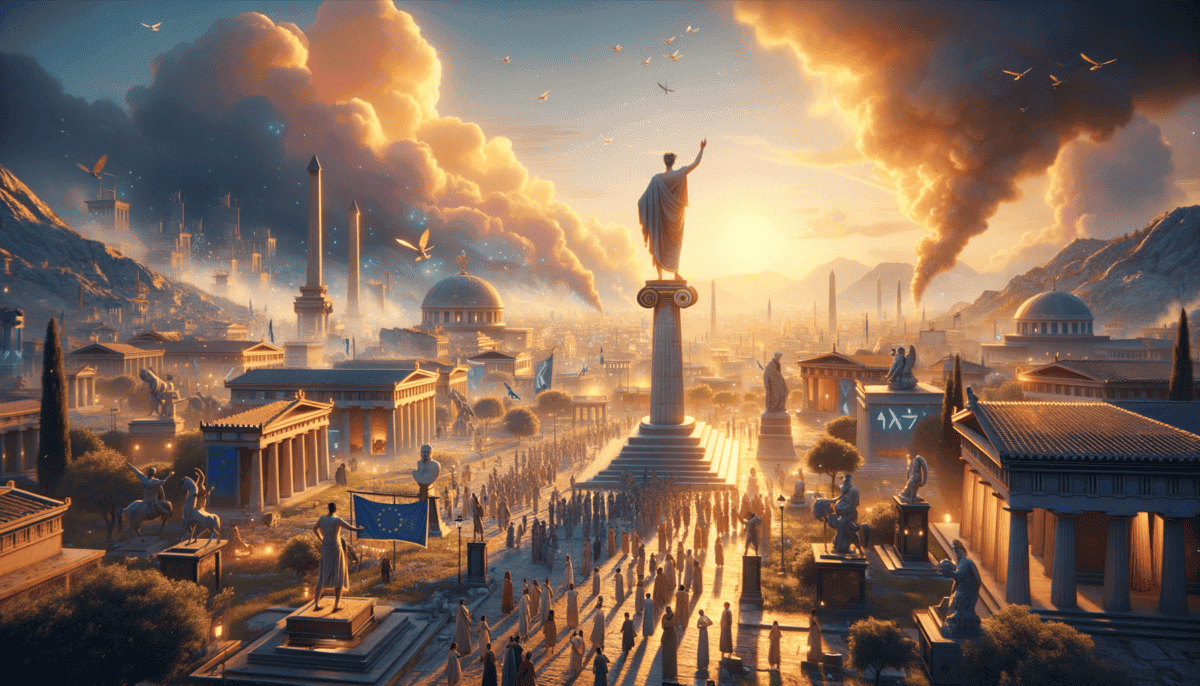
Athens was safe. And thanks to their brave king, the city would grow into something new and wonderful – a place where people would help decide their own future.
A New Dawn for Athens
The sun rose over Athens. It was the first morning without King Codrus. But the city felt different – stronger, braver, more united.
People gathered in the main square. A young girl pointed to the sky and said:
“Look! Even the birds are singing happier songs today!”
The city leaders called everyone together. They stood on the steps of the great temple. The oldest leader spoke:
The crowd cheered. Children waved olive branches. Mothers hugged their babies tight.
Medon, Codrus’s son, stepped forward. Everyone got quiet. Would he be angry about not becoming king?
Medon smiled and said:
“My father gave his life so Athens could live. He didn’t do it so I could wear a crown. He did it so ALL of us could have a better city!”
The people clapped and cheered. Some even cried happy tears.
All around the city, workers started building new things:
• A special meeting place where people could talk about city problems
• New schools where children learned about Codrus's bravery
• A beautiful tomb for their last king
• Gardens where people could gather and share ideas
An old teacher gathered children around him. He told them:
Years passed. Athens grew bigger and stronger. People came from far away to see the city where a king gave up his life for his people. ✨
They built a special wall with golden letters. It said:
“Here lived Codrus
The king who loved Athens more than life
His sacrifice made us free
His courage made us strong”
Every year, the people of Athens had a special day to remember Codrus. They wore simple clothes like he did on his last day.
Parents told their children:
And so, Athens became famous not just for its buildings and art, but for something more important – the idea that people should work together to make their city better.
The story of Codrus lived on. It taught people that true leaders think about others first. His sacrifice helped create a new way of living where everyone had a voice.
And even today, thousands of years later, we remember the brave king who loved his city so much, he gave everything to save it. His story reminds us that one person’s courage can change the world forever.