

The Curious Librarian
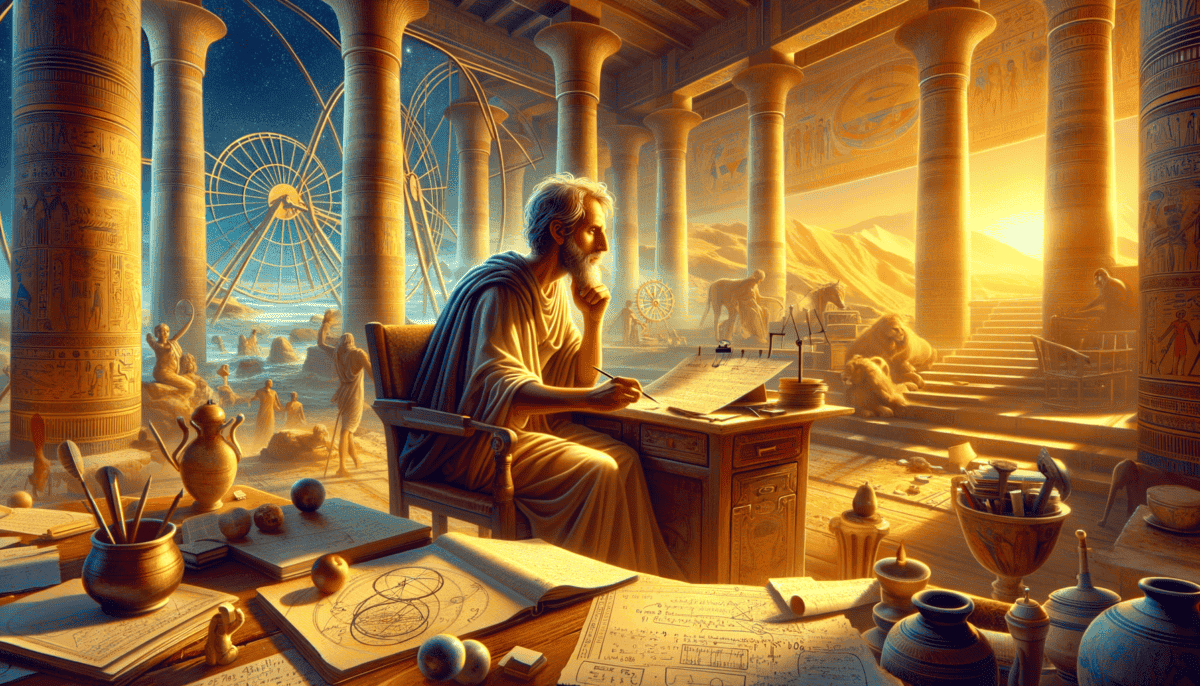
The hot Egyptian sun beat down on Alexandria's marble streets as Eratosthenes hurried up the steps of the Great Library. His sandals made soft padding sounds against the stone. At just 30 years old, he was already in charge of all the scrolls and books in this amazing place.
"Good morning, young scholar!" called out his friend Ptolemy. "What fascinating things will you discover today?"
Eratosthenes smiled and adjusted his white robes. He loved how every day brought new mysteries to solve at the library.
Inside the cool halls, sunlight streamed through high windows onto rows and rows of scrolls. Eratosthenes breathed in the familiar smell of papyrus and ink. He started organizing the new scrolls that had arrived by boat.
"Sir! Sir!" A young messenger boy came running in, waving a scroll. "News from the city of Syene!"
Eratosthenes took the scroll and carefully unrolled it. His eyes grew wide as he read about something very strange that happened in Syene:
“On the summer’s longest day, the sun shines straight down a deep well at noon. The well’s water reflects the sun perfectly, with no shadows at all!”
"How curious," Eratosthenes muttered. "Here in Alexandria, the sun never shines straight down. Things always cast shadows, even at noon."
He walked to the window, deep in thought. Looking at his own shadow on the floor, he wondered: Why would the sun shine differently in two cities?
"Bring me all our scrolls about the sun and shadows," he told his helpers. "And maps too – I need to see where Syene is located."
The helpers scurried off while Eratosthenes pulled out his writing tools. He loved using math to solve puzzles, and this seemed like a wonderful mystery to crack.
On his desk, he sketched:
- The well in Syene with no shadow
- Things in Alexandria casting shadows
- The sun's rays coming down from the sky
"If the sun hits differently in different places," he said to himself, "perhaps the Earth isn't flat like everyone thinks!"
That night, Eratosthenes could hardly sleep. His mind was full of numbers, angles, and ideas about measuring shadows. He knew he was onto something big – a discovery that would change how people saw their world forever.
As the moon rose over Alexandria's lighthouse, the curious librarian made plans to start the biggest experiment of his life. Sometimes the best adventures begin with a simple question about shadows.
The Shadow Mystery
The next morning, Eratosthenes spread a large map across his desk. His finger traced the line between Alexandria and Syene. “Almost 800 kilometers apart,” he whispered. “Yet the sun behaves so differently in each place.” ️
“Master Eratosthenes!” A merchant named Marcus burst into the library. “I heard you’re asking about the well in Syene. I’ve seen it with my own eyes!”
Eratosthenes leaned forward eagerly. “Tell me everything.”
“It happens once a year, during the summer solstice,” Marcus explained. “The sun sits directly overhead at noon. You can look down any well in Syene, and you’ll see the sun’s reflection perfectly centered in the water. No shadows anywhere!”
Eratosthenes grabbed his writing tablet. “And you’re absolutely certain about this?”
“As certain as the stars, sir. I’ve been there three years in a row. The local people even celebrate it!”
Excited, Eratosthenes rushed outside to the library’s courtyard. He planted a tall stick straight up in the ground and marked where its shadow fell.
“Look here,” he said to Marcus. “In Alexandria, even at noon, we always have shadows. Why would the sun hit Syene differently than Alexandria?”
He drew in the sand:
↘️ At an angle in Alexandria
That’s when it hit him – what if the Earth’s surface curved? If it did, that would explain why the sun’s rays hit different cities at different angles!
“Marcus,” Eratosthenes said with growing excitement, “I need you to help me gather more information. Ask every traveler from Syene about this. We need to know exactly when this happens and how the shadows look.”
For the next several days, Eratosthenes worked non-stop. He:
- Drew diagrams of the sun’s rays hitting different parts of Earth
- Studied ancient texts about measuring distances
- Made tools to measure shadow angles accurately
- Talked to travelers about their journeys between the cities
One evening, as he watched the sunset paint Alexandria’s sky orange, Eratosthenes had an amazing thought. “If I can measure the difference in shadow angles,” he said to himself, “and if I know the distance between the cities… I might be able to measure the size of the whole Earth!”
He rushed back to his desk and began designing an experiment. He would need tall measuring sticks called gnomons, helpers to take measurements, and lots of careful calculations.
As night fell over Alexandria, candlelight flickered on Eratosthenes’ busy workspace. His mind raced with possibilities. No one had ever measured the Earth before. But maybe, just maybe, a curious librarian with a love for math could do the impossible.
The shadow mystery was about to lead him on the greatest adventure of his life.
Measuring the Impossible
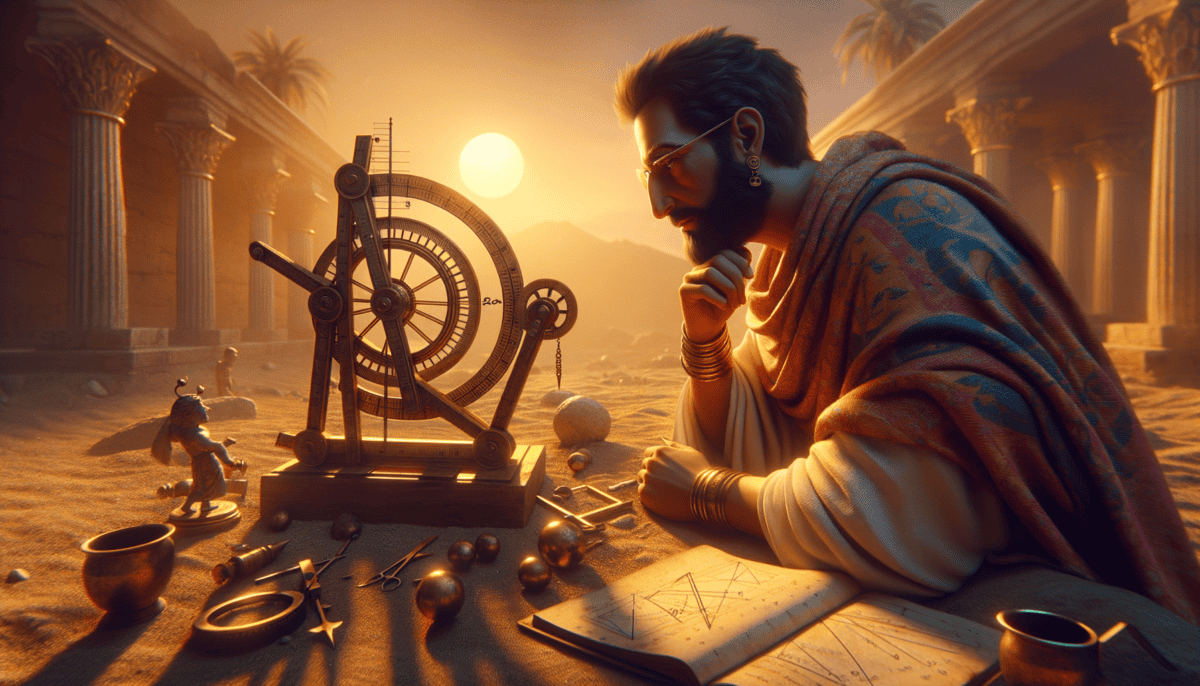
The early morning sun cast long shadows across Alexandria’s marble steps as Eratosthenes carefully positioned his measuring stick. It was a tall, straight pole called a gnomon, and it would help him solve one of the biggest mysteries ever!
“The stick must be perfectly straight,” he told his young assistant, Theo. “Even a tiny tilt could ruin our measurements.”
Theo squinted up at the stick. “But Master Eratosthenes, how will this help us measure the whole Earth?”
“Watch closely,” Eratosthenes said with a smile. He drew a circle in the sand:
“If the Earth is round like a ball, the sun’s rays hit different places at different angles. That’s why Syene has no shadows when we still do!”
As the sun climbed higher, they measured the shadow every hour. Eratosthenes made careful marks in his notebook:
Noon: Shortest shadow
Evening: Shadow grows long again
“Master!” Theo suddenly shouted. “The shadow is shortest now. It must be noon!”
Eratosthenes rushed to measure the angle between the gnomon and its shadow. His hands trembled with excitement as he used his measuring tools.
“7.2 degrees!” he announced. “That’s the angle difference between Alexandria and Syene!”
But knowing the angle was just the start. Eratosthenes needed to know exactly how far it was between the two cities. He called in his friend Marcus, the merchant who traveled that route often.
“How long does it take to go from here to Syene?” Eratosthenes asked.
“With my camel caravan, it’s about 50 days,” Marcus replied. “We travel roughly 100 stadia each day.”
Eratosthenes’ eyes lit up. “So that’s 5,000 stadia total!” He grabbed his writing tablet and started calculating.
But there were problems to solve. Sometimes camel caravans had to go around things like:
- Winding river bends
- Hills and rocky areas
- Desert storms that pushed them off course
- Places where they needed to rest
Eratosthenes knew he needed to think carefully about these things to get the right answer. He spent days working with maps, talking to travelers, and checking his math over and over.
“Theo,” he said one evening, “I think we’re ready for the big calculation. If we know the angle of the shadows and the distance between cities, we can figure out how big the whole circle of Earth must be!”
As the sun set over Alexandria’s famous lighthouse, Eratosthenes lit a candle and began the most important math problem of his life. The numbers were big, but his heart was full of hope. He was getting closer to measuring something everyone thought was impossible to measure – the size of our whole world!
The Geometric Solution
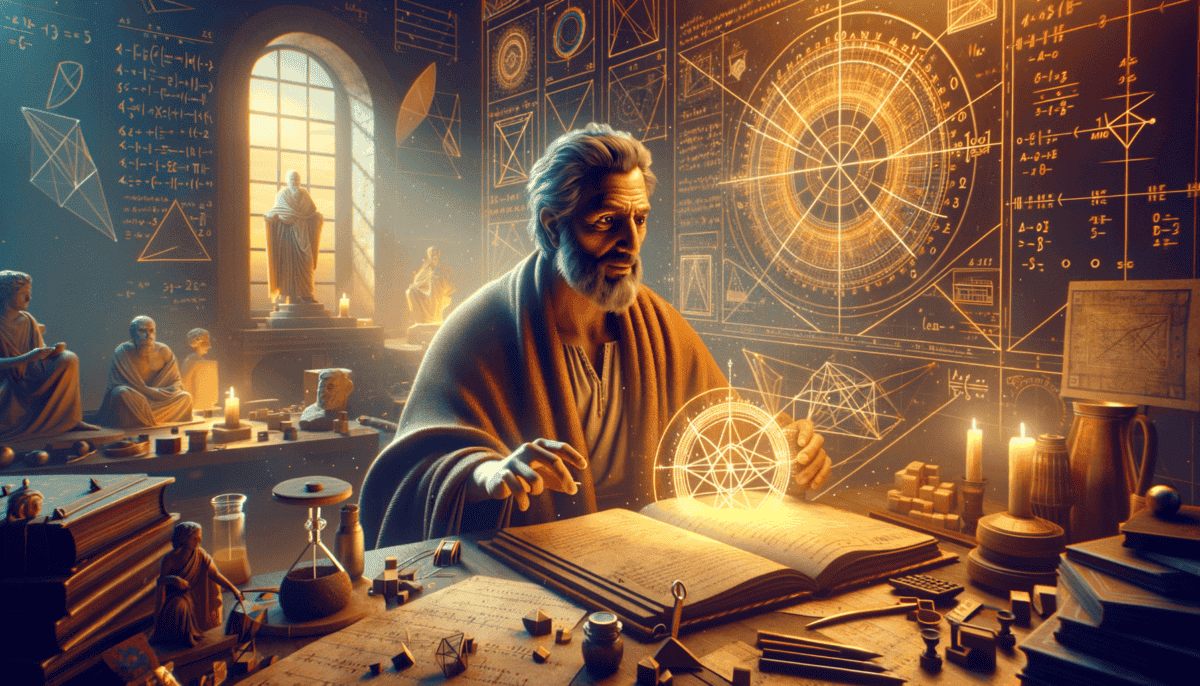
Eratosthenes sat at his desk in the Great Library, surrounded by scrolls and mathematical tools. The candlelight flickered as he drew a big circle on his papyrus.
“Look here, Theo,” he said excitedly. “If we draw a line from Alexandria to Syene, it makes a slice of the Earth – like cutting a piece of cake!”
Theo leaned in closer. “But how does that help us, Master?”
“Well,” Eratosthenes explained, drawing with his finger, “remember our shadow angle was 7.2 degrees? That’s like our slice of cake. If we know how big our slice is, we can figure out the whole circle!”
He picked up his abacus and began moving the beads carefully. “If 7.2 degrees equals 5,000 stadia, then the whole circle must be…”
“50 times bigger!” Theo shouted, his eyes wide with understanding.
“Exactly!” Eratosthenes beamed. “And 50 times 5,000 stadia equals…”
That’s how big around the Earth must be!
But Eratosthenes was a careful scientist. He knew he had to check for mistakes. Here’s what might have gone wrong:
- The roads between cities weren’t perfectly straight
- Shadow measurements might not be exact
- Distance reports could be off a little
- The Earth might not be a perfect sphere
“Master,” Theo asked, “what if we’re wrong?”
Eratosthenes smiled kindly. “Being wrong is part of science, Theo. We must always be ready to learn and correct our mistakes. But look at how our numbers match with what travelers tell us about distant lands!”
He pulled out a map showing trade routes to India. The distances sailors reported matched his calculations almost perfectly!
As word spread through Alexandria about his discovery, other scholars came to learn about his method. Some brought their own measurements from different cities to help check the calculations.
“See?” Eratosthenes told his visitors, “Anyone can do this! All you need is:
☀️ A sunny day
✏️ Good math skills
️ Knowledge of distances
One evening, as they watched the sun set from the library steps, Theo asked, “What will you measure next, Master?”
Eratosthenes gazed at the horizon, where Earth’s curve made the sun look like it was sinking into the sea. “The world is full of mysteries, Theo. And now we know something amazing – we can solve them with shadows and math!”
Challenging the Known World
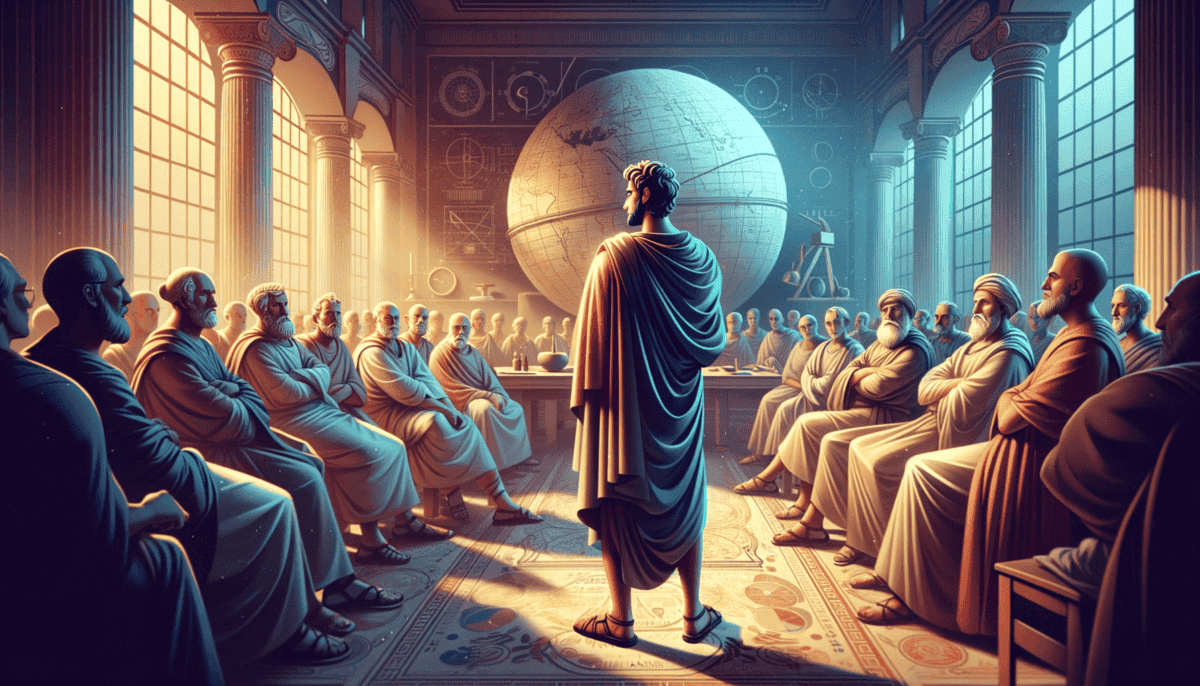
The morning sun streamed through the library windows as Eratosthenes prepared to share his discovery. Scholars from across Alexandria had gathered to hear about his method for measuring Earth.
“This is a big day,” whispered Theo, helping arrange the demonstration tools.
Eratosthenes nodded, his hands slightly shaky as he unrolled his papyrus diagrams. “Truth can be hard for people to accept, especially when it changes how they see the world.”
“Honorable scholars,” he began, “I have found a way to measure our Earth using nothing but shadows and math.”
The room buzzed with whispers. An older scholar named Marcus stood up, frowning. “Impossible! The Earth is too vast to measure!”
Eratosthenes smiled kindly. “Let me show you how simple it can be.” He set up a small stick and pointed to its shadow.
“Watch this shadow carefully. It tells us secrets about our world that we never knew before.”
He explained his discovery step by step:
2. Alexandria has a shadow at the same time
3. This difference shows Earth is curved
4. We can use this to calculate Earth’s size
Some scholars nodded with excitement, but others looked doubtful. “Show us your proof!” someone called out.
Eratosthenes turned to Theo. “Bring the model, please.”
Theo carefully carried over a clay sphere with tiny sticks poking out of it. When Eratosthenes held a lamp near it, the sticks cast different shadow lengths – just like in real life!
“But what about errors?” asked a young scholar named Helena. “How can you be sure?”
“An excellent question!” Eratosthenes beamed. “I’ve checked my work many ways:”
- Compared notes with travelers from distant lands
- Measured shadows in different seasons
- Double-checked all calculations
- Asked other cities to repeat the experiment
As the demonstration continued, more scholars began to nod. Even Marcus looked impressed.
“Master,” Theo whispered, “they’re starting to believe!”
Eratosthenes smiled. “It’s not about believing me, Theo. It’s about believing in what they can see and measure for themselves.”
Special Message: Good science shows its work and welcomes questions!
After the presentation, scholars crowded around to learn more. Some even wanted to try measuring shadows in their own cities!
“Today is just the beginning,” Eratosthenes told Theo as they packed up their tools. “Now that people know Earth can be measured, imagine what else they might discover!”
That evening, watching the curved horizon from the library steps, Theo saw the world differently. Thanks to shadows and clever thinking, they now knew just how big their home really was. And it was even more amazing than anyone had imagined!
Legacy of Discovery
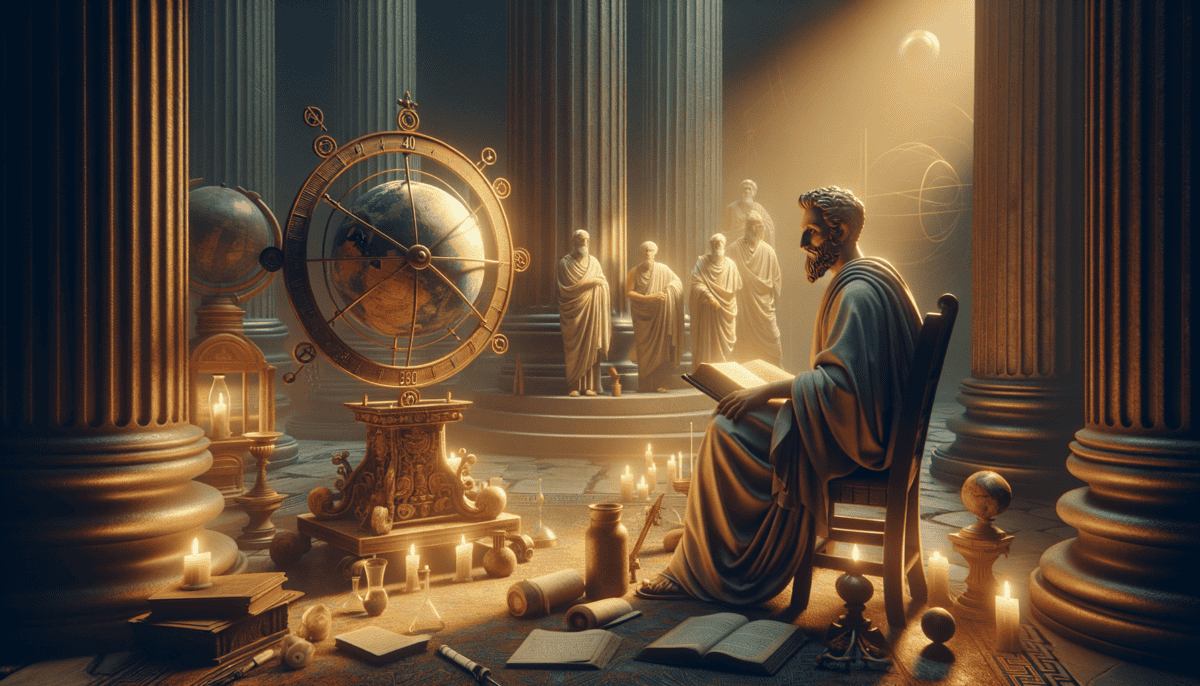
The sun was setting over Alexandria as Eratosthenes sat in his favorite library corner, carefully writing the final numbers of his Earth measurement.
“Two hundred and fifty-two thousand stadia,” he whispered, double-checking his calculations one last time.
Theo burst into the room, eyes shining with excitement. “Master! Travelers from India just arrived. They tried your shadow measurement there, and it worked perfectly!”
Eratosthenes smiled warmly. “That’s wonderful news! Our simple method is spreading across the world.”
“It’s amazing how far a curious mind and careful thinking can take us.”
News of the Earth measurement had spread like wildfire. Ships carried the method to distant ports, and caravans shared it across desert routes. Everyone wanted to try measuring shadows in their hometown!
– Better maps for sailors
– More accurate sundials
– New ways to measure distance
– Understanding of seasons
“But Master,” Theo asked, watching the stars appear, “what’s next? What else can we learn?”
Eratosthenes gestured to the evening sky. “Look up there, Theo. Each of those stars has secrets waiting to be discovered. All we need is curiosity and careful thinking.” ⭐
Big Idea: One discovery leads to many more!
Years later, an older Theo stood before his own students, holding a stick and pointing to its shadow. “Let me tell you about my teacher, Eratosthenes, and how he measured the Earth with nothing but shadows and smart thinking.”
The students leaned forward eagerly. “Did people believe him right away?” asked a small girl.
Theo smiled, remembering those exciting days. “Not everyone did at first. But that’s the beautiful thing about good science – you can show it’s true!”
“The best discoveries don’t need fancy tools. They need curious minds and careful observation.”
Even today, thousands of years later, students still learn about Eratosthenes’ clever method. His story shows us that big discoveries can come from simple things – like wondering about shadows in a well.
The library in Alexandria might be gone now, but Eratosthenes’ ideas live on. Every time someone looks at a globe or measures shadows at noon, they’re following in his footsteps.
And somewhere, right now, a child might be looking at their shadow and wondering, just like Eratosthenes did so long ago. What will they discover?
As night fell over Alexandria that last evening, Eratosthenes watched the stars reflect in the harbor water. He knew his work would help future explorers understand their world better. But even he couldn’t have guessed how far his simple shadow measurement would reach – across time itself, inspiring curious minds for generations to come. ✨