

A Little Girl Who Loved to Count
Little Katherine Coleman woke up early every morning in White Sulphur Springs, West Virginia. The sun was just peeking through her window, and she was already counting. She counted the birds outside. She counted the steps to the kitchen. She even counted the pieces of toast at breakfast!
"Mama," Katherine said one morning, "I counted all the stars I could see last night. There were 27!"
Her mother smiled. "You have such a special gift for numbers, Katherine."
Katherine lived with her family in a small house surrounded by tall mountains. It was 1924, and she was just six years old. But she wasn't like other kids her age. While they played with toys, Katherine played with numbers.
A Family That Believed in Dreams
"Papa, why do leaves fall in patterns?" Katherine would ask, watching the autumn leaves dance in the wind.
Her father, Joshua Coleman, was a farmer who knew the value of education. He would say, "Everything in nature follows rules, just like your numbers do."
Katherine's parents noticed how quickly she learned. She could solve big math problems in her head faster than most grown-ups could with paper and pencil!
Breaking Through Barriers
But life wasn't easy for a young African American girl in West Virginia during those times. Many schools wouldn't let Black children attend. Katherine's father wouldn't accept that.
"My children deserve an education," he would say firmly.
So the Coleman family moved 120 miles away to Institute, West Virginia, where Katherine could go to a good school. They did this every school year!
"Why do we have to move so far?" Katherine asked one day.
Her mother hugged her tight and said, "Because your mind is a gift, and we're going to help it grow."
The Girl Who Couldn’t Stop Learning
In school, Katherine's teachers were amazed. She asked questions about everything:
- Why is the sky blue?
- How do airplanes stay up?
- What makes numbers work the way they do?
"Miss Coleman," her math teacher said one day, "you have a special way of seeing patterns that others don't see."
Katherine beamed with pride. She didn't just want to learn math – she wanted to understand how the whole world worked through numbers.
Dreams Beyond the Stars
At night, Katherine would look up at the stars through her window. She imagined all the patterns and numbers hiding in the sky. Even then, she didn't know that one day she would help send people to those very stars.
"What do you want to be when you grow up?" her teacher asked the class one day.
While other students mentioned common jobs, Katherine stood up straight and said, "I want to learn everything I can about numbers. I want to solve problems that nobody has solved before."
Some kids giggled, but Katherine didn't mind. She knew in her heart that numbers would take her somewhere special.
Each evening, Katherine's family would gather around their dinner table. Her father would quiz her with math problems, and her mother would share stories about strong women who changed the world. They didn't know it then, but they were preparing Katherine for an amazing future.
As she fell asleep each night, Katherine would count the stars and dream of all the mysteries they held. She didn't know that someday, her love for numbers would help unlock those very mysteries and change the course of history.

Dreams Take Flight
The year was 1937, and Katherine Coleman’s heart raced as she walked onto the campus of West Virginia State College. At just 18 years old, she had already conquered high school. Now, bigger dreams waited ahead.
A Special Teacher
“Welcome to Advanced Mathematics,” Dr. William W. Schieffelin Claytor smiled at his class. He was one of the few African American math professors in the country.
Katherine sat in the front row, her notebook ready. Dr. Claytor noticed her enthusiasm right away.
“Miss Coleman,” he said one day, “you should be a research mathematician.”
“But… can a woman do that?” Katherine asked.
“You can be anything you want to be,” he replied firmly. “Your mind is too bright to waste.”
Breaking New Ground
College wasn’t easy. Katherine had to work extra hard because many people didn’t think women, especially African American women, should study math. But she loved every minute of it.
She solved problems that made other students’ heads spin:
- Complex geometry equations
- Tricky algebra problems
- Advanced calculations that even teachers found challenging
The First Big Step
After college, Katherine became a teacher. She loved helping young minds grow, but she dreamed of doing more with her math skills.
Then one day, her family heard exciting news. The National Advisory Committee for Aeronautics (which would later become NASA) was hiring women computers!
“What’s a computer?” Katherine’s daughter asked.
“Back then,” Katherine explained, “computers weren’t machines. They were people who solved math problems by hand!”
A New Beginning
Katherine walked into Langley for her first day of work. The building was huge, with long hallways and many doors. She found herself in the “West Area Computing” section, where African American women worked separately from others.
“Your desk is here,” said Dorothy Vaughan, her supervisor. “We calculate flight paths for airplanes.”
Katherine’s eyes lit up. Finally, she could use her math skills to solve real-world problems!
Rising Above
“These calculations must be perfect,” Dorothy explained. “Pilots’ lives depend on our math.”
Katherine nodded seriously. She checked each number three times to make sure everything was right. Her work was so good that engineers started asking specifically for her help.
“Katherine,” they’d say, “can you check these numbers? We need your eyes on this.”
She worked harder than ever before. Even during lunch breaks, she’d ask questions about airplanes and flight paths:
“How do you calculate wind resistance?”
“What makes a plane turn smoothly?”
“How do you know where it will land?”
The Door Opens
One day, a man from the Flight Research Division came to their office. “We need someone who’s excellent at geometry,” he announced.
Dorothy didn’t hesitate. “Katherine is your girl.”
And just like that, Katherine stepped through a door that would lead her to the stars. She didn’t know it yet, but she was about to become part of something bigger than she had ever dreamed.
As she walked to her new assignment, Katherine held her head high. Her love for numbers had opened a new door, and she was ready to show the world what she could do.
Stars Within Reach
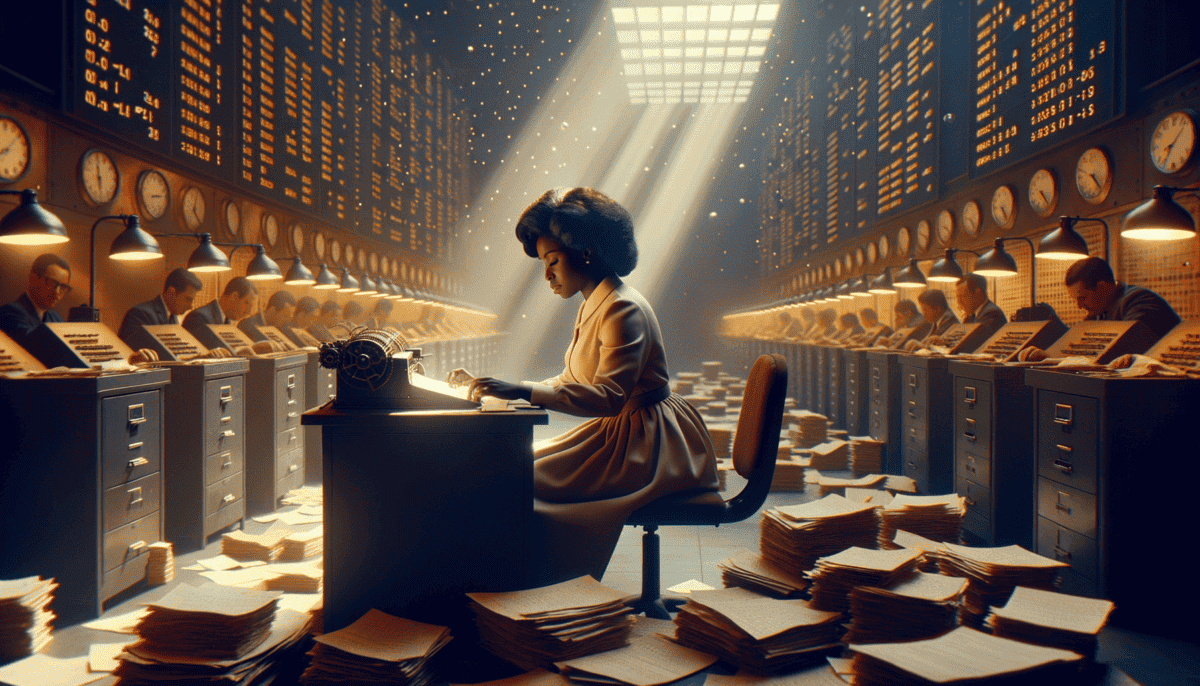
Katherine’s desk at NASA was stacked high with papers full of numbers. But these weren’t just any numbers – they were special calculations that would help send people to space!
A New Challenge
“We need to figure out how to get a spaceship into the sky,” said Bob, one of the engineers. “Can you help us, Katherine?”
Katherine smiled and picked up her pencil. This was exactly the kind of puzzle she loved to solve.
Breaking Down Barriers
At first, Katherine had to work in a separate building from her white coworkers. She had to use different bathrooms and eat at different tables.
“Where are you going?” someone asked as Katherine walked to the far building.
“To use the colored bathroom,” she replied.
“That’s nonsense,” Katherine said to herself. “The numbers don’t care what color I am!”
Soon, Katherine’s work was so important that people forgot about the color of her skin. They just wanted her amazing math skills!
Making Space History
One morning, Katherine arrived at work to find everyone excited.
“We’re going to send the first American into space!” announced the head engineer. “Katherine, we need your calculations to make sure the spaceship goes up and comes back safely.”
Double-Checking Everything
Katherine worked day and night on her calculations. She checked each number three times:
- How fast should the rocket go?
- What path should it take?
- Where exactly would it land?
“These numbers must be perfect,” she told herself. “A person’s life depends on them.”
Trust in Numbers
As the day of the space flight got closer, something amazing happened. The astronaut, Alan Shepard, asked specifically for Katherine.
“Get the girl to check the numbers,” he said. “If she says they’re good, I’m ready to go.”
Katherine felt proud. Her careful work had earned everyone’s trust.
The Big Day
On May 5, 1961, Katherine stood with her colleagues watching the rocket launch. Her heart beat fast as the countdown began:
“10… 9… 8… 7… 6… 5… 4… 3… 2… 1… LIFTOFF!”
The rocket roared into the sky, following the exact path Katherine had calculated. Minutes later, Alan Shepard became the first American in space!
When the capsule splashed down in the ocean right where Katherine said it would, everyone cheered. Her calculations had helped make history!
A New Beginning
That successful mission was just the start. NASA now trusted Katherine with more important work. They knew that when it came to space math, nobody was better than Katherine Johnson.
As she walked home that evening, Katherine looked up at the stars. Thanks to her numbers, people could now reach closer to those twinkling lights than ever before. And this was just the beginning of her amazing space journey.
Reaching New Heights
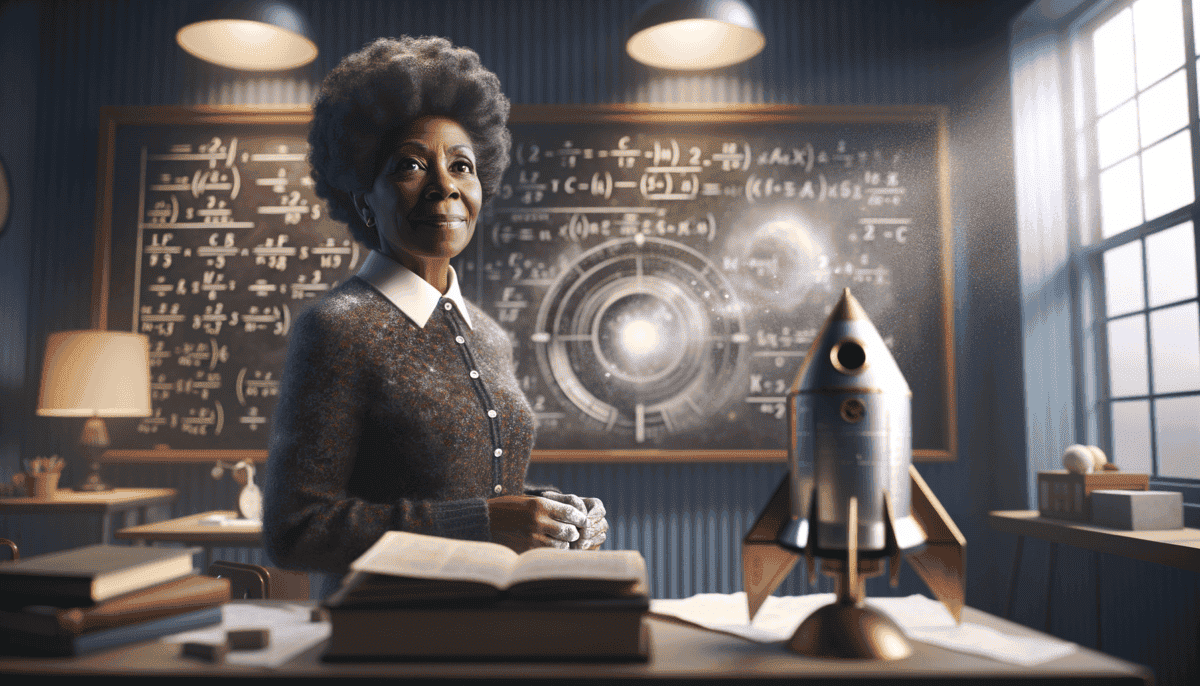
The success of Alan Shepard’s flight made Katherine a star at NASA! More astronauts wanted her help to check their flight paths.
A Special Request
One morning, Katherine’s phone rang. It was John Glenn, another astronaut.
“I hear you’re the best with numbers,” he said. “I want you to check my flight path. I don’t trust the new computers.”
Race Against Time
Katherine worked faster than ever. Her pencil flew across the paper as she did the math. She had to check thousands of numbers!
“Are you sure you can do this in time?” her boss asked.
“Just watch me,” Katherine smiled. She knew every number had to be perfect.
Teamwork Makes Dreams Work
Other mathematicians joined to help Katherine. They weren’t separated by color anymore – everyone worked together in the same room.
“Pass me that ruler,” Katherine would say.
“Here you go!” her coworkers would reply. “Need any help with those calculations?”
The Big Check
NASA’s new computers gave different numbers than Katherine’s calculations. Everyone watched as she double-checked her work:
- She checked the takeoff speed
- She checked the landing spot
- She checked every turn in the flight path
“My numbers are right,” Katherine said confidently. “I’ve checked them three times!”
Trust in Katherine
John Glenn stood up at a meeting. “If Katherine says the numbers are good, I’m ready to fly!”
Everyone clapped. They knew Katherine’s calculations were special.
Making History Again
On launch day, Katherine stood watching as John Glenn’s rocket lifted off. Her heart raced as it soared into the sky.
The mission was perfect! John Glenn orbited Earth three times and landed exactly where Katherine said he would.
A New NASA
After this success, things changed at NASA. Katherine got her own office. People came to her for help with all the important space missions.
“Your calculations are saving lives,” her boss told her. “You’re making space travel safer for everyone.”
Looking Forward
Katherine looked out her office window at the sky. Soon, NASA would try something even bigger – sending people to the moon!
She picked up her pencil and smiled. There were new numbers to calculate and more space missions to plan. The stars were waiting, and Katherine Johnson was ready to help reach them.

Race to the Moon
The year was 1969. NASA had a big dream – to land people on the moon! And they needed Katherine’s special math skills more than ever.
A Huge Challenge
“Katherine, this is our biggest mission yet,” her boss said. “We need to calculate how to get three astronauts to the moon and back safely.”
Katherine’s eyes sparkled. “Now that’s an exciting problem to solve!”
Planning the Path
Katherine started working on the Apollo 11 mission. She needed to figure out:
- How fast the rocket should go
- When to turn the spaceship
- Where to land on the moon
- How to get back home safely
Working Day and Night
“These calculations have to be perfect,” Katherine told her team. “The astronauts’ lives depend on our math.”
She worked long hours, checking and double-checking every number. Sometimes she even dreamed about numbers!
Meeting the Astronauts
Neil Armstrong, Buzz Aldrin, and Michael Collins came to meet Katherine.
“We trust you, Katherine,” Neil said. “Your numbers will help us make history.”
Katherine smiled. “I’ll make sure you get there and back safely.”
Launch Day Excitement
On July 16, 1969, Katherine stood watching as the giant Saturn V rocket prepared for launch.
“3… 2… 1… LIFTOFF!”
The ground shook as the rocket roared into the sky. Katherine’s heart soared with it.
The Big Moment
Four days later, Katherine watched on TV as Neil Armstrong stepped onto the moon.
“That’s one small step for man, one giant leap for mankind,” Neil said.
Katherine wiped happy tears from her eyes. Her calculations had helped make this moment possible!
Safe Return
The hardest part was still to come – getting the astronauts back to Earth.
Katherine’s calculations guided the spacecraft perfectly. The astronauts splashed down in the ocean right where she said they would!
A Proud Moment
“You did it, Katherine!” her coworkers cheered.
“We all did it,” Katherine said. “As a team.”
She looked up at the moon that night. It seemed different now, knowing her math had helped humans reach it.
More missions would follow, and Katherine would be ready. Her numbers would keep opening new paths to the stars.

Dreams Take Flight
As the years went by, Katherine’s amazing work at NASA changed how people saw women and African Americans in science.
A Special Honor
In 2015, President Barack Obama gave Katherine a very special award – the Presidential Medal of Freedom!
“This is for all the girls who dream of being scientists,” Katherine said with a bright smile.
Sharing Her Story
People wanted to know more about Katherine’s life. In 2016, they made a movie called “Hidden Figures” about her!
“Now everyone will know about the amazing women who helped America reach space,” Katherine said proudly.
NASA’s Special Gift
In 2017, NASA did something wonderful. They named a new building after Katherine!
“The Katherine G. Johnson Computational Research Facility,” read the big sign.
“I can’t believe it,” Katherine whispered, touching the letters of her name. “A little girl who loved counting stars now has her name on a NASA building!” ⭐
Teaching New Dreamers
Katherine spent her later years visiting schools and talking to children. Here’s what she told them:
- Never stop learning
- Be curious about everything
- Work hard and be kind
- Follow your dreams, no matter what others say
A Beautiful Legacy
Katherine lived to be 101 years old! She saw her work help send people not just to the moon, but to explore more of space.
Still Reaching for the Stars
Today, many young girls and boys look up to Katherine. They want to be just like her – brave, smart, and ready to solve big problems.
NASA still uses many of Katherine’s math ideas to explore space. Her work helps astronauts travel safely through the stars.
The Power of Dreams
Katherine showed us that dreams don’t have limits. Whether you’re a girl or boy, whatever your skin color, you can reach for the stars.
Every time we look up at the moon, we can remember Katherine Johnson – the girl who loved numbers and helped humans touch the stars.
Katherine’s spirit lives on in every calculator tap, in every space launch, and in every child who looks up at the night sky and thinks, “I can do amazing things too.” ✨