
The Day Everything Changed
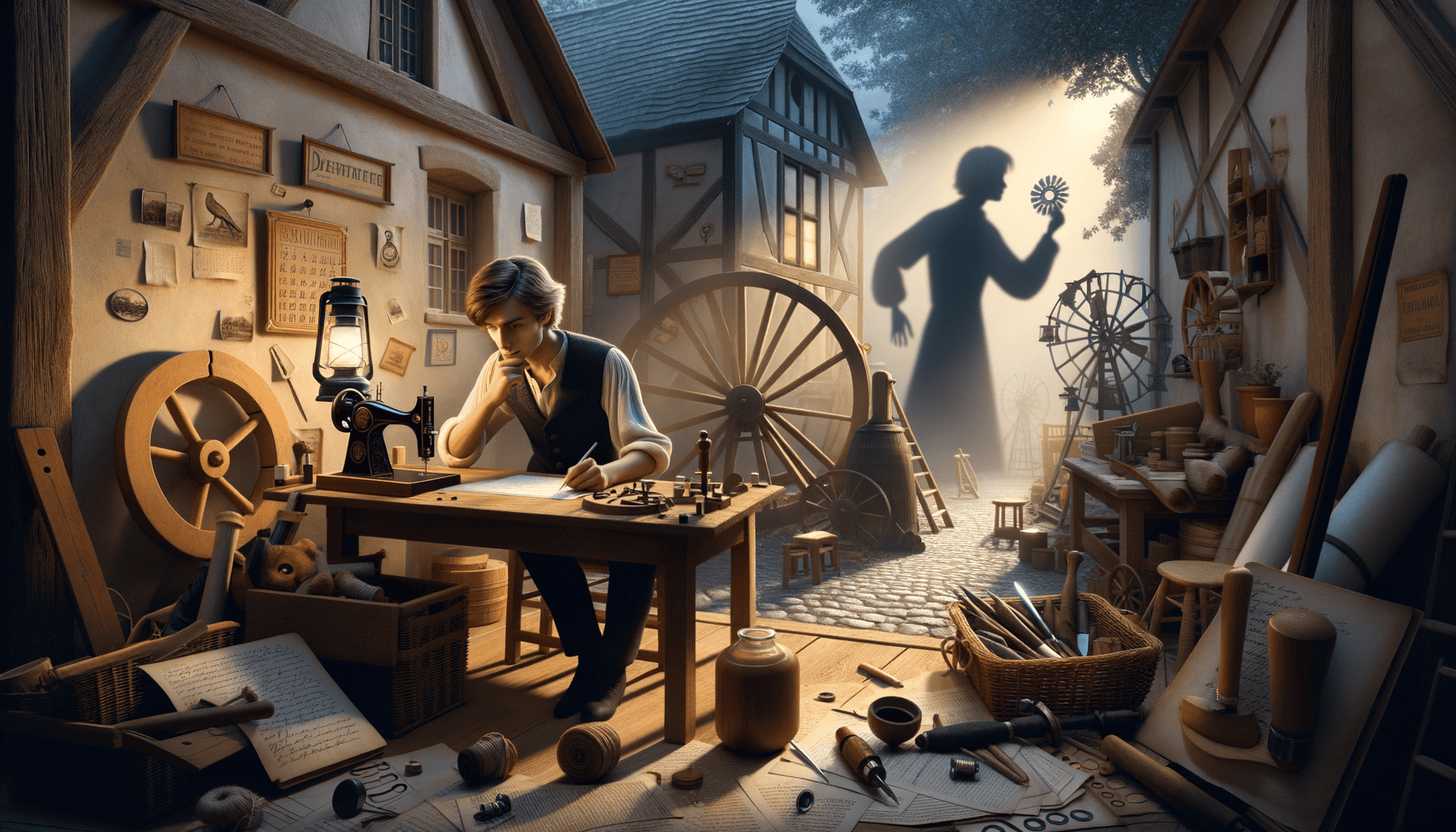
Little Louis ran his fingers along the rough leather in his father's workshop. The smell of fresh saddles and horse reins filled the air. Sunlight streamed through the dusty windows of their small home in Coupvray, France.
"Papa, can I help?" asked three-year-old Louis, his bright eyes sparkling with curiosity.
Simon Braille smiled at his youngest child. "Be careful, mon petit. These tools are very sharp."
The workshop was Louis's favorite place. He loved watching his father make beautiful things from leather. The sounds of hammering and cutting filled their small village home.
One morning, while his father was working, Louis wanted to be just like him. He picked up a sharp awl – a tool used to punch holes in leather. The tool was heavy in his tiny hands.
Suddenly, Louis slipped. The sharp point struck his eye.
"Papa!" he cried out in pain.
Simon rushed to his son. "Mon Dieu! Monique!" he called to his wife. "Come quickly!"
The doctor came, but there was nothing he could do. The injury became infected, and soon Louis couldn't see anything at all. His world became dark before he was even four years old.
A New Way of Living
"Will I ever see again, Maman?" Louis asked one night as his mother tucked him into bed.
Monique hugged her son tightly. "No, my brave boy. But you will learn new ways to understand the world."
And Louis did learn. He used his hands to feel everything around him. His sister Catharine helped him count stairs by touching each one. His brother helped him learn the shapes of trees by feeling their bark.
“I cannot see with my eyes, but I can see with my hands,” Louis would say, making his family smile.
But school was hard. The village teacher didn't know how to help a blind student. Louis was smart and wanted to learn, but how could he read or write?
His father made him a special cane from leather strips. Louis learned to tap it on the ground to find his way around. The whole village watched in amazement as the little blind boy walked confidently through the streets.
A Determined Spirit
Louis refused to let darkness stop him. He learned to:
• Play church organ by feeling the keys
• Make rope with his father
• Find his way around the entire village
• Remember stories others read to him
"This boy is special," the village priest told Simon and Monique. "He needs a proper school."
Louis's parents worried. How would their blind son get an education? But Louis had a spark inside him – a determination that would change the world. He just didn't know it yet.
At night, he would lie in bed, fingers tracing the walls of his room. "There must be a way," he whispered to himself. "There must be a way for blind people to read."
Little did young Louis know that his accident would lead him to create something amazing – something that would help millions of people see with their fingers instead of their eyes.
The darkness around him was just the beginning of a remarkable journey that would bring light to so many others.
A New Adventure Begins
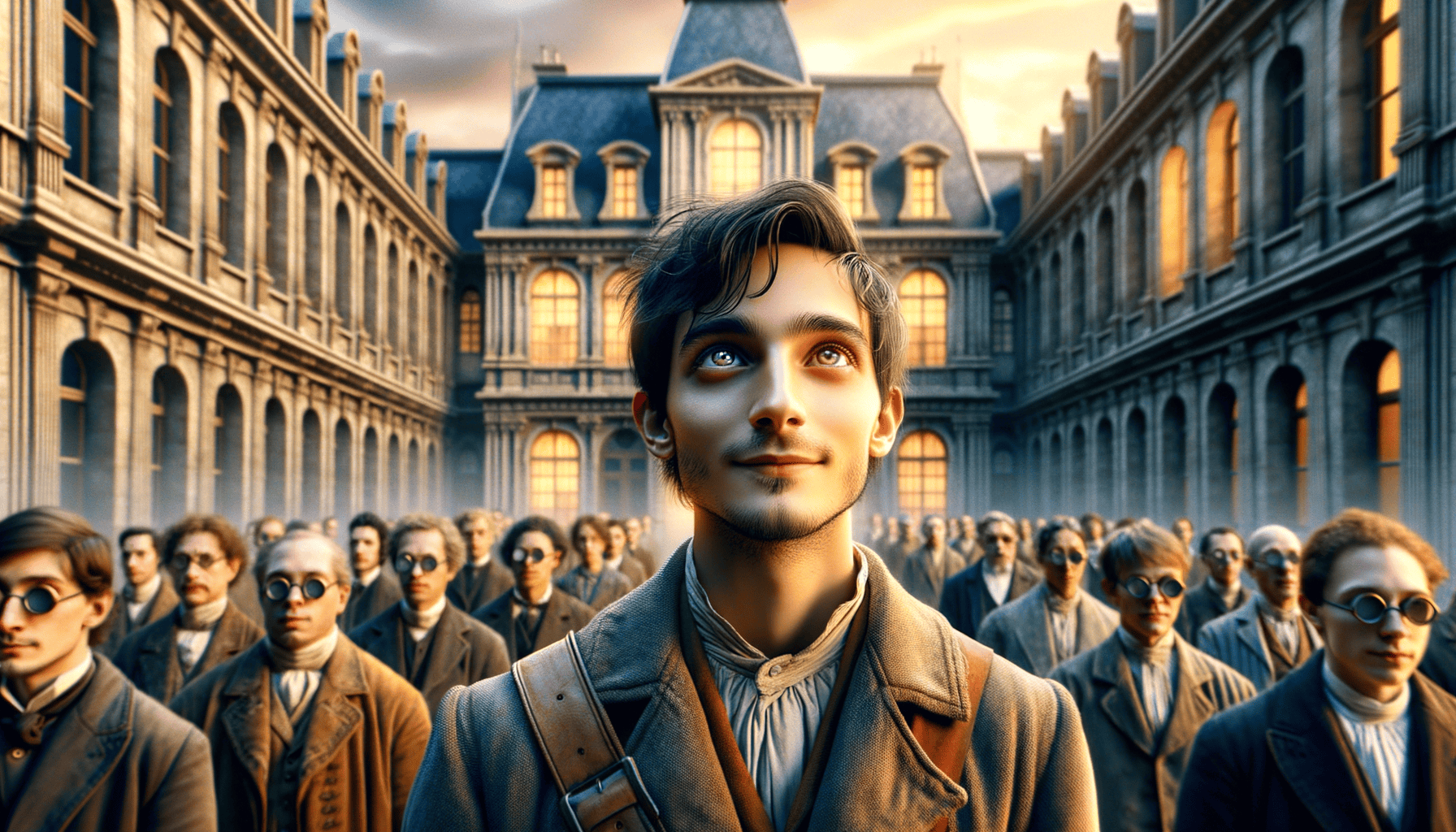
Ten-year-old Louis clutched his father’s hand tightly as their carriage bumped along the road to Paris. The autumn wind rustled through his hair, bringing new smells and sounds.
“Are you scared, mon fils?” Simon asked softly.
“Non, Papa,” Louis replied, though his fingers trembled slightly. “I’m excited to learn!”
The carriage stopped at a large building. Louis heard children’s voices and felt cool stone steps under his feet. His heart beat faster with each step.
Welcome to the Institute
“Welcome, young Louis,” said a kind voice. It belonged to Dr. Pignier, the school’s director. “We’ve heard wonderful things about you.”
Louis smiled, standing tall despite his nervousness. He could feel his father’s proud presence beside him.
“Here, you will learn to read, write, and make music,” Dr. Pignier explained. “You’ll meet many friends who see the world just like you do.”
Saying goodbye to Papa was hard. But Louis knew this was his chance to learn and grow. He followed his new teacher down echoing hallways to meet his classmates.
New Friends, New Ways
In his dormitory, Louis met Pierre, another boy his age.
“Want to feel how we read?” Pierre asked excitedly. He led Louis to a shelf of special books.
Louis ran his fingers over large, raised letters. They were big and took up whole pages. Reading them was slow and difficult.
The school days were full of new experiences:
• Learning to read raised letters
• Playing music on beautiful pianos
• Making crafts with rope and baskets
• Studying geography with special maps
• Learning math with counting boards
“This is amazing,” Louis told Pierre one evening. “But reading is so slow. There must be a better way!”
“I know,” Pierre sighed. “Sometimes I can only read two or three words a minute.”
A Dream Takes Shape
At night, Louis lay in his bed thinking. His fingers were sore from tracing the huge letters in his books. He remembered how easily sighted people read their small, flat books.
“What if,” he whispered to himself, “we could make letters that are easier to feel? Something small, like dots…”
The next morning, Louis was extra attentive in his classes. He noticed how everyone used their hands to learn – feeling shapes, counting beads, touching maps.
“Did you know,” his history teacher mentioned, “that soldiers sometimes send secret messages at night using dots?”
Louis sat up straighter. His mind was racing with possibilities.
That evening, as other students headed to dinner, Louis stayed behind in the classroom. He took out a piece of paper and began poking holes in it with his writing stylus.
“What are you doing?” Pierre asked, returning to fetch his forgotten hat.
Louis grinned, his fingers tracing the dots he’d made. “I’m trying something new. Want to help?”
A spark of excitement filled the air. Neither boy knew it yet, but this was the beginning of something that would change lives forever.
The Spark of Inspiration
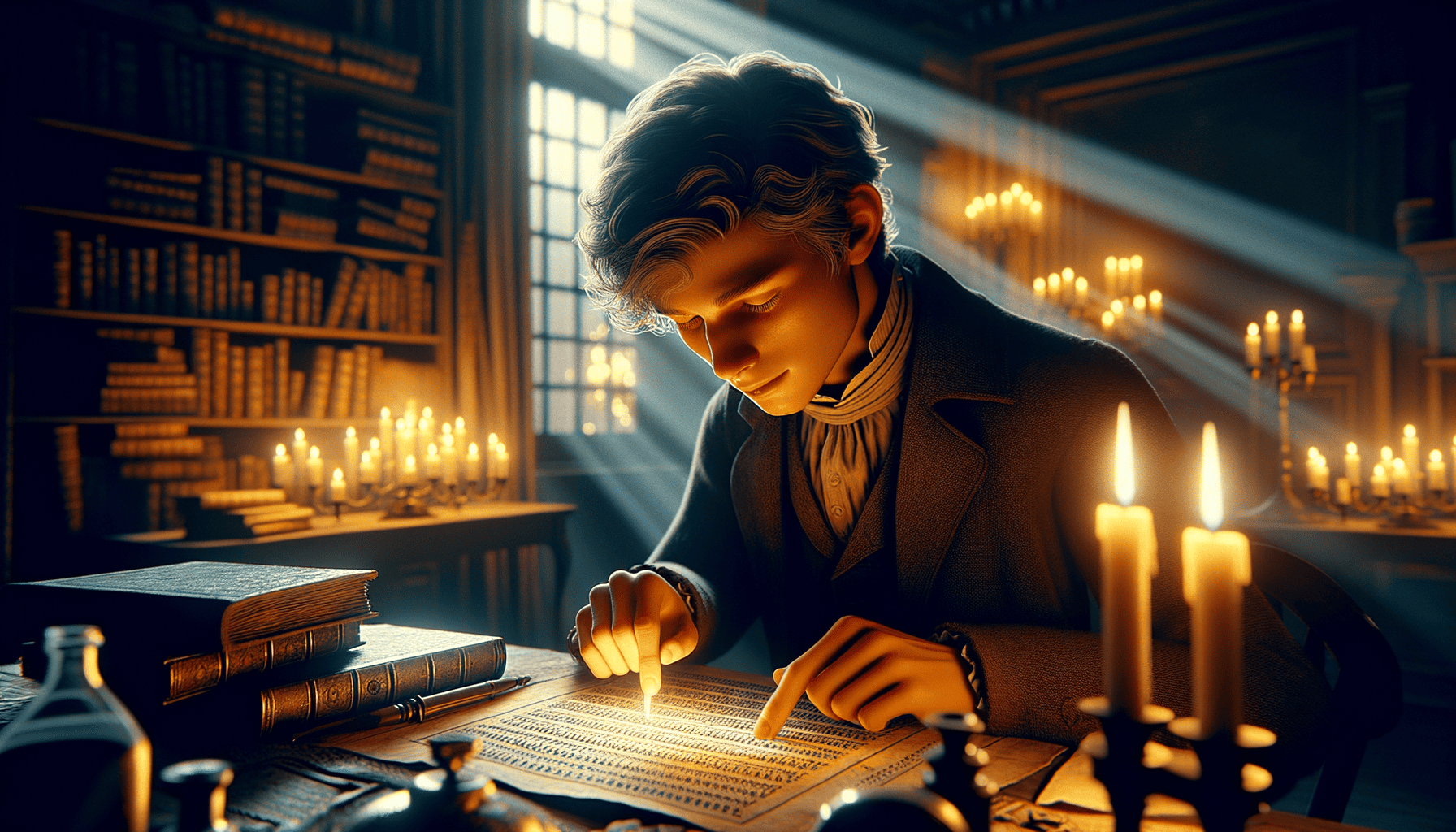
Louis sat at his desk, his fingers dancing over the paper filled with dots. The evening bell had just rung at the Royal Institute, but he couldn’t stop working on his idea. 🌟
“What’s that noise?” asked Marie, a new student, hearing the tap-tap-tap of Louis’s tool.
“I’m making something special,” Louis smiled. “Come feel these dots!”
A Soldier’s Secret Code
One day, a visitor came to the school. It was Captain Charles Barbier, a soldier with an interesting invention.
“This is night writing,” Captain Barbier explained, showing the students his system of raised dots. “Soldiers use it to read messages in the dark.”
Louis ran his fingers over the dots, his heart beating faster. “This is amazing!” he exclaimed.
“But Captain,” Louis said thoughtfully, “twelve dots is too many to feel at once with one fingertip.”
Making It Better
That night, Louis couldn’t sleep. His mind was full of dots and patterns. He grabbed his slate and stylus – tools for making raised dots on paper.
“What if…” he whispered, poking holes in the paper, “we used fewer dots?”
Pierre woke up in the next bed. “Are you still working, Louis?”
“I think I can make it simpler,” Louis replied excitedly. “Six dots instead of twelve!”
Here’s what Louis needed to figure out:
• How many dots to use
• Where to place the dots
• Which patterns would mean which letters
• How to make the dots easy to feel
• Ways to write the dots quickly
Testing and Trying
“Try this pattern,” Louis told his friend Marie. “What does it feel like?”
Marie touched the dots carefully. “I can feel all of them with just one finger! It’s much easier than Captain Barbier’s code.”
Louis beamed. He was getting closer to his goal.
Friends Help Out
“Let us help you test it,” Pierre offered. Soon, a small group of students gathered in their free time to try Louis’s new patterns.
“This dot means ‘A’,” Louis explained, showing them a single dot in the top corner. “And these two dots mean ‘B’.”
The other students were amazed. They could feel the difference between letters much more easily than with the old raised letters.
“You’re making magic, Louis!” Marie clapped.
“Not magic,” Louis laughed. “Just a better way for us to read.”
A Big Challenge
Not everyone understood what Louis was trying to do. Some teachers worried that changing how blind students read would be too difficult.
“But look how fast we can read this way!” Louis demonstrated to his teachers. “And we can write our own words too!”
Dr. Pignier watched with interest as Louis and his friends read using the new dot patterns. The young inventor’s enthusiasm was contagious.
“Keep working on it,” Dr. Pignier encouraged. “Show us what’s possible.”
Louis nodded, his mind already racing with more ideas. He knew he was onto something important – something that could help blind people everywhere read and write as easily as anyone else.

Creating the Code
The small workroom at the Royal Institute buzzed with excitement. Louis sat surrounded by papers covered in dots, his fingers moving quickly across each page. 📚
“I’ve got it!” Louis exclaimed, his face bright with joy. “The perfect pattern for each letter!”
The Perfect Pattern
“Show us, Louis!” his friends gathered around eagerly.
Louis took out his special metal slate and pointed to the six dots arranged in two columns of three.
“Feel this,” he said, guiding Marie’s hand. “Six dots is all we need. Just six dots can make all the letters!”
“It’s like magic in your fingertips,” Marie whispered, feeling the raised dots.
Working Day and Night
Louis worked harder than ever. His friends often found him asleep at his desk, his special tool still in his hand.
“You need to rest,” Pierre would say, shaking him gently.
“Just one more letter pattern,” Louis would answer, smiling.
• Each letter fit under one fingertip
• The dots were easy to feel
• Anyone could learn it quickly
• It was simple to write
• It worked for any language
Teaching Others
“Let me teach you,” Louis said to each new student. His patience never ran out.
Some students learned quickly. Others needed more time. But Louis helped them all.
“Remember,” he would say, “this is our way to read and write just like everyone else!”
Facing Doubts
“But what about our old books?” some teachers worried.
“And the raised letters we’ve always used?” others questioned.
Louis stood tall. “Watch this,” he said.
He wrote a sentence in his dot system, then asked a student to read it.
“It’s so fast!” the teachers gasped as the student read smoothly.
Making Dreams Real
Word spread through the school. More and more students wanted to learn Louis’s new code.
“Can you teach us to write music too?” asked Thomas, who loved playing piano.
Louis’s eyes lit up. “Yes! We can use dots for music notes too!”
Every day, Louis worked on new patterns – for numbers, punctuation marks, and musical notes.
A Special Moment
One evening, Dr. Pignier called Louis to his office.
“Show me everything,” he said kindly.
Louis demonstrated his complete system – letters, numbers, and music notes.
“This is remarkable,” Dr. Pignier said softly. “You’ve created something extraordinary.”
Louis smiled, his heart full of hope. His dream of helping blind people read and write was becoming real.
But not everyone was ready to accept such a big change. Louis knew there were still battles ahead.
Standing Strong
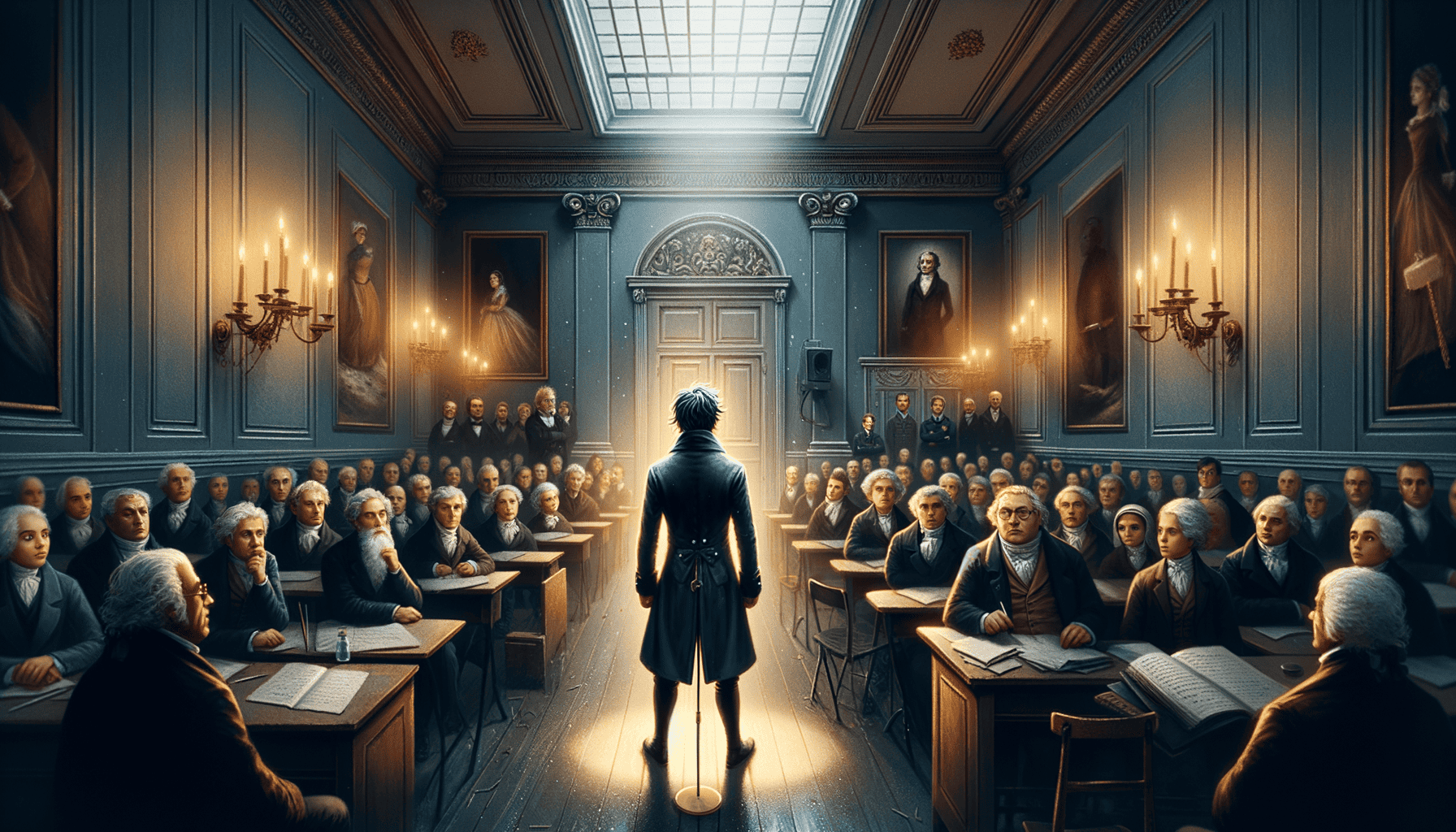
The morning sun filtered through the windows of the Royal Institute as Louis faced a room full of skeptical teachers. 🌅
Brave Hearts
Louis took a deep breath. His fingers brushed across his familiar dots. “Watch this,” he said quietly.
He called Marie forward. She sat down and began reading a page written in Braille – faster than anyone had ever read using the old raised letters.
“I couldn’t read before,” Marie announced proudly. “Now I can read as fast as my seeing friends!”
Friends Stand Together
“We all want to learn Louis’s way!” Thomas spoke up from the back of the room. Other students nodded.
“It’s not just about reading,” Pierre added. “We can write our own stories now too!”
Small Victories
Dr. Pignier watched as Louis taught another group of students. Their faces lit up as they learned each new letter.
“Maybe,” Dr. Pignier thought, “this young man really has found a better way.”
He started letting Louis teach small classes after regular school hours.
Hard Times
But not everything was easy. Some days were really hard.
“Your dots will never replace real books,” one teacher scolded.
Louis felt sad, but he didn’t give up. He remembered how it felt to not be able to read at all.
Growing Support
Slowly, things began to change. More teachers started watching Louis’s classes.
“Show me how it works,” they would ask.
Louis taught everyone who wanted to learn – students, teachers, and visitors to the school.
Each new person who learned the system became a supporter.
A Special Letter
One day, Louis received an exciting letter. A school in another city wanted to learn about his dot system!
“Your invention is spreading,” Dr. Pignier told him with a smile.
Never Giving Up
“Remember when you first came here?” Pierre asked Louis one evening.
“Yes,” Louis smiled. “I just wanted to read like everyone else.”
“Now you’ve made it possible for all of us to read,” Pierre said proudly.
Louis nodded. His system was more than just dots on paper – it was hope for blind people everywhere.
But the biggest challenge was still ahead. Would the world accept this new way of reading and writing?
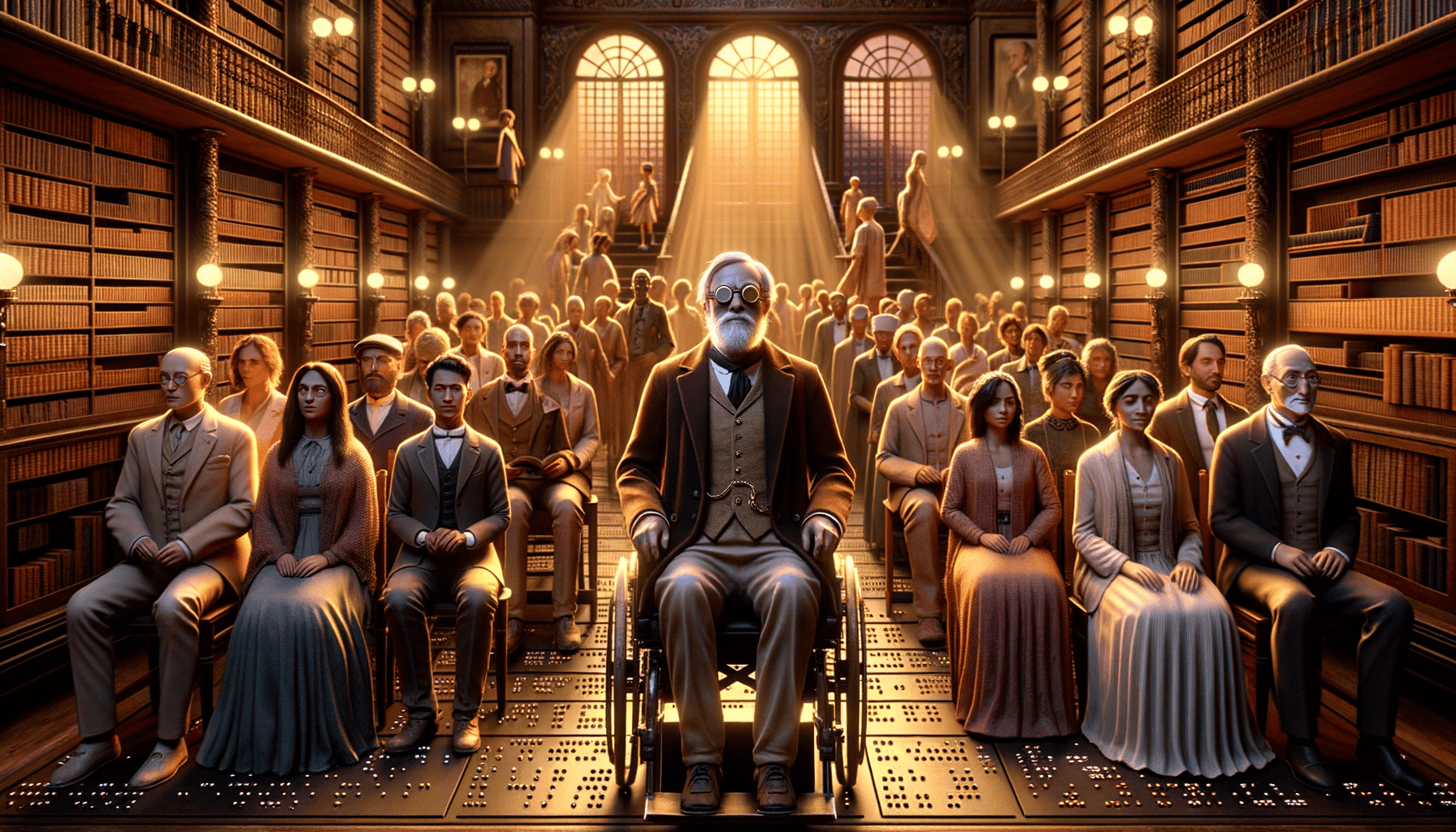
A Gift to the World
Louis stood at his classroom window, feeling the warm sunshine on his face. He was now a teacher at the Royal Institute where he had once been a student. 🌟
Growing Dreams
Louis smiled. His simple dots had traveled far beyond the walls of the Institute. Schools in other parts of France were teaching it. Letters came from other countries asking to learn more.
“Your dots helped me write to my mother for the first time,” Maria, a new student, said excitedly. “She cried happy tears!”
“Each dot is like a tiny star,” Louis told his students. “Together, they light up whole worlds of stories.”
Making Music
Louis had also created a way to write music using his dots. Blind musicians could now read and play songs on their own! 🎵
“Watch this,” Thomas said, sitting at the piano. His fingers moved across the dotted music sheet, then danced over the keys, playing a beautiful melody.
A Life’s Work
Though Louis wasn’t feeling well these days, his heart was full of joy. His students were becoming teachers themselves, spreading the dots to new places.
“Did you ever think your accident would lead to helping so many people?” Dr. Pignier asked him one day.
“Sometimes the darkest moments can lead us to the brightest lights,” Louis answered softly.
The Greatest Gift
Louis’s system would soon spread across the whole world. It would be used in every country, helping millions of blind people read and write.
His dots would become letters, numbers, music notes, and mathematical symbols. They would open doors to education, jobs, and independence for blind people everywhere.
Forever Bright
Today, we remember Louis Braille as someone who turned his own challenge into a gift for others. His six simple dots continue to light up the world for millions of people.
His story teaches us that we all have the power to make the world better, no matter what challenges we face.
Like stars in the night sky, Louis Braille’s dots continue to guide people toward brighter futures, proving that sometimes the smallest things can make the biggest difference.