

The Curious Spark
Maya pulled the dusty sheet off something big in her grandfather's attic. Her eyes grew wide. "Wow! What is this?" she whispered, running her fingers along the smooth metal tube.
"That's my old telescope," Grandpa Joe said with a twinkle in his eye. "Would you like to try it?"
Maya nodded eagerly. She loved learning about space. At school, her science teacher said there were more stars in the sky than grains of sand on all the beaches in the world!
"Let's set it up tonight," Grandpa Joe smiled. "The sky should be clear."
Later that evening, Maya bounced with excitement as Grandpa Joe showed her how to point the telescope. The metal felt cool against her cheek as she looked through the eyepiece.
"Years?" Maya gasped. Through the telescope, she could see tiny dots of light twinkling like diamonds. Some were blue, others red or white. "They're so beautiful!"
Then Maya saw something that made her jaw drop. "Grandpa! Look! That one has rings around it!"
"Ah, you've found Saturn," Grandpa Joe chuckled. "Pretty amazing, isn't it?"
Maya couldn't stop staring. The planet looked like a golden ball wearing fancy rings. She had seen pictures in books before, but seeing it for real was different. It felt magical.
“How did all of this get here, Grandpa?” Maya asked. “Why does Saturn have rings but Earth doesn’t? Why are some stars different colors?”
"Those are excellent questions," Grandpa Joe said. He sat down on the grass next to Maya. "The universe is full of mysteries waiting to be solved. That's why we have scientists – to help us understand these wonderful things."
As the night grew darker, more stars appeared. Maya saw patterns in the sky that Grandpa called constellations. He showed her the Big Dipper, which looked like a giant spoon made of stars.
"Can we do this again tomorrow?" Maya asked, her eyes sparkling with excitement.
"Of course," Grandpa Joe replied. "And maybe we can learn more about what makes our universe so special."
That night, Maya could hardly sleep. Her mind was filled with images of glowing stars and Saturn's beautiful rings. She thought about all the amazing things that must be out there, waiting to be discovered.
Looking through the telescope changed something in Maya. She didn't just want to see the stars anymore – she wanted to understand them. Why was everything the way it was? What other secrets was the universe hiding?
As she finally drifted off to sleep, Maya dreamed of floating among the stars, exploring all the mysteries of space. She couldn't wait to learn more about our amazing universe.
The telescope in the attic wasn't just an old piece of equipment – it was the key that opened a door to endless wonder for Maya. And this was just the beginning of her cosmic adventure.
Goldilocks and the Universe
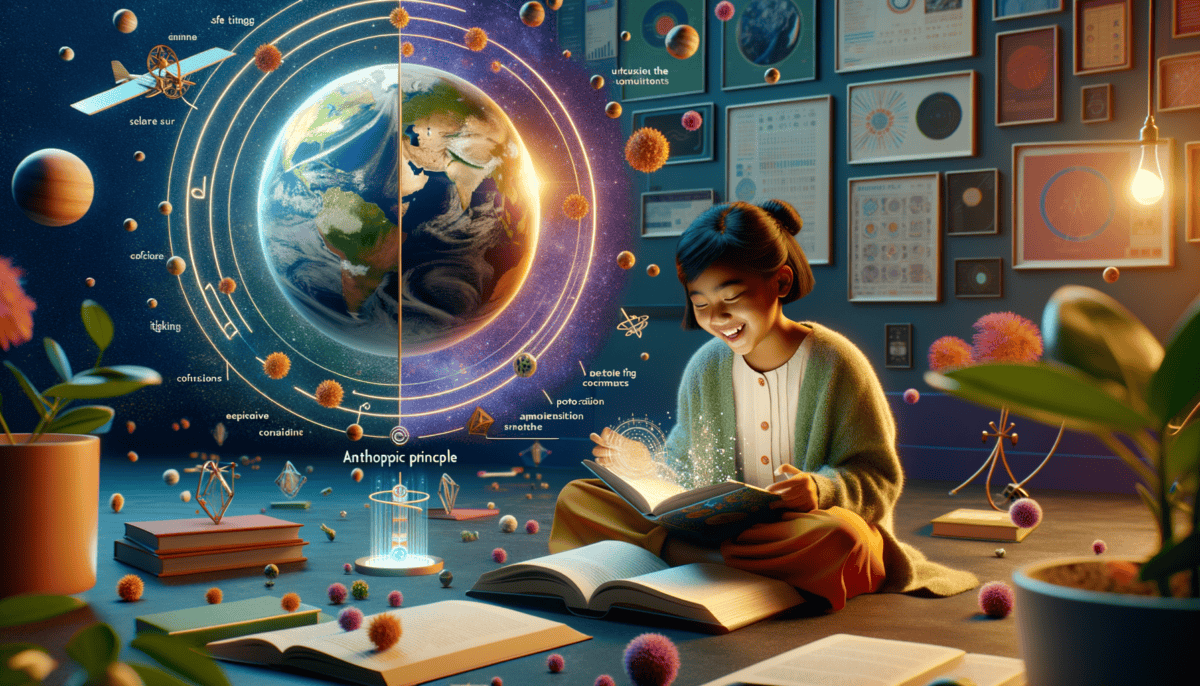
“Maya, did you know Earth is like Goldilocks’ perfect bowl of porridge?” Grandpa Joe asked the next morning.
Maya giggled. “What do you mean? Earth isn’t soup!”
“Well,” Grandpa Joe smiled, “just like Goldilocks found a bowl that was not too hot and not too cold, Earth is just right for us to live here.”
Maya sat at the kitchen table, sipping her hot chocolate. “Tell me more, Grandpa!”
“Look at Mercury – it’s too close to the Sun. It’s super hot there! And poor Pluto is so far away, it’s frozen solid. But Earth? Earth is just perfect.” ️
“Like my hot chocolate!” Maya held up her mug. “Not too hot, not too cold!”
“Exactly!” Grandpa Joe beamed. “And that’s not all. Earth has other special things that make it just right for us.”
“Earth has a blanket of air called the atmosphere. It keeps us warm and gives us air to breathe. It’s like a cozy blanket wrapped around our planet!”
Maya wrapped her own blanket tighter around her shoulders. “What else makes Earth special?”
“Well, we have water – not too much, not too little. Some places have oceans, some have rivers, and some have just enough rain to help plants grow.”
Grandpa Joe got up and grabbed an apple from the fruit bowl. “And Earth spins at just the right speed. If it spun too fast, we’d have super short days. Too slow, and one side would get too hot while the other got too cold.”
Maya’s eyes widened. “It’s like everything has to be perfect!”
“That’s right! Even our Moon helps us. It’s just the right size and distance to create tides in our oceans.”
Maya looked out the window at the blue sky. “But Grandpa, how did Earth get so perfect?”
“Some scientists think we’re very lucky. Others think there might be many planets out there, and we just happen to live on one that’s just right.”
Maya thought about this while finishing her hot chocolate. Then she jumped up excitedly. “Grandpa! Can we look for other ‘just right’ planets with your telescope?”
“We can try! Scientists are doing that right now. They’re searching for planets that might be like Earth – not too hot, not too cold, with the right ingredients for life.”
That afternoon, Maya drew a picture of Earth with all its special features: the atmosphere blanket, the oceans, the Moon, and the Sun shining just right. She wrote at the top: “Earth – The Goldilocks Planet.”
As she colored in the blue oceans, Maya thought about how amazing it was that everything worked together so perfectly. She wondered if somewhere out there, on another ‘just right’ planet, someone else might be wondering the same thing.
That night, when Maya looked through the telescope again, she saw the stars differently. Each one might have its own planets spinning around it. Could any of them be just right, like Earth? She couldn’t wait to find out.
Cosmic Coincidences
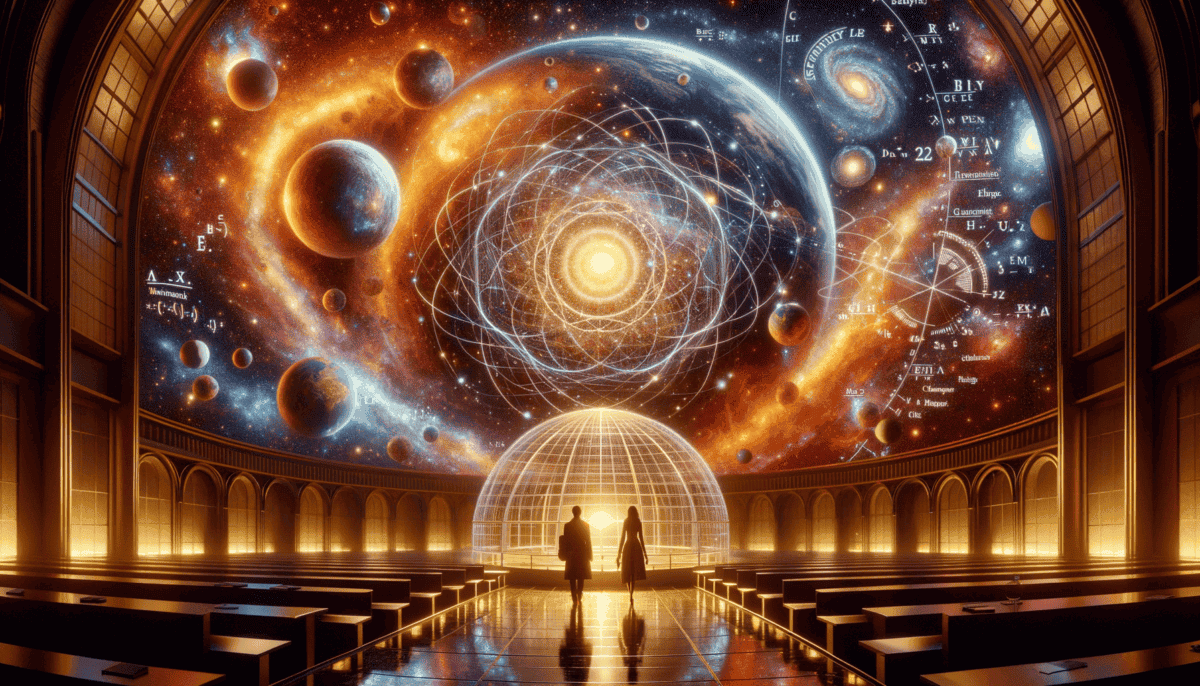
Maya bounced excitedly as she walked into the planetarium. Today was special – she was going to meet Dr. Elena Rodriguez, a real astrophysicist!
“Welcome, Maya!” Dr. Rodriguez smiled warmly. “Your grandfather tells me you’re curious about the universe.”
“Yes! I want to know why everything is so perfect for us to live here,” Maya said.
Maya’s eyes widened. “What do you mean?”
Dr. Rodriguez pulled out a large marble and a tiny bead. “Think of these as atoms. The forces that hold atoms together are just right – not too strong, not too weak.”
“Like Goldilocks!” Maya exclaimed.
“Exactly! If these forces were different, stars couldn’t shine and make the elements we need for life.” ⭐
Dr. Rodriguez led Maya to a large screen showing swirling galaxies. “It’s like the universe is a giant puzzle, and all the pieces fit perfectly.”
“Even gravity has to be just right. If it was stronger, everything would crush together. If it was weaker, stars and planets couldn’t form!”
Maya scrunched her face in thought. “That’s a lot of perfect things!”
“Want to see something cool?” Dr. Rodriguez pressed a button, and the planetarium ceiling lit up with thousands of stars. “Each of these rules we’re talking about is like an ingredient in a cosmic recipe.”
She pulled out a cookie from her lunch bag. “If I changed the recipe for this cookie just a little – too much salt, not enough flour – it wouldn’t taste right. The universe is the same way!”
Maya watched as simulations showed different versions of the universe. Some had no stars. Others had no planets. None looked like home.
“But why is everything so perfect?” Maya asked.
Dr. Rodriguez sat down next to her. “That’s what we call the Anthropic Principle. It’s like asking: Is the universe perfect for us, or are we perfect for the universe?”
“I don’t understand,” Maya said.
“Think about fish,” Dr. Rodriguez smiled. “They might think water is perfect for life. But really, they evolved to live in water. Maybe we evolved to live in this kind of universe.”
Maya’s mind was spinning with new ideas. “So it’s like… we fit the universe, and the universe fits us?”
“Now you’re thinking like a scientist!” Dr. Rodriguez beamed.
As they walked through the planetarium, Dr. Rodriguez showed Maya more cosmic coincidences:
- The perfect strength of electricity that lets atoms share electrons
- The exact mass of tiny particles that make up everything
- The perfect balance of forces that lets stars burn for billions of years
Maya looked at her hands, thinking about how all these perfect rules came together to make her possible. “The universe is like a big friendly home,” she whispered.
That evening, as Maya gazed through her telescope, she felt different. Every star, every planet, even the space between them was part of an amazing cosmic dance. And somehow, in all that vastness, everything worked together just right to create her world.
A Dance of Infinite Worlds
Maya sat cross-legged on her bedroom floor, surrounded by colorful marbles. After her talk with Dr. Rodriguez, she couldn’t stop thinking about different universes.
“What if gravity was stronger?” she wondered, pushing the marbles together into a tight cluster. “Or weaker?” She scattered them across the floor.
“Maya! Time for dinner!” her mom called.
“Coming!” Maya jumped up, but stopped at her mirror. “In another universe, would I have green skin? Or six arms?” She giggled at her reflection.
At dinner, Maya couldn’t contain her excitement. “Dad, did you know there might be other universes?”
“Tell us more,” her dad smiled, passing the potatoes.
“Dr. Rodriguez says it’s called the multiverse! It means there could be lots of different universes, each with different rules.”
“Like parallel worlds?” her little brother Tommy asked.
“Yes! In some universes, maybe dogs can fly, or trees grow upside down!”
That night, Maya had a special dream. She was floating through space in a magical bubble. Each time she touched a star, it opened a window to a different universe:
In one universe, everything was made of music. Stars sang instead of shined.
In another, time ran backward. People got younger instead of older.
In a third, light moved so slowly you could watch it bounce between things.
When Maya woke up, she rushed to write everything down in her science journal. She drew pictures of her dream universes, using every crayon in her box.
At breakfast, she asked, “Mom, if there are so many universes, why are we in this one?”
Her mom thought for a moment. “Maybe because this is the only one where we could exist?”
Maya’s eyes lit up. That’s what Dr. Rodriguez meant! Like how fish need water, maybe humans needed this exact universe to be possible.
Later that day, Maya built a “universe maker” from an old cardboard box. She cut holes in the top and put different colored lights inside.
“Each color is a different universe,” she explained to Tommy. “The blue one has talking plants. The red one has floating cities!”
Tommy peeked through the holes. “Cool! Can we visit them?”
“Not really,” Maya said. “But isn’t it amazing that out of all the possible universes, we got one that’s just right for us?” ✨
That evening, Maya added a new page to her journal. She wrote in big letters:
She drew herself among the stars, connected to everything by invisible threads. In her picture, she gave herself a superhero cape made of stardust.
Before bed, Maya looked out her window at the night sky. Somewhere out there, maybe other universes were dancing their own cosmic dances. But this one, with its perfect rules and beautiful patterns, was home.
As she drifted off to sleep, she imagined all the possible worlds spinning like a carousel in space. And at the center was our universe, ticking along with its just-right rules, making everything – including her – possible.
Starlight Questions
Maya sat in Dr. Rodriguez’s observatory, watching the sunset paint the sky in shades of pink and orange. Her mind was full of big questions.
“Dr. Rodriguez,” Maya said, fiddling with her pencil. “I’ve been thinking a lot about why we’re here.”
“Is it just luck that we exist?” Maya asked. “Or is there a reason?”
“That’s what scientists and philosophers have wondered for a very long time,” Dr. Rodriguez replied. “Some think it’s random chance. Others believe there must be a purpose.” ⭐
Maya drew stars in her notebook while she thought. “Like how a cake needs the right ingredients to turn out good?”
“Exactly! The universe needed just the right ‘ingredients’ for us to be here. That’s what we call the Anthropic Principle.”
Maya giggled. “That’s a big word!”
“It just means that the universe seems perfectly set up for life like us to exist,” Dr. Rodriguez explained.
Maya looked through the big telescope. “Do you think there are other people out there wondering the same things?”
“I bet there are! That’s what makes science so exciting – we’re all exploring these mysteries together.”
Maya wrote in her journal: “The universe is like a giant puzzle. We’re trying to figure out how all the pieces fit together.”
That evening, Maya and Dr. Rodriguez sat outside watching stars appear. They shared hot chocolate and talked about space.
“What if we’re here to learn about the universe?” Maya suggested. “Like it made us so it could understand itself!”
Dr. Rodriguez smiled warmly. “That’s a beautiful thought, Maya. Maybe humans are the universe’s way of asking questions about itself.”
On her way home, Maya looked up at the twinkling stars. She felt small but special, like a tiny part of something huge and amazing.
In her bedroom, Maya added new drawings to her universe maker box. She drew people on different planets, all looking up at their own skies, all wondering about the same big questions.
She wrote underneath: "We're all cosmic explorers!"
That night, Maya dreamed she was a star, shining light across space. In her dream, every beam of light was a question, and every twinkle was a discovery waiting to happen. ✨
When she woke up, Maya felt different. The universe wasn’t just a big space anymore. It was like a story, and every person was both the reader and part of the story too.
At breakfast, Tommy asked why she was smiling so much.
“Because we’re part of the biggest mystery ever,” Maya said. “And we get to help solve it!”
Maya drew a new picture for her wall: the Earth floating in space, with question marks made of stars all around it. Being part of the mystery made her feel excited and brave.
She couldn’t wait to learn more about her place in the cosmic story. After all, every question she asked was the universe asking questions about itself – through her!
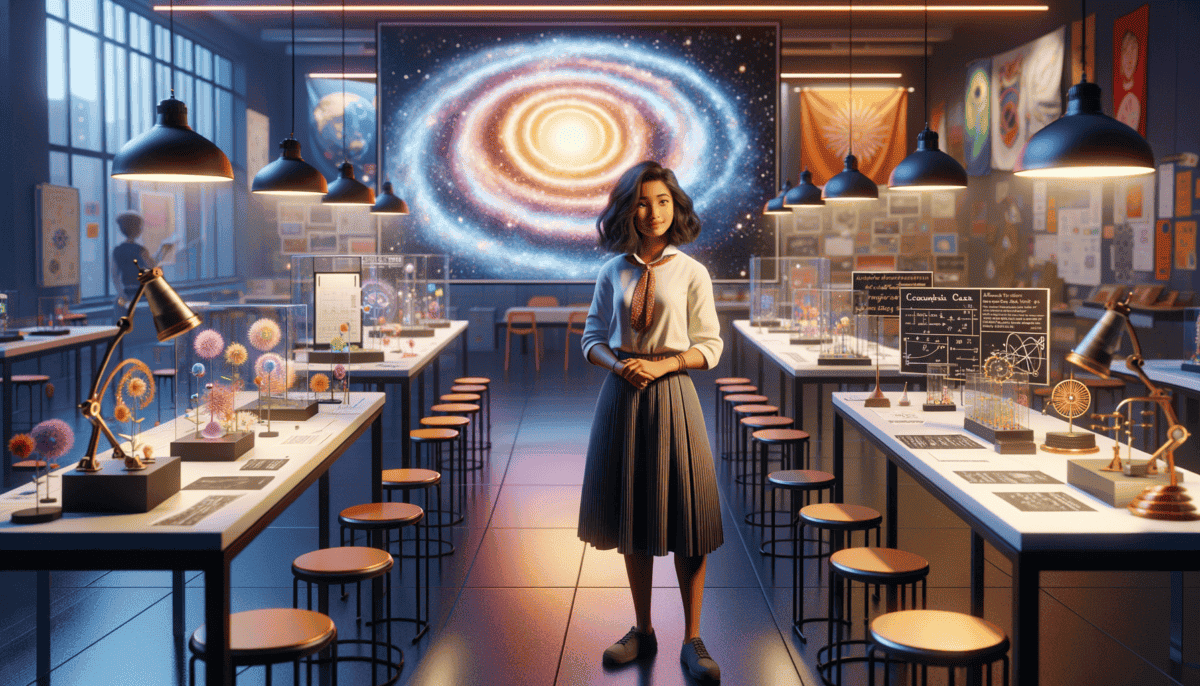
Starlit Dreams Come True
The morning sun streamed through Maya’s window, casting rainbow patterns on her universe maker box. Today was special – it was the school science fair!
“Ready for your big presentation?” Mom asked, helping Maya pack her project.
At school, Maya set up her display. She had pictures of galaxies, her drawings, and a sign that read: “The Universe’s Perfect Recipe!”
Tommy helped her arrange everything. “This is way cooler than my plant growing project,” he admitted.
“Every project helps us learn something new,” Maya said, remembering what Dr. Rodriguez taught her.
“Ladies and gentlemen,” Maya began when it was her turn, “did you know we live in a universe that’s just right for us?”
The room grew quiet as Maya showed her classmates the universe maker box. Inside, she had built a tiny solar system with clay.
“If our Earth was a little closer to the sun, it would be too hot,” she explained. “If it was farther away, it would be too cold!” ❄️
Dr. Rodriguez watched from the back of the room, giving Maya a thumbs up.
“The best part is,” Maya said, her eyes sparkling, “we get to be universe explorers! Every time we learn something new, it’s like the universe is learning about itself through us!”
The audience clapped loudly. Even the principal looked impressed!
After the fair, Dr. Rodriguez had a surprise. “Maya, how would you like to join our junior astronomy club?”
Maya jumped with joy! “Really? I can keep learning about space?”
“You’ve shown that you have the most important thing a scientist needs – curiosity,” Dr. Rodriguez said.
That evening, Maya and her family celebrated at her favorite pizza place. She won first prize at the science fair!
“What’s next for our little astronomer?” Dad asked.
Maya looked out the window at the first stars appearing. “I want to learn everything I can about our universe. Maybe someday I’ll be an astronaut or a scientist!”
Later, Maya updated her journal: “Today was just the beginning. There are so many mysteries to solve!”
She placed her science fair ribbon next to her grandfather’s telescope. The old telescope that started her journey now pointed toward her future.
As Maya fell asleep, she smiled at the glow-in-the-dark stars on her ceiling. She knew that somewhere out there, other curious minds were looking up at their own skies, asking questions, and dreaming big dreams.
Her universe maker box sat on her desk, but Maya didn’t need it anymore. She had discovered something better – that she was part of the real universe’s story, and her chapter was just beginning.
“Goodnight, universe,” Maya whispered. “Thanks for being just right for us.” ✨
And somewhere in the vast cosmos, billions of stars twinkled back, waiting for Maya and all the other explorers to uncover their secrets, one discovery at a time.