

The Spinning Wheels of Change
Thomas wiped sweat from his forehead as he watched his father work the spinning wheel. The wooden wheel creaked with each turn, making yarn from fluffy cotton. Their small workshop smelled like wool and wood.
"Papa, why do we spin the cotton this way?" Thomas asked, his bright eyes following the motion.
His father smiled. "This is how we've always done it, son. Just like my father taught me."
The workshop was cozy but worn. Sunlight streamed through dusty windows, dancing on piles of cotton and spools of thread. Thomas loved watching the cotton transform into yarn, but his arms got tired from helping all day.
One morning, everything changed. Thomas heard excited voices outside. He ran to the village square where a crowd gathered around a strange metal contraption.
"It's called a spinning jenny," explained Mr. Roberts, the merchant. "One person can spin eight threads at once!"
Thomas's eyes grew wide. "Eight threads? But how?"
The machine had multiple spindles that turned together. It looked nothing like their simple wooden wheel at home. Some villagers seemed scared of the new invention, but Thomas couldn't look away.
That night at dinner, Thomas's family talked about changes coming to their village. Mama stirred the thin soup slowly.
"The big factories in Manchester are using these new machines," she said. "They make cloth faster and cheaper than we can."
Papa nodded sadly. "Times are hard for hand spinners like us. We barely earn enough to eat."
A Glimpse of the Future
The next day, Thomas sneaked another look at the spinning jenny. He noticed all its moving parts – the wheels, gears, and spindles working together like a dance.
"Fascinating, isn't it?" came a voice. An old man with kind eyes stood nearby. "I'm Mr. Harrison. I work with these machines in Manchester."
"Do you think machines will replace all the spinning wheels?" Thomas asked.
Mr. Harrison patted Thomas's shoulder. "Change is coming, lad. But change brings opportunity for those willing to learn."
That evening, Thomas couldn't stop thinking about the machine. He drew pictures of gears and wheels in the dirt outside their cottage. His little sister Sarah watched curiously.
"What are you drawing, Thomas?"
"The future," he replied, smiling.
Papa came home looking tired but excited. "I have news. Mr. Harrison offered to take Thomas as an apprentice in Manchester. He'd learn about the new machines and earn wages to help our family."
Mama gasped. "But he's only twelve!"
"Many young people work in the factories," Papa said. "This could be a chance for a better life."
Thomas's heart raced. Manchester was a big city full of machines and possibilities. But he'd miss his family terribly.
A Decision to Make
That night, Thomas couldn't sleep. The moon shone through his window as he thought about leaving home. He heard the familiar creak of Papa's spinning wheel from downstairs.
The sound reminded him of warm, safe days learning his father's craft. But now that world was changing. New machines were coming, bringing both worry and hope.
Thomas closed his eyes and imagined the spinning jenny's multiple threads. Eight threads at once! What other amazing things might he see in Manchester?
The next morning, Thomas made his decision. He would go to Manchester and learn about the new machines. His family needed him to be brave.
As the sun rose over the village, Thomas watched his father at the spinning wheel one last time. Soon he would enter a different world of metal and steam, where change spun faster than any wheel he'd ever known.
Sarah hugged him tight. "Will you come back and teach me about the machines?"
"I promise," Thomas said. "And I'll write letters telling you everything I learn."
The whole village gathered to bid farewell to Thomas. Mr. Harrison's cart waited to take him to Manchester. Thomas took one last look at the familiar workshop, knowing his life would never be the same.
The Factory’s Roar
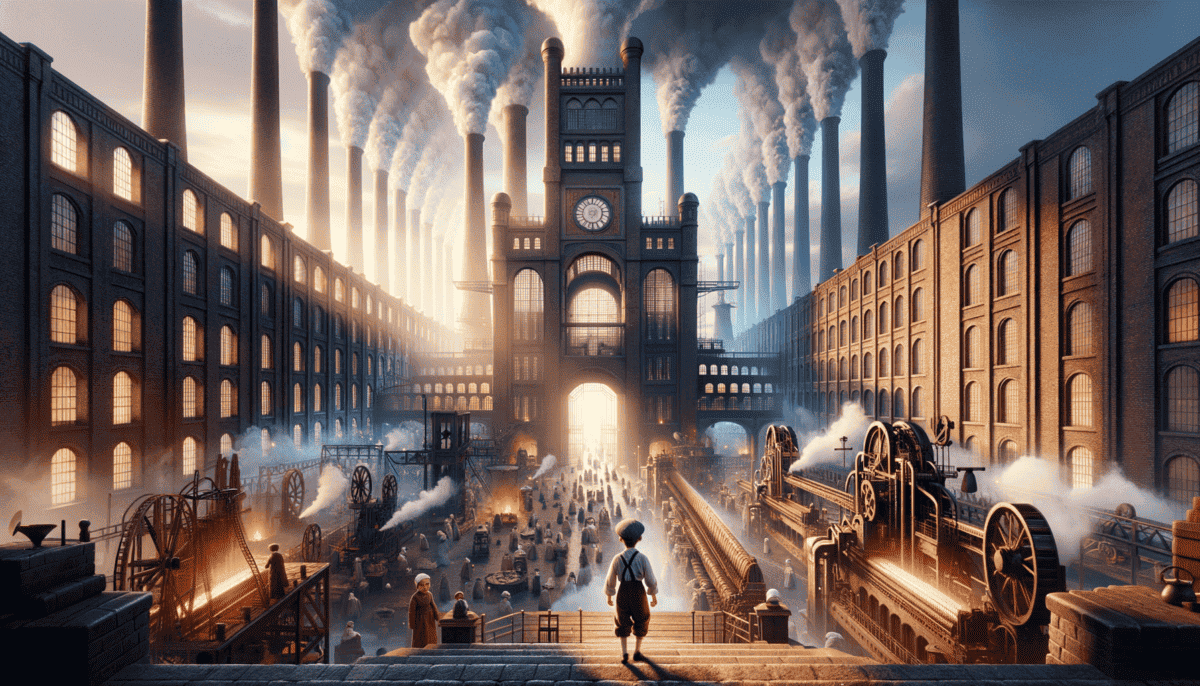
The cart bumped along the dusty road to Manchester. Thomas had never traveled so far from home. As they got closer, he saw tall brick buildings with smoking chimneys reaching into the sky.
“Welcome to Manchester, lad,” Mr. Harrison said. “The city of a thousand spinning jennies!”
Thomas’s eyes grew wide at the sight. The streets were packed with people rushing about. The air smelled different here – smoky and thick. Everywhere he looked, there were factory buildings.
A New Home
“You’ll stay with other apprentices in the worker’s house,” Mr. Harrison explained. “Wake-up is at 5 AM sharp!”
The worker’s house was small and crowded. Thomas shared a room with five other boys his age. His bed was just a thin mattress on the floor.
“I’m James,” said the boy in the next bed. “First time in a factory?”
Thomas nodded. “Everything’s so big here!”
“Wait till you see inside the mill,” James grinned. “It’s like nothing you’ve ever seen.” ⚙️
The First Day
The factory bell rang before sunrise. Thomas followed the crowd of workers through iron gates. Inside, the noise was deafening.
Hundreds of machines filled the enormous room. The floor shook with their movement. Giant leather belts connected to a massive steam engine that powered everything.
Thomas worked beside a power loom – much bigger than the spinning jenny he’d seen at home. His fingers moved quickly, tying broken threads and feeding cotton into the machine.
The hours were long. His back ached. The air was full of cotton dust that made him cough. But Thomas couldn’t stop watching the amazing machines.
Learning the New Ways
“Keep up, boy!” the floor manager barked when Thomas paused to examine a gear mechanism.
“Sorry, sir! I just wanted to see how it works.”
James nudged him. “Best not to ask questions. Just do the work.”
But Thomas couldn’t help being curious. During lunch break, he drew pictures of the machines in his small notebook. He wanted to understand every moving part.
That night, Thomas wrote to his family:
Dear Mama, Papa, and Sarah,
The factory is amazing and scary. The machines are bigger than our whole workshop! They’re loud as thunder but they make cloth faster than anything. My hands are sore but I’m learning so much.
Love, Thomas
Changes and Challenges
Days turned into weeks. Thomas got faster at his work. His hands learned to move without thinking. But some things were hard to get used to.
Many children younger than him worked in the factory. Some got hurt when they were too tired to be careful. The machines never stopped, even when workers were exhausted.
One day, a boy named William got his sleeve caught in a machine. The adults stopped it just in time, but Thomas saw how dangerous the work could be.
“I miss the quiet of Papa’s workshop,” Thomas told James that night. “But these machines… they’re changing everything, aren’t they?”
“That they are,” James agreed. “And we’re part of it all.” ⭐
Despite the hardships, Thomas felt proud. He was earning money for his family. And every day, he learned more about the incredible machines that were transforming the world.
One evening, Mr. Harrison found Thomas studying the steam engine after work.
“Interested in how it all works, eh?” he asked kindly.
Thomas nodded eagerly. “The power of steam is amazing! But sir, couldn’t the machines be made safer for the workers?”
Mr. Harrison looked thoughtful. “Perhaps that’s something you’ll help figure out one day, young Thomas. The age of machines is just beginning.”
Wheels and Steam
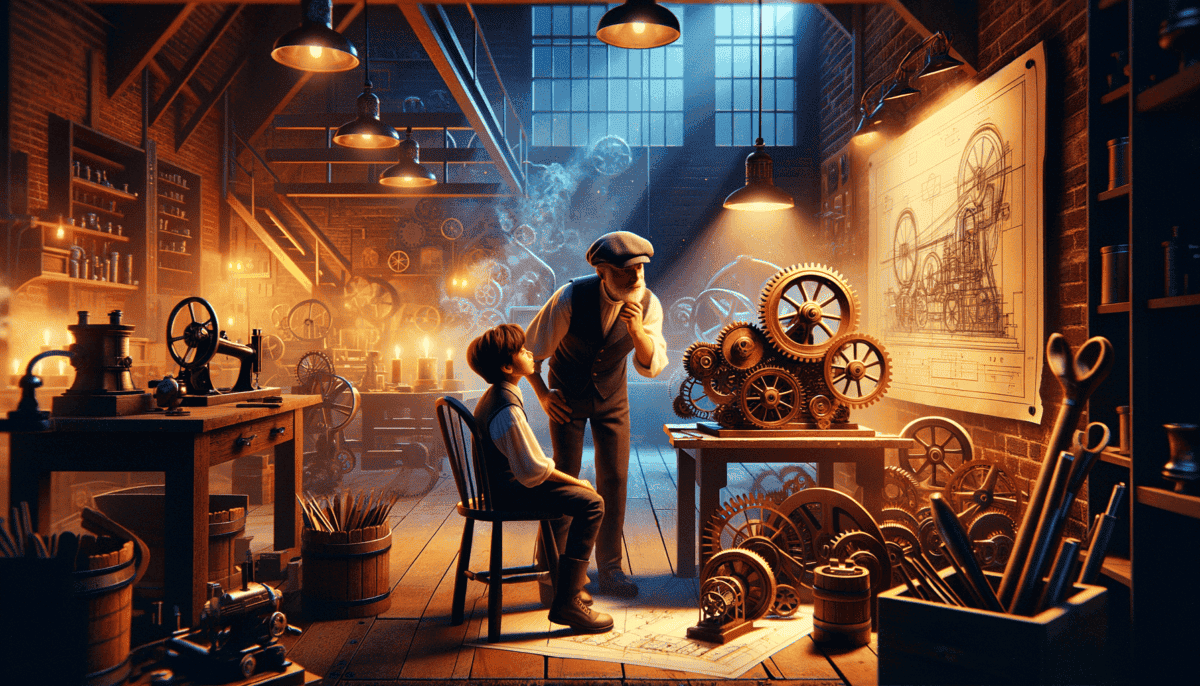
Thomas stared in wonder at the massive steam engine. Its giant pistons moved up and down like a breathing metal giant.
“Fascinating, isn’t it?” came a voice behind him. An older man with kind eyes and oil-stained hands smiled at Thomas. “I’m Mr. Bennett, the factory engineer.”
“Can you teach me how it works?” Thomas asked eagerly.
Mr. Bennett’s eyes twinkled. “Come by after your shift. I’ll show you the magic of steam power.”
Learning from a Master
Every evening, Thomas rushed to Mr. Bennett’s workshop. It was filled with tools, gears, and tiny working models of machines.
“See this miniature spinning jenny?” Mr. Bennett pointed to a small wooden model. “James Hargreaves built the first one to help his daughter Jenny spin more yarn.”
Thomas carefully turned the handle. “It spins eight threads at once!”
“That’s right! And now our big machines can spin hundreds at a time.”
Hands-On Learning
Mr. Bennett gave Thomas simple tasks at first:
• Clean and oil the gears
• Draw machine parts
• Help fix broken belts
• Build small working models
Thomas’s notebook filled with drawings and notes. His hands grew stronger and more skilled. Even the factory manager noticed his careful work with the machines.
“You have a gift, lad,” Mr. Bennett said one day. “You see things others miss.”
Making Things Better
Thomas couldn’t stop thinking about ways to improve the machines. He remembered William’s accident and other close calls he’d seen.
“What if we added a guard here?” Thomas showed Mr. Bennett a drawing. “It could stop sleeves from getting caught.”
“Now you’re thinking like an inventor!” Mr. Bennett beamed. “Let’s build it and test it out.”
“Small changes can make big differences,” Mr. Bennett always said. “That’s how we make progress – one improvement at a time.”
Growing and Learning
James noticed the change in his friend. “You’re different now, Thomas. Your head’s always in the clouds – or should I say, in the steam?”
“There’s so much to learn!” Thomas replied. “Did you know the steam engine works like a tea kettle? Heat makes steam, steam pushes things, and that makes power!”
One day, Mr. Bennett brought exciting news. “Thomas, how would you like to become my apprentice? You’ll learn everything about machines – not just how to work them, but how to make them better.”
Thomas could hardly believe his ears. “Really? Oh yes, please!”
That night, Thomas wrote in his journal:
Today I took my first step toward becoming an engineer. Machines are amazing, but they’re just tools. It’s up to us to make them work for good. I can’t wait to learn more!
As Thomas fell asleep, his mind whirled with gears and steam and possibilities. Tomorrow would bring new challenges and discoveries. The world was changing fast, and now he was part of making those changes happen.
Connections and Commerce
The steam locomotive thundered down the track, pulling Thomas and Mr. Bennett toward Liverpool. It was Thomas’s first train ride, and his heart raced with excitement.
“Look at the countryside zip by!” Thomas pressed his nose against the window. Fields, farms, and villages blurred past like a moving painting.
“This is just the beginning,” Mr. Bennett smiled. “These iron horses are changing our world.”
The Busy Port
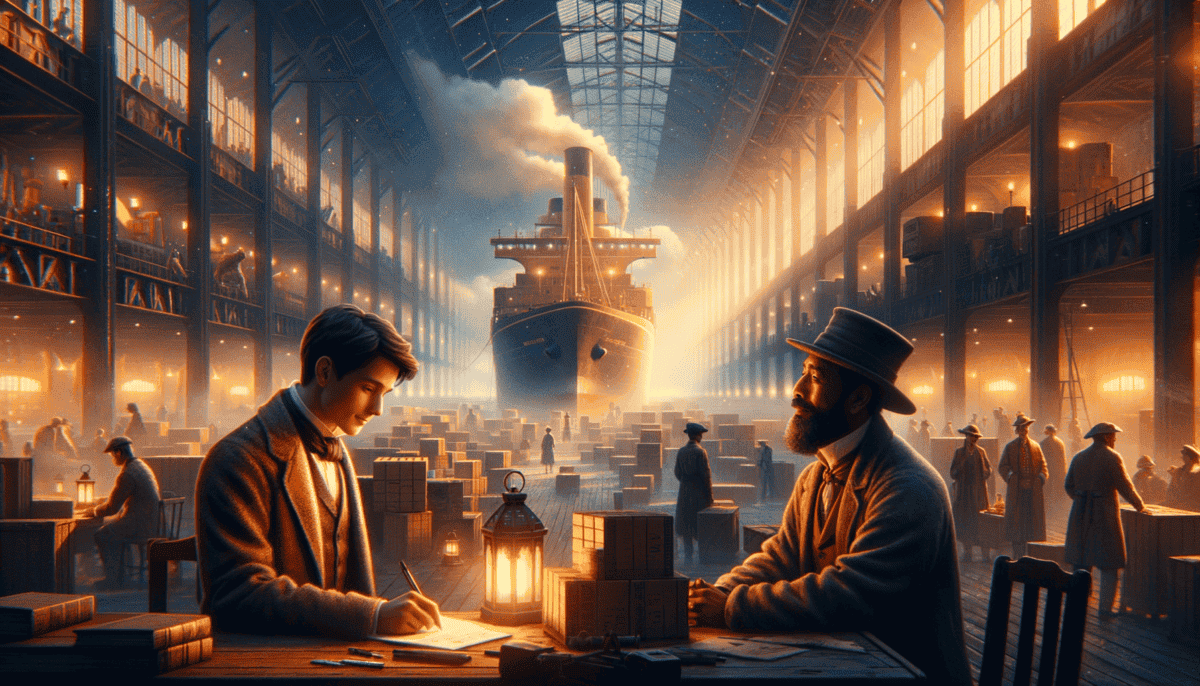
Liverpool’s port buzzed with activity. Huge steamships filled the harbor, their smokestacks reaching toward the sky. ⚓
“Where do all these ships go?” Thomas asked, watching crews load cotton bales.
“Everywhere! To America for cotton, to India for tea, to China for silk. The whole world is connected now.”
“It’s like a giant web of trade,” Mr. Bennett explained. “Our factories make cloth, ships carry it across oceans, and people everywhere wear British clothes!”
Meeting New Friends
At the docks, they met Captain Rogers, who commanded a steamship.
“Want to see my engine room?” the Captain asked Thomas.
Thomas’s eyes lit up. “Yes, please!”
Trading Stories
The Captain shared stories from his travels:
• American cotton farmers using new machines
• Indian tea plantations sending leaves to England
• Chinese silk makers trading for British goods
• African traders exchanging goods at coastal ports
“You see, Thomas? Our machines aren’t just changing England – they’re changing the whole world!”
Learning About Trade
Mr. Bennett showed Thomas a map covered with red lines. “These are trade routes. Like veins carrying blood through a body, they carry goods across the Earth.” ️
“And trains and ships make it all possible?” Thomas asked.
“Exactly! A hundred years ago, it took months to send goods to India. Now it takes weeks!”
Making Connections
Thomas wrote letters to new friends in different ports. He learned about their lives and shared stories about England’s factories.
“Dear Thomas,” wrote Chen from China, “Your steam engines sound amazing! Here, we still weave silk by hand. Maybe someday we’ll have machines too!”
“The world feels smaller now,” Thomas told Mr. Bennett. “We’re all connected by steam and steel and friendship!”
Coming Home
On the train ride back to Manchester, Thomas couldn’t stop thinking about his adventures.
“What did you learn?” Mr. Bennett asked.
“I learned that machines don’t just make things – they bring people together! They help us share ideas and goods and stories.”
That night, Thomas added new drawings to his notebook – steamships, trains, and trade routes connecting distant lands. The world was growing bigger and smaller at the same time, and he was right in the middle of it all. ⚡
Dark Clouds Over Progress
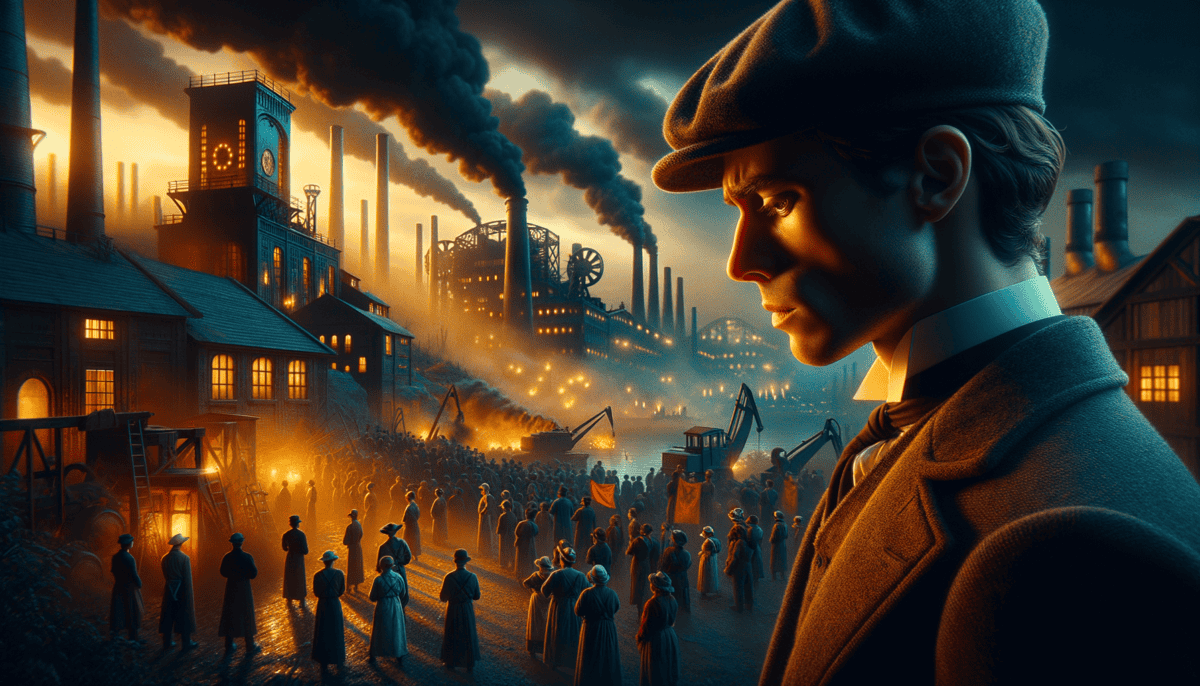
Thomas stood at the factory window, watching black smoke fill the Manchester sky. His heart felt heavy as he saw children younger than him trudging into work.
“Something isn’t right,” Thomas whispered to himself. His excitement about machines was mixing with worry about the people who worked them.
A Friend in Need
That morning, Thomas’s friend Billy wasn’t at his usual spot by the spinning machine.
“Where’s Billy?” Thomas asked Sarah, another young worker.
“Sick from the cotton dust,” Sarah coughed. “Like lots of us.”
“The machines make cloth faster, but they make the air harder to breathe,” Sarah explained, wiping sweat from her face.
Speaking Up
Thomas couldn’t stop thinking about Billy. That evening, he talked to Mr. Bennett.
“Sir, why can’t we make the factories safer?” Thomas asked. “Maybe add windows for fresh air?”
The Workers Unite
Things workers wanted to change:
• Shorter working hours
• Safer machines
• Clean air to breathe
• Fair pay for their work
• No more child labor
Thomas watched as workers began meeting in secret. They wrote letters and made plans to ask for better treatment.
Nature’s Warning
Walking home one day, Thomas saw a dead fish floating in the river. The water was dark with factory waste.
“The machines help us make more things,” he told Mr. Bennett. “But they’re hurting the rivers and the air.”
Finding Solutions
Thomas started drawing new machine designs in his notebook. He added safety guards and better air pipes.
“Maybe we can make machines that help people AND protect nature,” he said.
“That’s the spirit!” Mr. Bennett smiled. “The best inventors think about more than just their machines – they think about people too.”
A Growing Movement
More people joined together to fight for better working conditions. They held peaceful protests and wrote to newspaper editors. ✊
“We want fair treatment!” they called. “Safe factories for all!”
That night, Thomas added something new to his notebook – ideas for laws to protect workers and nature. He knew that true progress needed both amazing machines AND care for people and the Earth.
Dreams Take Flight
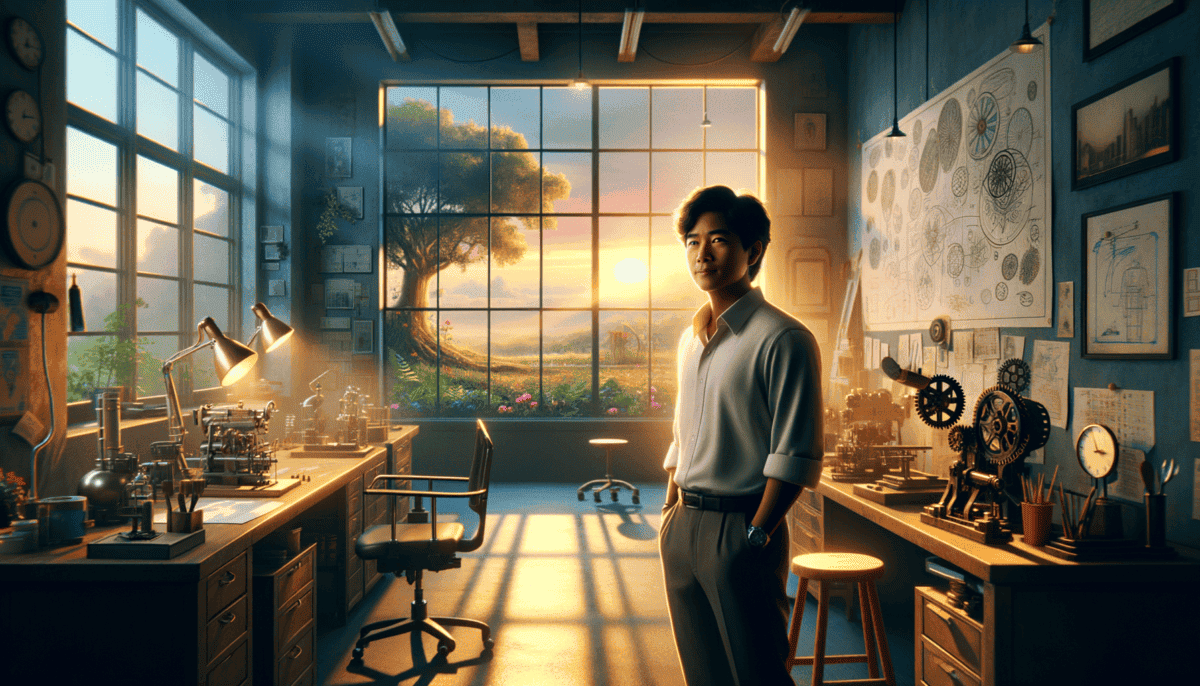
Five years had passed since Thomas first stepped into Manchester’s bustling factories. Now eighteen, he stood proud in his own workshop, surrounded by blueprints and tools. ️
His latest invention sat before him – a safer spinning machine with special pipes to catch cotton dust. Workers wouldn’t get sick like Billy did.
Making Things Better
“What do you think?” Thomas asked Sarah, now his trusted assistant. She wasn’t coughing anymore.
“It’s wonderful!” Sarah beamed. “The air feels so clean, and it’s quieter too!”
“We’re proving that new machines can help people without hurting them,” Thomas said proudly.
A Special Visit
Mr. Bennett, older now but still full of wisdom, visited Thomas’s workshop.
“My boy,” he smiled, “you’ve done exactly what I hoped you would. You’ve made technology work for people, not against them.”
Changes for Good
Good things happening in the factories:
• Children going to school instead of work
• Clean air in workshops
• Safe machines with guards
• Fair pay for all workers
• Clean rivers and skies
Thomas walked through Manchester’s streets. The city looked different now.
Looking Forward
“What’s next?” Sarah asked, looking at Thomas’s newest drawings.
“I’m thinking about trains that don’t make black smoke,” Thomas grinned. “And machines that use the sun’s power!”
A New Dawn
Every morning, Thomas watched the sunrise over Manchester. The sky was clearer now, and birds sang in the trees that lined the clean river.
“We’ve learned that progress means taking care of each other and our world,” Thomas told his young apprentices.
In his workshop, Thomas kept his old notebook. It reminded him of his journey from a curious boy to an inventor who helped change things for the better.
As Thomas worked on his newest invention, he smiled. He knew that each new day brought chances to make things better. And he was ready for whatever came next. ⭐
Sarah opened the workshop windows, letting in fresh air and sunshine. “The future looks bright,” she said.
“Yes,” Thomas agreed, picking up his tools. “And we’re going to help build it – the right way.”